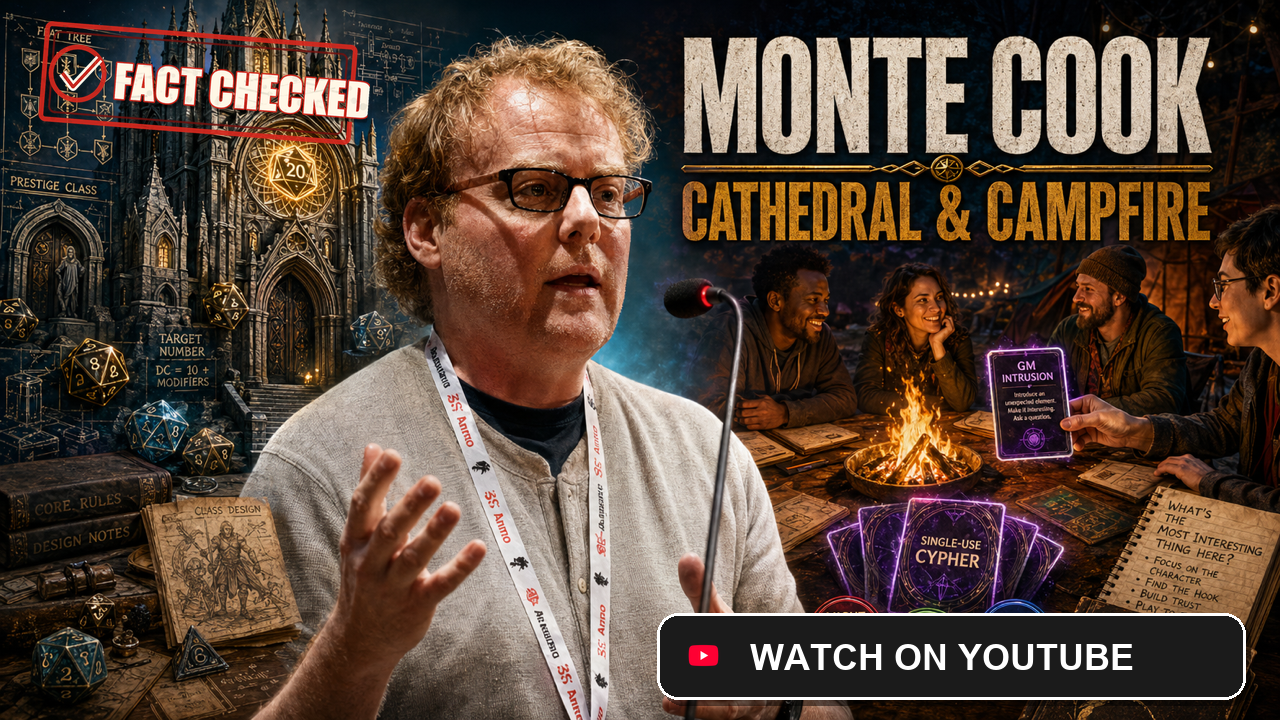
Then he built a game that argued the rules should get out of the way.
That reversal is the key to him.
Some designers spend a career refining one answer. Cook is more interesting than that. He learned the machinery of complex role-playing games from the inside, helped rebuild D&D into a unified system for a new era, then spent the next part of his career asking whether authority really belonged in the rulebook at all.
The cathedral and the campfire were built by the same hands.
The Cathedral
Dungeons & Dragons 3rd Edition was a huge act of reconstruction.
By the late 1990s, D&D carried decades of accumulated procedures. Some things rolled high. Some things rolled low. Armor Class descended, then ascended in player arguments if not yet in the rules. Thieves, fighters, wizards, saving throws, skills, and subsystems all carried traces of different design eras.
The 3rd Edition team, with Jonathan Tweet, Monte Cook, Skip Williams, and others, rebuilt the game around a clearer spine.
Roll a d20.
Add modifiers.
Meet or beat the target.
That unified logic did not invent role-playing. It did not invent the d20. It did something almost as important: it made the world’s most important RPG easier to extend, teach, hack, publish for, and argue about in public.
Cook’s role was especially visible in the Dungeon Master’s Guide. That book is not just advice. It is infrastructure: treasure, encounter design, magic items, prestige classes, campaign tools, and the hidden machinery that lets the person behind the screen build the world.
If the Player’s Handbook teaches people how to play characters, the Dungeon Master’s Guide teaches someone how to hold the machine.
Cook helped write that machine.
The Prestige Class
The prestige class may be Cook’s cleanest personal fingerprint on D&D 3rd Edition.
The idea is simple and powerful: a character can begin in a broad class, then later enter a more specific path that carries setting, story, requirement, and specialization. Not everyone can become an Arcane Archer, Assassin, Blackguard, Loremaster, or Shadowdancer. You qualify. You find the path. The campaign world opens a door.
That changed how level-based RPG design could think about character identity.
Classes no longer had to do all their work from first level. A second layer could appear later, shaped by what the character had become and what the campaign wanted to reward.
The idea spread through the d20 era, into Pathfinder, and into the broader design vocabulary of class specialization. D&D 5th Edition’s subclasses are not prestige classes in the old sense, but they live in the same family of thought: character identity is not only a starting box. It can become a structured path.
That is a real design contribution.
Not just a rule.
A way for worlds to have doors.
The Workshop
After D&D 3rd Edition, Cook did not simply stay inside the official machine.
Through Malhavoc Press, he explored what the d20 engine could do when loosened from TSR and Wizards tradition. Arcana Evolved reworked fantasy assumptions. Ptolus turned his own campaign into a massive published city, part setting, part monument, part proof that home play could become architecture. The Book of Eldritch Might helped establish the viability of early commercial PDF publishing in tabletop RPGs.
That period matters because it shows Cook as more than a company designer.
He was using the new open era to test, expand, and bend the very system he had helped build.
Arcana Evolved’s flexible spellcasting is a good example. Spells could become greater or lesser versions of themselves, pointing toward ideas later made familiar through upcasting in D&D 5th Edition. The exact histories are never as simple as one line becoming another line, but Cook was clearly working early with a question that later became central: why should a spell be frozen at one level of expression?
The workshop was full of experiments.
Some stuck.
Some simply showed what the chassis could survive.
The Campfire
Then came Numenera.
The Cypher System does not feel like D&D 3rd Edition with softer edges. It feels like a counterargument.
Difficulty is reduced to a clear scale. The GM does not roll dice. Characters are built from a sentence: I am an adjective noun who verbs. Cyphers are not permanent treasure to hoard forever. They are single-use wonders that push players to act, spend, improvise, and move on.
The emotional difference is enormous.
D&D 3rd Edition says the rules can define the world with enough detail.
Cypher says the people at the table can carry more of that authority themselves.
Cook has described the Cypher System as an attempt to split authority between the GM and players rather than putting it in the rules. That is not a small design preference. It is a philosophy of play.
The designer who helped build a rules cathedral went outside and lit a campfire.
The Intrusion
GM Intrusion is one of Cypher’s most elegant mechanisms.
The GM introduces a complication. The player receives experience and shares some of that reward with another player. The player can refuse by spending experience.
That small exchange does a lot of work.
It turns complication into consent and currency. It gives the GM permission to make the story worse in an interesting way, but it also gives the player a real choice. It replaces piles of special-case failure rules with a social and mechanical negotiation.
Something goes wrong.
You get paid.
You can say no.
The game keeps moving.
The idea has relatives in other games, especially Fate’s compel structure, but Cook’s version is clean, table-friendly, and strongly tied to Cypher’s broader trust in people over procedure.
The Cost Of Effort
Cypher’s stat pools are another strong piece of design.
Might, Speed, and Intellect are not just numbers on a sheet. They are resources. You spend them to apply Effort and improve your chances. But those same pools also measure your durability.
Competence has a cost.
Push harder and you become more vulnerable. Spend yourself to succeed and the next danger matters more. That can feel strange to players trained by other systems, but it gives Cypher a distinctive emotional economy. Heroism is not only whether you can do the thing.
It is how much of yourself you are willing to spend.
That idea connects Cypher back to Cook’s larger career. He is always asking where authority and cost belong. In the cathedral, cost lives in the build. In the campfire, cost lives in the moment.
The Long Arc
Cook’s career has phases, and the phases matter.
He learned complex system machinery through Iron Crown Enterprises and early professional RPG work. He wrote inside TSR’s worlds, including Planescape, where philosophy itself became playable material. He helped rebuild D&D for the d20 era. He explored the open d20 workshop through Malhavoc. Then he founded Monte Cook Games and built Numenera, The Strange, Invisible Sun, the Cypher System, and later experiments around a very different sense of table authority.
That is not random wandering.
That is a designer changing his mind in public.
The rare part is that both sides are strong.
Many designers can do crunch. Many can do light narrative trust. Fewer can credibly help build one of the most elaborate mainstream RPG architectures of the modern era, then build a second major system whose whole argument is that the architecture should become lighter, stranger, and more human-facing.
What He Actually Built
Monte Cook helped build the d20 era, then built one of its clearest alternatives.
He co-designed D&D 3rd Edition, with shared credit and shared responsibility for a system that powered a huge third-party publishing ecosystem. He gave the game prestige classes, helped shape the Dungeon Master’s Guide, and helped make D&D’s mechanics more unified and extensible. Through Malhavoc Press, he pushed d20 into stranger and more experimental territory.
Then he built Numenera and the Cypher System, where cyphers are temporary wonders, players do the rolling, GM Intrusion turns complication into a negotiated economy, and the table holds more authority than the rules.
That is the achievement.
Not just one system.
Two opposing answers, both built seriously.
Where To Find Him
Cook continues to publish through Monte Cook Games, alongside collaborators who have expanded Cypher into Numenera, The Strange, Invisible Sun, Old Gods of Appalachia, The Magnus Archives, and other projects. The Cypher System Open License has also opened the door for more third-party development.
The lasting image is split in two.
On one side, the cathedral: d20s, target numbers, feats, prestige classes, carefully joined stone.
On the other, the campfire: a GM offers an intrusion, a player weighs the cost, a cypher burns bright and disappears.
Monte Cook built both.
Then he asked which one your table needed tonight.
Fact Check Notes
Publication notes
This site is AI-assisted and human-reviewed. We use artificial intelligence to help gather research, organize source material, and draft profile content. Human editors then read, revise, and check each profile before it goes live. Most profiles are built through deep AI research and two separate rounds of fact-checking.
Leave a Reply
You must be logged in to post a comment.