PRINTING BECAME PLAY
Waddingtons entered games through ink.
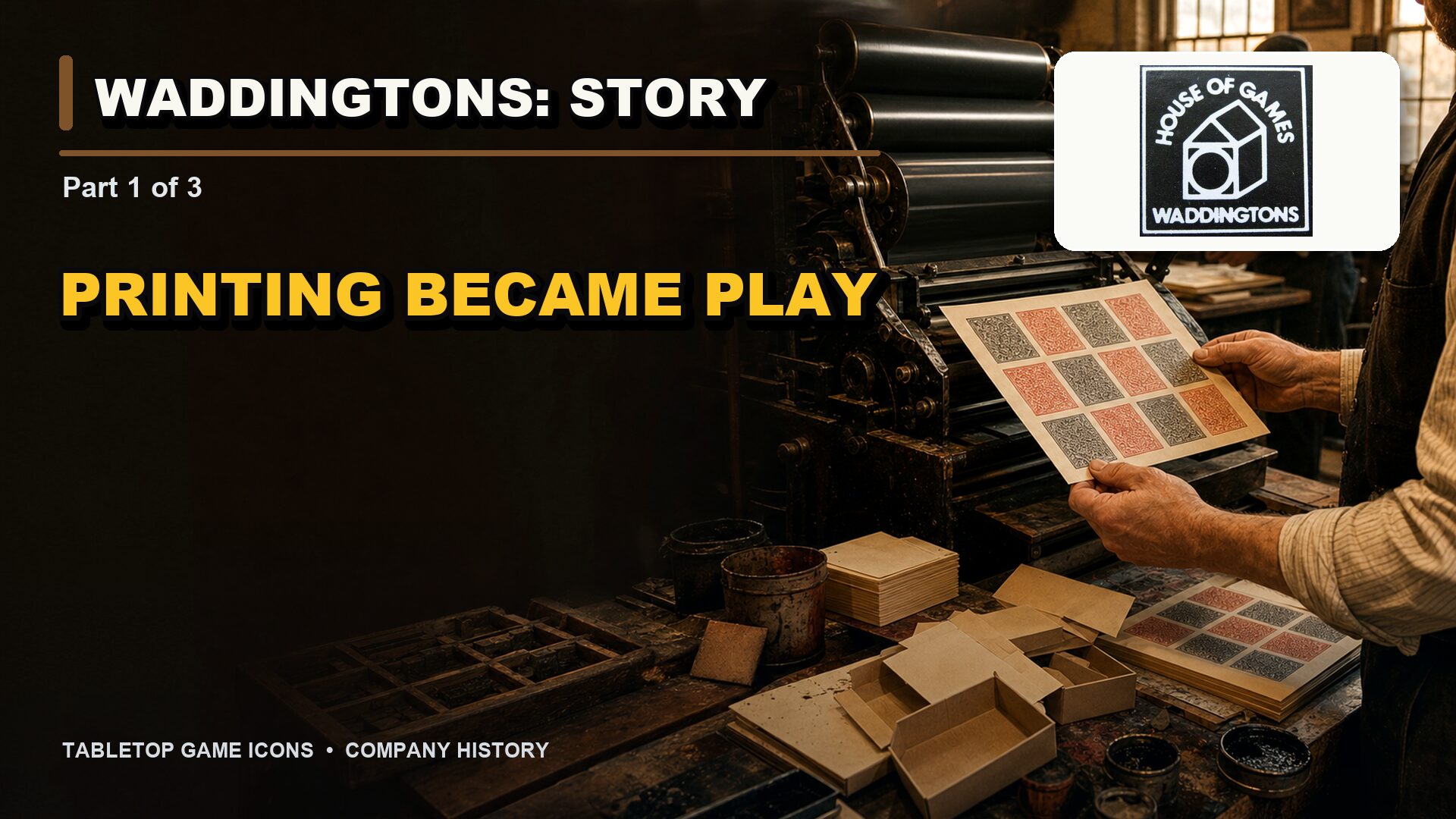
Before British families associated the name with Monopoly, Cluedo, Subbuteo, or playing cards, John Waddington’s company printed the things that made a night at the theatre possible: posters, tickets, playbills, and programmes.
The exact founding year is disputed. Sources place the theatrical printing business between the 1890s and the early 1900s, and an advertisement proves it was trading by 1901. John Waddington worked with theatre manager and playwright Wilson Barrett. Their world depended on strong color, readable type, accurate schedules, and the ability to produce attractive paper in quantity.
Those skills translated naturally into games, but the change took years.
The firm became John Waddington Ltd in 1905 after a financial reorganization. Victor Hugo Watson, initially hired as a lithographic foreman, rose to become the crucial manager. When founder John Waddington departed in 1913, Watson helped direct the business toward a larger industrial future. His family would lead the company for three generations.
The legal company familiar from public records was incorporated on March 14, 1921. It later became a public company in 1928. This was the Leeds printing parent, not a separate game publisher. The games operation would remain one part of a group whose larger interests included packaging, plastics, labels, greeting cards, and specialist printing.
Playing cards created the bridge.
Waddingtons began manufacturing cards in 1922, entering a market long shaped by firms such as Thomas De La Rue and Charles Goodall. Its early trade names included Twillese, Empire, Encore, Chevalier, and Ambassador. A 1924 dispute with De La Rue over the ace of spades ended in Waddingtons’ favor.
Cards demanded the same mixture of artistry and industrial discipline as theatrical printing. Every back had to align. Every deck needed the right count. Colors had to remain consistent. Boxes had to protect the product while selling it from the shelf. Waddingtons could apply its lithographic experience to an object people handled repeatedly.
The company also learned that a deck could carry more than standard suits.
Its first major proprietary game was Lexicon, a word-card game designed by writer David Whitelaw and released in 1932. The original launch disappointed. Management changed the package and raised the price from one shilling ninepence to two shillings sixpence. The revised presentation helped turn Lexicon into a success.
That episode revealed a useful truth: customers judged value before learning the rules. A better box and a higher price could signal that the game deserved attention. Waddingtons was not merely printing components. It was becoming an editor and marketer of play.
Lexicon also created a relationship across the Atlantic. Waddingtons sent the game to Parker Brothers in the United States. A few years later, Parker Brothers returned the favor with a new property-trading game called Monopoly.
The timing was extraordinary. Monopoly had reached Parker Brothers through Charles Darrow, but its deeper history ran through Elizabeth Magie’s Landlord’s Game and community-made variants. Parker Brothers standardized and promoted its commercial edition in 1935. It needed partners to carry the game outside the United States.
Victor Watson Sr. handed the American set to his son Norman, who led the card-games division. Norman played it over a weekend and immediately understood its appeal. The company contacted Parker Brothers and obtained a license covering Britain and large parts of the world outside North America.
Waddingtons adapted the board to London. Norman Watson and secretary Marjory Phillips selected locations that moved from modest Old Kent Road to expensive Mayfair. Stations replaced railroads. Pounds replaced dollars. The geography gave British players a city they recognized while preserving the fantasy of buying an entire urban world.
The British edition arrived in late 1935 or 1936. Waddingtons did not own Monopoly. It licensed and localized it. That distinction would remain important through later corporate deals.
Monopoly transformed the games division, but the printing company around it remained larger. Waddingtons produced packaging and commercial print for other industries. Its ability to make boards, cards, money, deeds, boxes, and instructions inside a broader printing group gave it unusual control over game production.
That control became strategically important during the Second World War.
Waddingtons possessed rare expertise printing on silk. British military intelligence needed maps that could be folded silently, hidden easily, survive water, and help captured servicemen escape. MI9 technical officer Christopher Clayton Hutton worked with the company on silk escape maps and concealment devices.
Monopoly boxes were among the containers used to hide maps, small tools, compasses, and currency in parcels sent through covert channels to prisoner-of-war camps. Popular retellings often claim the Red Cross carried them. Stronger research indicates that officials avoided compromising Red Cross parcels and used private or fictitious relief organizations instead.
No verified original escape Monopoly set is known to survive, and the number of escapes directly aided by the boards cannot be established. The documented core is remarkable enough: a Leeds printer used its game-making technology in a secret military effort.
Waddingtons had moved from playbills to playing cards, from playing cards to word games, and from word games to Monopoly.
Its next great title would not come from America.
It would come from a Birmingham musician with a murder mystery drawn on paper.
Printing skill gave the company an advantage that went beyond appearance. Games require exact repetition. A card back must conceal its face. A board must register colors and spaces correctly. Rules must fit inside a box, and thousands of components must remain consistent across a production run. Waddingtons already understood deadlines, paper supply, color, cutting, and high-volume finishing.
The move into games also diversified the printer. Theatre work depended on productions and events; playing cards and boxed games created goods that could be reordered and stored. Lexicon, introduced in 1932, showed that the company could build a durable game identity before Monopoly arrived.
The British Monopoly edition became an act of adaptation as well as licensing. Parker Brothers supplied the game, but Waddingtons replaced the Atlantic City properties with London locations familiar to British players. Norman Watson and company secretary Marjory Phillips are associated with selecting the streets. The resulting board felt local even though its commercial route crossed the Atlantic.
Wartime service demonstrated the physical knowledge behind the catalog. Waddingtons printed silk escape maps and participated in a secret program that concealed escape materials in specially prepared Monopoly sets for prisoners of war. Later retellings often add unsupported claims involving the Red Cross or exact numbers of escapes. The verified achievement needs no embroidery: a Leeds printer used specialized presses and materials to support military intelligence.
BRITAIN PLAYED ALONG
At Waddingtons’ height, game night in Britain often began with a box printed in Leeds.
Monopoly had given the company a transatlantic hit. The next defining title came from Anthony E. Pratt, a Birmingham musician and factory worker who had watched people entertain themselves with murder-mystery parlor games during wartime blackouts.
Pratt called his design Murder!. Players moved through rooms, considered suspects and weapons, and tried to deduce a hidden solution. His wife Elva designed the original board. Pratt filed a provisional patent application in December 1944 and demonstrated the game to Waddingtons in February 1945 after an introduction from Buccaneer designer Geoffrey Bull.
The company saw the idea, renamed it Cluedo, and waited.
Postwar shortages delayed production. The patent was granted in 1947, but the game did not reach the market until 1949. Parker Brothers published it in North America as Clue. The two firms now had a valuable exchange: Waddingtons carried Monopoly in Britain, while Parker carried Clue in America.
Waddingtons bought Pratt’s overseas rights in 1953 for £5,000, while he continued receiving certain British royalties until the patent expired. The history is a reminder that the name on the box belongs beside, not instead of, the names of Anthony and Elva Pratt.
Cluedo offered something different from Monopoly. Property trading created an open contest for wealth. Cluedo created a private puzzle. Every player held incomplete information, every suggestion revealed something, and the solution waited inside an envelope. The game turned a table into a country-house investigation without requiring an actor or referee.
The company’s catalog expanded in several directions. Lexicon continued. Geoffrey Bull’s Buccaneer offered treasure and sea adventure. Totopoly turned horse racing into a game. Waddingtons published British editions and licensed titles from abroad while developing its own products and television tie-ins.
In 1969, Waddingtons acquired Subbuteo Sports Games from Peter Adolph for a reported £250,000. Adolph had created table football in the 1940s, building a community around flicked miniature players, cloth pitches, accessories, team colors, and league play. Waddingtons gained more than a boxed game. It gained a hobby system whose customers returned for teams, goals, grandstands, and equipment.
Subbuteo connected Waddingtons to the culture of football at a personal scale. Players could reproduce a favorite club, organize tournaments, paint details, and argue over technique. Manufacturing continued in Tunbridge Wells before later relocation.
The company also entered licenses tied to Disney and television. Blockbusters and Wheel of Fortune became household quiz-show games in the 1980s. Waddingtons could use its printing expertise to respond quickly to current entertainment while classic titles supported the catalog underneath.
Yet games were never the whole group.
John Waddington PLC operated printing, packaging, plastics, greeting-card, and label businesses. It acquired companies such as Valentine & Sons and Tower Press and expanded into folding cartons and specialized containers. At its 1970s peak, contemporary and family accounts place employment above 3,000 people, many in Leeds.
The games division supplied public fame but a minority of group profit. Packaging kept the industrial machine running. This distinction explains why the later sale of Waddingtons Games did not equal the immediate end of John Waddington PLC.
The company’s power came from integration. A game could be developed, illustrated, printed, die-cut, boxed, and shipped through an organization that understood every physical layer. Waddingtons also knew how presentation changed perceived value, a lesson learned from Lexicon decades earlier.
Its famous brands acquired lives larger than their inventors. Monopoly became a ritual of family competition. Cluedo taught generations to eliminate possibilities. Subbuteo became a hobby culture. Waddingtons No. 1 playing cards entered pubs, clubs, and homes. The logo promised a British form of game-night reliability.
Corporate life was less comfortable.
In the early 1980s, publisher Robert Maxwell’s British Printing and Communications Corporation pursued Waddingtons. Some reference sources incorrectly describe Maxwell as gaining control. Better-supported accounts from Victor Watson Jr. and contemporary obituaries say Watson fought off the hostile approaches in 1983 and 1984. The battle reportedly drove the share price sharply upward before Maxwell withdrew.
The defense preserved independence, but it also demonstrated how valuable the pieces had become. Waddingtons sat at the intersection of printing, packaging, and famous entertainment properties. Shareholders could reasonably ask whether those businesses belonged together.
Victor Watson Jr., often called “Mr Monopoly,” served as chairman from 1977 to 1993. He represented the third generation of the Watson dynasty. Under his leadership, the group continued operating across markets far removed from the theatrical printer of 1901.
By the 1990s, consolidation was reshaping toys and games. Hasbro had acquired Milton Bradley and Parker Brothers. It already stood on the other side of Waddingtons’ oldest licensing relationships. Owning Waddingtons Games would unite the British and American histories of Monopoly and Cluedo inside one corporation.
The game division was famous.
The packaging division was profitable.
Keeping them together was no longer inevitable.
Cluedo became a strong example of how Waddingtons refined an outside design. Pratt supplied the murder-mystery structure and Elva Pratt drew the early board, but wartime shortages delayed publication. When the game appeared in 1949, Waddingtons had simplified elements of the prototype and built a product that could travel internationally. Parker Brothers published it in North America as Clue.
The company later bought the overseas rights from Pratt in 1953 for £5,000. That payment fixed the property inside Waddingtons’ catalog, but it did not erase the Pratts’ authorship. Modern histories sometimes let the publisher’s famous name overshadow the couple who created the design during the war.
Subbuteo extended Waddingtons into another form of British play. The company acquired the tabletop football business in 1969 for a reported £250,000. Its miniature teams, cloth pitches, and flicking rules created a hobby that sat between sport, collecting, modeling, and board gaming. New club colors and accessories encouraged repeat purchases long after a starter set was sold.
At the same time, Waddingtons remained a printing and packaging group. That industrial base made the company more complicated than a catalog of famous games. It owned equipment, property, and commercial relationships that potential buyers could value separately. The tension between entertainment brands and manufacturing assets shaped the decisions that followed.
THE FACTORY BECAME MEMORY
Waddingtons did not end when Hasbro bought its games.
The name divided into two histories.
In November 1994, John Waddington PLC announced the sale of Waddingtons Games to Hasbro for £50 million, commonly reported in the United States as about $78 million. The buyer acquired the game business, its brands, and its intellectual-property position. It did not acquire the entire printing and packaging group.
The distinction matters. Customers saw Monopoly, Cluedo, Subbuteo, Lexicon, and the Waddingtons name. Corporate records saw one division separated from a larger Leeds manufacturer.
Hasbro had already acquired Parker Brothers through Tonka in 1991. The purchase placed both sides of the old Monopoly license inside the same parent. It also reunited Cluedo and Clue under a company that controlled Parker’s North American publishing history.
The old licensing relationship became internal corporate history.
The games operation moved away from Leeds. Over time, Hasbro closed or consolidated production, and the Waddingtons name became a heritage brand rather than an independent publisher. Subbuteo production declined and later moved through revival licenses. Waddingtons No. 1 playing cards and Lexicon continued through arrangements with Winning Moves. Other classic products appeared under Hasbro or licensed publishers.
The parent company remained.
John Waddington PLC changed its registered name to Waddington Limited in July 1996. It continued in packaging and specialist printing without the game division that had made it famous to the public. In 2000, the remaining businesses were acquired through the John Mansfield Group, which became Communisis.
That successor entered a difficult printing market shaped by consolidation, digital communication, and pressure on traditional commercial print. Communisis companies entered administration in December 2023, with assets sold onward. Waddington Limited itself was dissolved on May 28, 2024.
The legal entity lasted more than a century after its 1921 incorporation. The game company people remembered had left thirty years earlier.
This split produces several easy mistakes. Hasbro did not buy the whole Waddington printing group. Waddingtons never owned Monopoly outright; it held valuable territorial publishing rights. The Toronto auction house called Waddington’s is unrelated. The modern North American packaging company using the Waddington name has a different lineage.
The rights to individual games also follow different paths.
Hasbro owns Monopoly and Cluedo. Winning Moves licenses Waddingtons No. 1 playing cards and Lexicon. Subbuteo has moved through Hasbro and later license arrangements. Modern jigsaws using Waddingtons nostalgia may come from other publishers. A familiar brand on a current box does not restore the old Leeds operation.
What survives most strongly is British cultural memory.
Monopoly’s London board turned streets, stations, utilities, and neighborhoods into a map generations could recite. The localized edition proved that a licensed game could become more culturally specific than a simple translation. Cluedo transformed Anthony and Elva Pratt’s wartime murder puzzle into an international standard. Subbuteo gave football supporters a tabletop hobby with its own equipment, collecting, and competitive technique.
Waddingtons also survives in printing history. Its factories made playing cards, cartons, labels, and commercial materials far beyond the games aisle. Thousands of Leeds workers participated in an industrial operation whose products entered daily life. The game boxes were a visible fraction of a much larger manufacturing system.
The wartime silk maps add another layer. Waddingtons’ contribution did not depend on a magical Monopoly set rescuing one famous prisoner. It depended on specialized knowledge of printing surfaces, inks, folding, concealment, and security. The same company that made leisure objects used its production craft for escape-and-evasion tools.
That story has accumulated myths because almost no physical examples survive and secrecy prevented good recordkeeping. Responsible history keeps the well-supported core and releases the dramatic additions it cannot prove. The Red Cross was not knowingly used as the pipeline. The number of escapes attributable specifically to the boards is unknown. Modern display sets are reproductions.
The company’s publishing legacy is equally dependent on credit. David Whitelaw created Lexicon. Anthony Pratt designed the murder system behind Cluedo, and Elva Pratt designed its first board. Peter Adolph created Subbuteo. Parker Brothers supplied Monopoly under license, carrying a design whose deeper roots included Elizabeth Magie and community variants.
Waddingtons’ achievement was selection, adaptation, production, and stewardship. It made the London Monopoly board feel definitive. It recognized Pratt’s prototype, improved its identity, and waited through postwar shortages. It acquired a miniature-football business and supported its community. It printed the physical objects with a quality that made the company name trusted.
The factory is no longer producing family games in Leeds. The original legal company is dissolved. Hasbro owns the central game properties and brand lineage.
Yet British players still say Waddingtons when they remember a certain kind of box, card stock, rulebook, or rainy afternoon.
The theatrical printer became a game company.
The game company became a portfolio.
The portfolio became memory, played every time the old boxes return to the table.
Hasbro’s purchase reunited important rights relationships. Parker Brothers had licensed Monopoly to Waddingtons in 1935 and published Clue in North America. By 1994, Hasbro owned Parker Brothers. Acquiring Waddingtons Games brought the British side of those intertwined histories into the same corporate portfolio.
The remaining printing and packaging group continued independently. It adopted the Waddington Limited name in 1996 and later became part of John Mansfield and Communisis in 2000. The old parent’s legal life extended far beyond the sale of the games division, with dissolution recorded on May 28, 2024. Saying Waddingtons simply “closed” in 1994 would confuse the sale of one celebrated operation with the end of the larger company.
The games also continued through different commercial arrangements. Hasbro retained the core properties it purchased. Winning Moves and other licensees have issued Waddingtons-branded playing cards and games, keeping the familiar name visible without recreating the independent Leeds publisher.
Collectors can therefore encounter several kinds of continuity. An older box may be a product of the original game company. A later edition may use a property now owned by Hasbro. A modern item may license the Waddingtons name. The shared branding does not make the corporate histories identical.
What survived most clearly was a British vocabulary of play. Passing Go, accusing Colonel Mustard, flicking a footballer, or arranging Lexicon cards became activities families recognized without needing to know who currently owned the mark.
Fact Check Notes
Publication notes
This site is AI-assisted and human-reviewed. We use artificial intelligence to help gather research, organize source material, and draft profile content. Human editors then read, revise, and check each article before it goes live.
Leave a Reply
You must be logged in to post a comment.