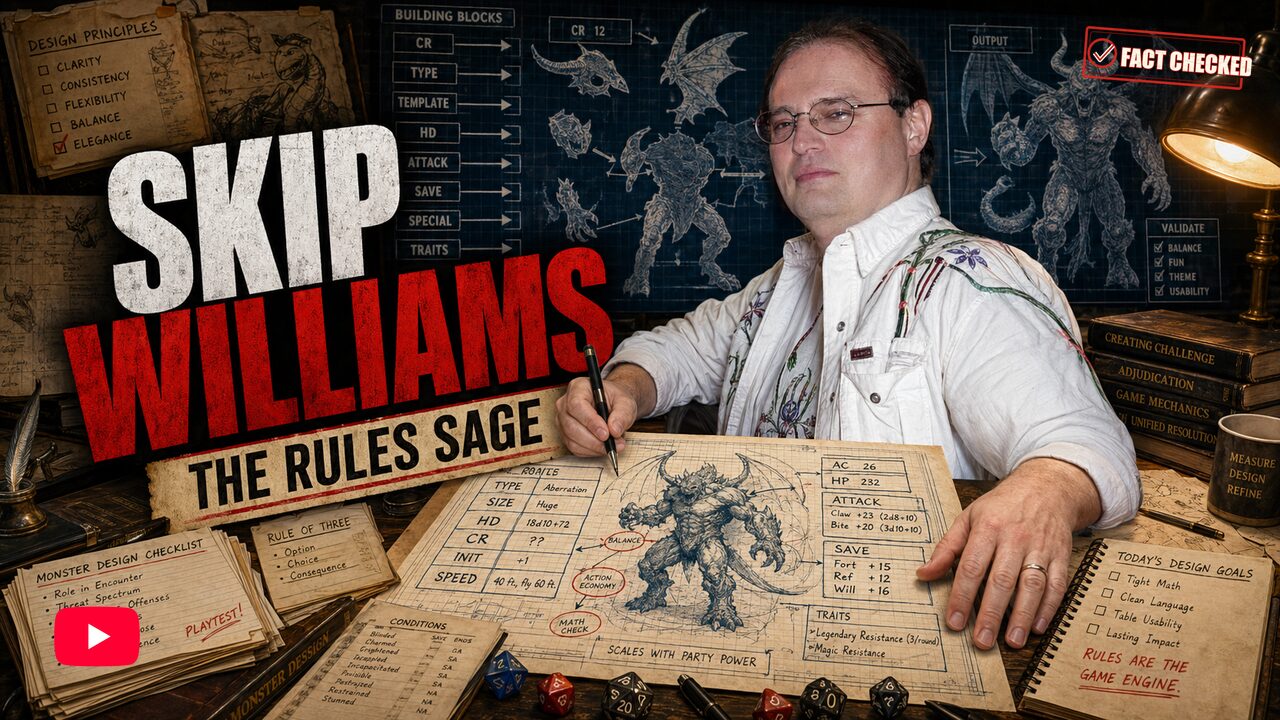
When people talk about Dungeons & Dragons 3rd Edition, the first two names usually arrive quickly. Jonathan Tweet, the systems visionary. Monte Cook, the creative force. Then, if the conversation is careful, the third architect appears.
Skip Williams.
That order tells you something about the way game history remembers people. Vision gets quoted. Voice gets interviewed. Infrastructure gets used until it becomes invisible.
Williams’ work is infrastructure.
He was the rules sage, the person thousands of players trusted to answer the impossible question. He was the Monster Manual lead, the designer responsible for turning D&D creatures into a standardized, extensible, repeatable architecture. He helped build the edition that made the d20 System precise enough to license, copy, expand, and mutate across an entire publishing boom.
The result was not just a new D&D.
It was a rules language other people could build in.
The Lake Geneva Apprenticeship
Williams grew up close to the source.
Lake Geneva was not just a place on a map for Dungeons & Dragons. It was the hobby’s early workshop, clubhouse, warehouse, battlefield, and rumor mill. Williams knew the Gygax family circle and entered TSR through the practical side of the business. He worked in the Dungeon Hobby Shop, handled operational jobs, and directed Gen Con during the early 1980s.
That matters because it gave him a different kind of education than a designer who only wrote rules.
He saw games as products that had to ship. He saw tournaments that needed rulings to be consistent across tables. He saw players attack every ambiguity because players always do. A rule that works when the author explains it in person is one thing. A rule that works when thousands of strangers argue over it is something else.
Williams’ early visible design credits arrived in the mid-1980s, including D&D adventure work, but the deeper training had already happened. He had learned that rules are not only ideas.
Rules are public machinery.
Sage Advice
In 1987, Williams took over Sage Advice in Dragon Magazine.
He held that role for years, becoming one of the most visible rules authorities in the game. Players sent in the questions that broke their tables. What happens if this spell interacts with that monster ability? Does this movement rule apply underground? Can this edge case be read this way, or that way, or the third way the designer probably never intended?
Every answer was a small act of repair.
Over time, that work becomes a map of failure. A designer who answers rules questions for long enough stops seeing the game as a book and starts seeing it as pressure points. Ambiguous language. Unclear timing. Terms used three different ways. Monsters written like stories instead of procedures. Exceptions with no place to live.
That is the kind of knowledge Williams brought to D&D 3rd Edition.
Not the glamour of invention from nothing. Something more practical: a memory of where the old machine kept breaking.
The Combat Blueprint
The 3rd Edition revolution did not arrive all at once in 2000.
Some of it appeared in 1995, in Player’s Option: Combat & Tactics, co-designed by Richard Baker and Skip Williams. The book pushed AD&D toward grid-based tactical combat, with facing, reach, opportunity attacks, miniature-friendly positioning, and the five-foot-square logic that later became normal for 3E play.
D&D had always had a complicated relationship with miniatures. Its roots were in wargaming, but much of actual RPG play had become looser, described in words and negotiated at the table. Combat & Tactics tried to give AD&D a more exact spatial engine.
It was optional. It was crunchy. It did not become the final form of D&D combat by itself.
But looking backward, the family resemblance is obvious.
The 3E combat grid did not come from nowhere. Combat & Tactics was a working draft of a future style: the battlefield as rules space, movement as measured procedure, opportunity as something the system could define rather than something the DM improvised every time.
Williams was already moving toward rules that could be repeated reliably.
The Monster Manual
The Monster Manual is where Williams’ legacy becomes architectural.
Sean K. Reynolds, who worked directly on 3E monster design, has described the division of labor clearly: Jonathan Tweet led the Player’s Handbook, Monte Cook led the Dungeon Master’s Guide, and Skip Williams led the Monster Manual.
That book was not just a collection of creatures.
It was the operating manual for how D&D would define every non-player thing in the world.
Creature types and subtypes. Standardized stat blocks. Challenge Ratings. Advancement rules. Templates. Spell-like abilities. Damage reduction. Special qualities. Saves, skills, feats, movement modes, senses, and attack routines all organized into a form that could be read, reused, and extended.
Earlier D&D monsters could be wonderfully evocative, but they were not always built from a consistent engineering language. The 3E Monster Manual changed that. A monster became a structured object. You could compare it to another monster. You could advance it. You could apply a template. You could estimate its difficulty. You could publish a new creature and make it feel like it belonged to the same system.
That last point is crucial.
The d20 boom needed more than permission to publish. It needed a grammar.
Williams helped provide that grammar.
The Challenge Rating Problem
Challenge Rating was imperfect from the beginning.
Every 3E veteran has stories. A creature whose listed difficulty felt too low. A monster that was easy for one party and lethal for another. Undead with ability damage. Incorporeal enemies. Dragons. Anything that challenged the assumed party composition or optimization level could bend the math.
The criticism is fair.
It also misses why CR mattered.
Before Challenge Rating, encounter balance in D&D was mostly instinct, experience, and folk wisdom. A good DM could learn what a party could handle, but the system did not give every creature a single explicit difficulty label that tied into encounter design. CR made the attempt.
It said: this monster has a place in the math.
The math was rough. The idea was transformative.
Pathfinder kept the basic logic. Later D&D editions changed the details but kept the premise that monsters should have explicit difficulty measures. Third-party d20 publishers built whole catalogs of creatures around the stat block and rating framework. Even when people complained about CR, they complained because they expected the number to mean something.
That expectation is part of Williams’ legacy.
The Core Books And The Open System
D&D 3rd Edition was a team achievement.
That has to stay clear. The unified d20 mechanic, the feat and skill systems, the class redesigns, the spell revisions, and the Open Gaming License all came from a larger group of designers, developers, editors, and business minds. Ryan Dancey’s OGL was a business and legal innovation. Tweet and Cook shaped major portions of the core design. Many other hands touched the books.
Williams’ contribution sits inside that team structure.
But the system’s success depended on clarity. ICv2 reported in early 2002 that the three 3E core rulebooks had passed one million combined sales. The OGL and d20 license let other publishers build on the system. Hundreds of products followed. Some were brilliant. Some were not. All of them depended on D&D 3E being legible enough that a publisher outside Wizards could understand the framework and write into it.
You cannot license fog.
The d20 System became publishable infrastructure because its rules could be expressed, repeated, and extended. Williams’ Monster Manual work was one of the clearest examples of that discipline.
He did not open the license.
He helped make the licensed thing precise.
The Road Not Taken
Williams was not only a d20 technician.
Dragonlance: Fifth Age used the SAGA system, a card-driven approach that moved away from familiar D&D dice procedure. Player action ran through a custom deck and hand management, creating a very different texture from traditional D&D. Williams was part of that design world too.
That matters because it prevents the easy caricature.
The rules sage was not simply a man who could recite old D&D. He understood alternate procedures. He worked in card-based RPG design. He later contributed to miniatures and mass combat work, including projects such as Chainmail and Cry Havoc.
Still, his deepest mark remains D&D’s rules infrastructure.
Some designers are remembered for worlds. Williams is remembered for the parts list that made worlds easier to run.
The Freelance Sage
After Wizards, Williams kept working.
He wrote and co-wrote d20 material, contributed to 3.5 books, and produced later columns such as Ask the Kobold for Kobold Quarterly. Races of the Wild earned strong reader attention in the 3.5 era, and his ongoing rules-answering work showed that the Sage Advice role had never really left him.
That continuity is part of the appeal.
Williams’ public persona was never the flamboyant genius. It was the person you asked when the rules had to work. That is a quieter kind of authority, and often a more durable one.
What He Actually Built
Skip Williams built rules infrastructure for the most licensed era Dungeons & Dragons has ever had.
His individual invention score is limited by collaboration. D&D 3rd Edition was not his solo creation. The d20 mechanic was not his personal invention. The OGL was not his business move.
But the architecture case is strong.
As lead on the Monster Manual, he helped define the creature-design framework that the d20 ecosystem used for a decade. Stat blocks, CR, creature types, templates, advancement, and standardized monster abilities became the grammar of an entire publishing movement. Pathfinder inherited much of that grammar. Later D&D editions reacted to it, simplified it, revised it, but did not return to a world where monster difficulty was only table instinct.
That is why Williams belongs high on the list.
Not because he was the loudest architect of 3E. Because his part of the building carried weight.
Where To Find Him
Open a 3E Monster Manual and look at the stat block.
Look at how much information has been compressed into a repeatable form. Look at the creature type, the attacks, the special qualities, the CR, the advancement. Then look at a third-party d20 monster book, or an early Pathfinder Bestiary, and watch the same grammar reappear.
That is Williams’ legacy.
30 points. 1986. The Sage who rebuilt the engine.
He did not invent the cathedral.
He made the blueprints precise enough for other people to build from.
Fact Check Notes
Publication notes
This site is AI-assisted and human-reviewed. We use artificial intelligence to help gather research, organize source material, and draft profile content. Human editors then read, revise, and check each profile before it goes live. Most profiles are built through deep AI research and two separate rounds of fact-checking.