Iconic Tabletop Game Convention
Origins Game Fair
The traveling game fair that found a home, survived upheaval, and kept rebuilding.
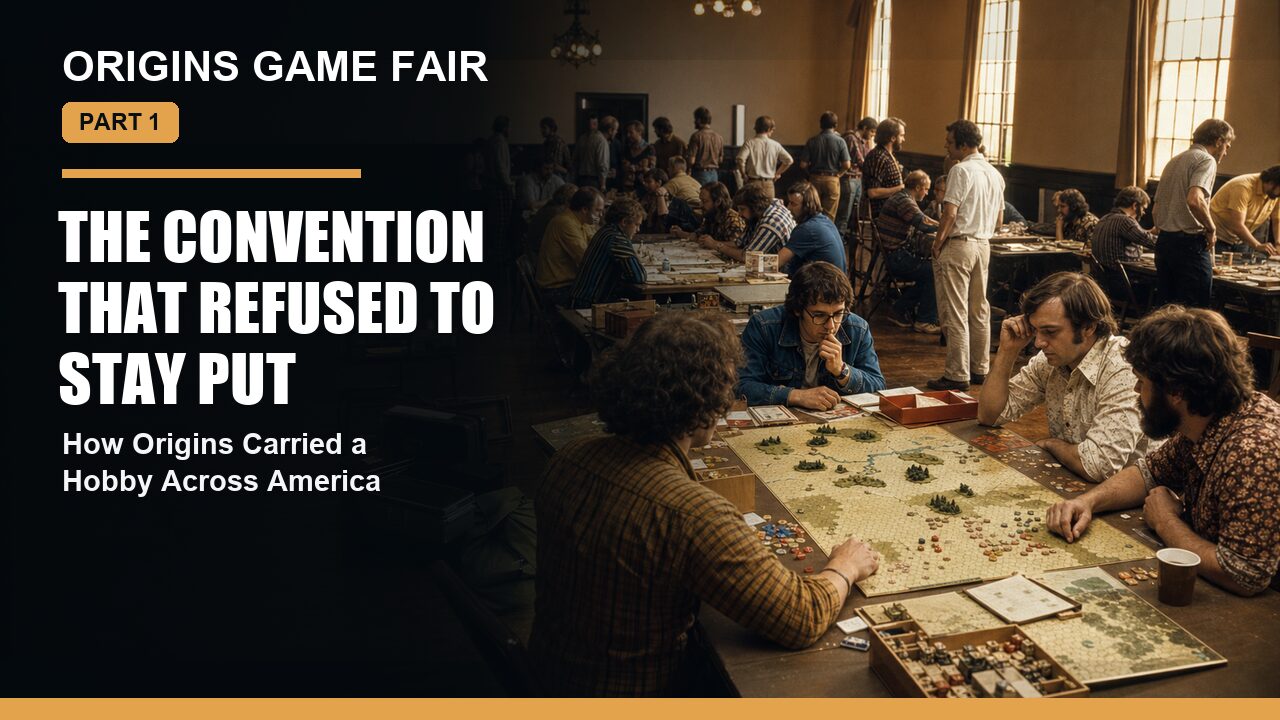
The Convention That Refused to Stay Put
How Origins Carried a Hobby Across America
Origins Game Fair, Part 1 of 3
The first Origins did not begin with a permanent home. It began with a claim about where the hobby had come from.
On July 25, 1975, board wargamers gathered at Johns Hopkins University in Baltimore for a three-day convention built by the Avalon Hill Game Company and the local club Interest Group Baltimore. Avalon Hill designer Don Greenwood is credited with proposing the name. Baltimore was home to Avalon Hill, and Avalon Hill founder Charles S. Roberts had helped turn historical simulations into commercial board games in the 1950s. Calling the new convention "Origins" placed the city at the beginning of that story.
It was also a declaration of independence. Gen Con was growing around miniatures and roleplaying games. The Baltimore organizers wanted a national meeting where board wargames would not be pushed to the edge. Richard Berg's contemporary report in MOVES called Origins One the first national board-game convention and described a hall full of publishers, tournaments, and demonstrations. Dungeons & Dragons was already present in force, proof that the walls between hobby categories would never be as firm as the founders imagined. MOVES No. 23
The size of that first gathering is less certain than the date and place. A later Avalon Hill account reported about 1,500 registered visitors, 25 manufacturers, and 24 events. That is a contemporary retrospective estimate, not an audited count of unique badge holders. The important point is scale: Origins was large enough to fill nearby hotel rooms and convince the organizers to do it again.
Origins II returned to Johns Hopkins on July 23, 1976. The surviving advertisement in Avalon Hill's The General shows how quickly the convention had become an institution. Admission was priced by the day or for the full weekend. Campus rooms could be reserved. Checks went to Interest Group Baltimore. The program mixed tournaments, seminars, open gaming, auctions, miniatures, and roleplaying. What began as a defense of board wargaming was already becoming a meeting place for the whole tabletop field. The General, Vol. 12 No. 6
Then Origins moved.
The third show went to Staten Island in 1977. Ann Arbor followed in 1978, then Chester, Pennsylvania, in 1979 and 1980. Later years took the convention to San Mateo, Detroit, Dallas, Towson, Los Angeles, Milwaukee, Atlanta, Fort Worth, and other cities. It could borrow local clubs, university rooms, hotel ballrooms, and regional enthusiasm. It could also lose continuity every time a new host had to learn the job.
The moving map reflected the young industry's structure. Tabletop publishing was not yet concentrated around a few giant conventions and distribution channels. Players formed clubs, publishers mailed newsletters, and volunteer networks carried expertise from one city to another. Origins was less a fixed destination than a national franchise. Each host assembled a temporary capital for the hobby, then packed it away.
That model needed a steward. The Game Manufacturers Association says it formed in 1977 to protect the interests of Origins and incorporated as a nonprofit in 1982. A separate historical account places the decisive organizing meeting at Gen Con in 1978. The date when GAMA assumed responsibility for Origins is also untidy. Avalon Hill's history dates the handoff to 1980, while another retrospective places the new arrangement after the 1980 show, beginning with 1981. The honest formulation is that GAMA took control around the 1980-81 transition. GAMA, "About GAMA"
GAMA did not end the traveling system. It gave that system an owner and a set of industry interests to protect. Regional organizations could still handle local work while the association licensed the name and coordinated the national show. Ownership, sponsorship, and operation were different jobs long before later corporate deals made the distinction more visible.
The convention's migrations also created unlikely alliances. In 1988, Origins and Gen Con appeared together at Milwaukee's MECCA. The surviving catalog spells out the arrangement in its branding: ORIGINS was a service mark owned by GAMA, while GEN CON was a registered TSR mark. The two conventions shared a weekend and a building without becoming one permanent institution. 1988 Gen Con/Origins catalog
They repeated the experiment in Milwaukee in 1992. Between those joint shows, Origins traveled to Atlanta for Origins/Dragon-Con '90, held June 28 through July 1 at the Atlanta Hilton and Towers. Contemporary listings and the Dragon Con archive at Georgia Tech confirm the co-branded event. These partnerships were practical, not existential. A traveling convention could combine audiences, publishers, and staff for a year, then resume its own route. Georgia Tech Dragon Con records
The route helped Origins perform a job that mattered more each year. A game could move from a designer's table to a national audience in one weekend. Publishers could watch strangers learn rules, retailers could judge demand, and players could encounter a system before it reached their local store. Origins was a tournament site, but it was also a living test market.
That power became clear in July 1993. Wizards of the Coast brought Magic: The Gathering to Origins in Fort Worth before the game's larger August splash at Gen Con. Later accounts often compress the first appearance into "Dallas" or give all the credit to Gen Con. Wizards' own history preserves the sequence: Origins came first, and Gen Con turned the early response into a national phenomenon. Wizards of the Coast, "Different Worlds"
Magic represented something Origins had not been built to defend. It was not a traditional board wargame, a roleplaying campaign, or a miniatures ruleset. It created a new collectible market with its own tournaments, release rhythm, and retail demands. Yet the convention could absorb it because Origins had spent eighteen years learning how to put players, publishers, and new systems in the same room.
The moving show had carried the industry through its early divisions. It had outgrown the idea that one category needed protection from all the others. What it still lacked was a stable city and a management system that could turn that national role into predictable growth.
In 1994, Andon Unlimited began running Origins for GAMA. Wizards of the Coast would soon buy Andon, and in 1996 the convention would settle in Columbus. Origins had learned how to travel. The next test was whether it could stay home without losing the restless energy that made it matter.
Sources
- Avalon Hill, The General, Vol. 12 No. 6
- SPI, MOVES No. 23
- GAMA, "About GAMA"
- 1988 Gen Con/Origins catalog
- Dragon No. 187, 1992
- Georgia Tech Library, Dragon Con records
- Wizards of the Coast, "Different Worlds"

The Fair That Found a Home
Columbus, Wizards, and the Long Climb
Origins Game Fair, Part 2 of 3
Origins arrived in Columbus in 1996 with two problems hidden inside one opportunity.
The opportunity was a permanent address. After two decades of moving among universities, hotels, and convention centers, Origins could build relationships with one venue, one city, and one returning audience. The problem was control. The Game Manufacturers Association owned and sponsored the event, but another company had begun running it. That operator was about to become part of the largest corporate chain the tabletop industry had yet seen.
Andon Unlimited took over management of Origins in 1994 under an arrangement with GAMA. In 1995, Wizards of the Coast bought Andon for an undisclosed price. A contemporary report in Dragon said Andon ran both Origins and the GAMA Trade Show. Another report described the convention as sponsored by GAMA while Andon handled management. The distinction matters. Wizards did not simply buy the Origins name. It bought the company contracted to operate the show. Dragon No. 217 Dragon No. 233
Wizards had good reason to understand conventions. Magic: The Gathering had premiered at Origins in 1993, then exploded at Gen Con. Organized play, demonstrations, and convention sales helped turn the game into a new kind of tabletop business. When Wizards acquired Andon, it gained a professional events arm at the same moment its products were changing what an events calendar could do.
Origins '96 ran July 4 through 7 at the Greater Columbus Convention Center and the attached Hyatt. An advertisement in Avalon Hill's The General promised more than 1,000 events and directed inquiries to Andon Unlimited. The document captures the new structure in one page: GAMA's national convention had a corporate operator and a permanent downtown complex. The General, Vol. 30 No. 5
Columbus changed the work before it changed the numbers. Returning to the same building meant an organizer could refine room plans instead of rebuilding them. Hotels could learn the crowd. Restaurants and city agencies could treat Origins as an annual event rather than a one-time booking. Volunteers and exhibitors could plan against a familiar floor. A convention built around thousands of scheduled games depends on that invisible knowledge.
The city also sat within reach of large Midwestern and eastern population centers. Origins no longer needed to move in order to represent a national hobby. Players could learn where it would be next year, publishers could budget for a known destination, and the convention could create traditions that belonged to a place.
Corporate ownership above Andon kept changing. Hasbro acquired Wizards of the Coast in 1999. That placed the Origins operator inside a global toy company, but it did not transfer GAMA's asserted ownership of the convention brand. Contemporary joint-convention programs had called ORIGINS a GAMA-owned mark before Wizards bought Andon. The clean history is a chain of operation, not a simple chain of title.
The operating arrangement ended around 2001-02. First-person reporting from a former Origins volunteer director called 2002 the first year GAMA managed the show directly. Other histories describe a transition that began in 2001. Without the management contract or a dated asset schedule, a single handoff day would be false precision. GAMA resumed direct management across that two-year transition. RPGnet, "ConVocation: Origins 2002"
That sequence corrects a common shortcut. Hasbro did not necessarily "sell Origins back to GAMA." The available evidence shows that GAMA had sponsored the fair and asserted ownership of the Origins mark while Andon, Wizards, and then Hasbro controlled the operator. When GAMA took management in-house, it reunited ownership claims, association policy, and show production.
The next challenge was identity. The formal name had become Origins International Game Expo, language aimed at an industry that understood what an "expo" promised. By the late 2000s, GAMA wanted a name that invited the public. Executive Director Anthony J. Gallela explained the move to "Origins Game Fair" in the official 2008 preregistration program.
The precise year needs care. Contemporary calendars and photographs still call the July 2007 event Origins International Game Expo. The 2008 program presents the Game Fair identity as a new public-facing change. Some later timelines assign the rebrand to summer 2007, but the visible implementation crosses the 2007-08 boundary. That is more useful than pretending a marketing change happened at one perfectly recorded moment. 2008 Origins preregistration program
"Game Fair" fit what Origins had become. The event still served publishers, retailers, designers, and organized play, but it was not merely a trade show. Families, clubs, cosplayers, tournament players, and people looking for a weekend of open gaming were the audience. GAMA Expo remained the association's separate business-to-business convention. Origins Trade Day became the professional Wednesday inside the consumer fair. The Origins Awards remained an awards program presented in the convention's orbit, not another name for the show.
Growth followed, though not in a straight line. GAMA-reported unique attendance reached 17,001 in 2017 and 18,648 in 2018. ICv2 also reported turnstile totals of 58,958 and 70,765, respectively. Those larger numbers count repeat daily entries and cannot be compared as if they were unique people. The separate metrics reveal two kinds of success: more people came, and they used more of the show while they were there. ICv2, 2018 attendance
The 2018 convention also exposed failures in the institution around the games. Multiple attendees reported sexual harassment. Tabletop Gaming quoted allegations and GAMA's response that the conduct violated show policy. The association said it was investigating and discussed less intrusive ways to report incidents. Those were allegations, not adjudicated findings, but the public accounts forced Origins to confront whether a welcoming brand was matched by a safe reporting system. Tabletop Gaming, 2018 reports
That same year, GAMA invited author Larry Correia as a guest of honor and then rescinded the invitation. GAMA said his views conflicted with the show's inclusive, family-friendly philosophy. Correia said the decision punished him for politics. The dispute became a test of who the public promise of inclusion protected and how an industry association should make guest decisions. It did not produce a clean consensus.
By 2019, the attendance line looked triumphant. ICv2 reported 20,642 unique attendees, up 11 percent from 2018, plus 71,237 turnstile entries and 257 exhibitors. It was the highest comparable unique-attendance figure in the available modern record. ICv2, 2019 attendance
After twenty-four Columbus shows, Origins appeared to have solved the problem that defined its first era. It had a home, a recognizable public name, direct association management, and a national audience.
The unresolved problem was resilience. A permanent venue could stabilize a convention, but it could not protect the show from a pandemic. Nor could a larger crowd answer every question about trust, governance, and whose voices the association heard. In 2020, Origins lost its building, its online replacement, and an entire physical edition. The fair that had finally stopped moving would have to learn how to rebuild.
Sources
- Dragon No. 217
- Dragon No. 233
- Avalon Hill, The General, Vol. 30 No. 5
- RPGnet, "ConVocation: Origins 2002"
- 2008 Origins preregistration program
- ICv2, 2018 attendance
- Tabletop Gaming, 2018 harassment reports
- ICv2, 2019 attendance

The Show That Had to Rebuild
Cancellation, Accountability, and Origins After 2020
Origins Game Fair, Part 3 of 3
Origins survived twenty years without a permanent city. It did not survive 2020 without interruption.
The Game Manufacturers Association first postponed the physical convention as COVID-19 made a June gathering impossible. It moved the planned Columbus show to October and announced an online replacement for the original dates. The sequence looked like the same practical improvisation that had carried Origins from city to city in its early years. If the building was unavailable, the community could gather somewhere else.
The virtual plan failed for a different reason.
As protests followed the murder of George Floyd, creators and publishers criticized GAMA for a delayed response to calls for racial justice. Participants withdrew from Origins Online. Leder Games, publisher of Root, issued a public statement ending its participation and describing the association's response as inadequate. On June 11, GAMA canceled the online convention. The association later canceled the postponed physical show because of the pandemic and the risks of an autumn event. Leder Games statement ICv2 on Origins Online
The two cancellations must not be merged into one cause. COVID made the physical convention unsafe. The online event collapsed after a public dispute over the association's values and response. GAMA's July 2020 board agenda preserved a participant complaint and the association's statements, giving the conflict a documentary record beyond social media. It showed that a convention could lose trust even when no one had entered a hall. GAMA board agenda, July 23, 2020
The interruption cut into the association's operating structure. In 2021, the GAMA board said Origins and GAMA Expo together produced roughly 70 percent of the organization's operating revenue. The two events were separate, but both funded the association's work. Losing the consumer convention was not only a missed weekend. It threatened the system around the weekend. GAMA statement on proposed bylaw changes
GAMA responded with a membership and governance restructuring. It announced the effort in October 2020 and adopted a new membership structure in 2021. That did not settle every criticism, but it recognized that Origins was shaped by who could vote, who held responsibility, and how the association responded when members and attendees challenged it. GAMA restructuring announcement
Origins returned September 30 through October 3, 2021 at the Greater Columbus Convention Center as a hybrid event. The timing was unusual and the audience was smaller. Later attendance tables report 10,476 unique attendees, but hybrid participation and in-person badges are not interchangeable. The safer fact is operational: after a year with no physical Origins, the fair reopened in its longtime building with an online component. GAMA 2021 Origins listing
Recovery came in steps. ICv2 reported 11,689 attendees in 2022 and 16,082 in 2023. The 2024 event reached a reported 17,706 attendees, 326 exhibitors, and 6,528 scheduled events. These are organizer figures relayed by trade press, not independently audited totals. They are still useful when the same metric is compared across years. ICv2, 2023 attendance ICv2, 2024 attendance
The numbers describe more than people passing through a door. Every scheduled event represents a table, a referee or teacher, a set of players, and a block of space that someone had to coordinate. Exhibitors judge whether a show is worth freight, staff, and inventory. Libraries and open-gaming rooms depend on volunteers and systems. Rebuilding attendance meant rebuilding all of those small commitments at once.
The 2025 show gave the recovery a historical frame. GAMA and trade reports called it the fiftieth physical edition. Fifty years had passed since the first Origins in 1975, but the canceled 2020 show meant the count of actual editions lagged the anniversary by one. ICv2 reported 19,171 attendees, 410 exhibitors, and about 7,810 events. Origins had nearly returned to its 2019 reported high of 20,642 unique attendees without pretending the missing year had occurred. ICv2, 2025 attendance
Origins 2026 ran June 17 through 21. GAMA's public results reported 18,700 attendees, 413 exhibitors, more than 8,600 scheduled events, 8,065 game-library checkouts, and $15,000 raised for Extra Life. The association also reported 23,000 badges printed. That last number is not attendance. Printed badges can include categories and credentials that do not equal unique people, so the 18,700 attendee figure is the proper comparison with prior years. ICv2, 2026 attendance
The small decline from 2025 and the gap below 2019 resist an easy victory story. Origins recovered a large national audience, but it had not fully reclaimed its pre-pandemic peak by 2026. That makes the modern fair more interesting. Its legacy does not depend on an unbroken growth chart.
Leadership was also moving. John Stacy left the executive director role in late 2025. Platform research found an earlier announcement naming Zaria Davis as interim executive director, but GAMA's later official July 2026 public material described Melinda Prickett as interim executive director and chief operating officer. Meredith Placko was listed as association president. The later source controls the current description, and "interim" matters. A future editor should recheck the page before publication because leadership can change faster than a convention history. GAMA leadership
The show also carried a stronger public policy framework than the one exposed in 2018 and 2020. Current Origins rules prohibit harassment and describe reporting and conduct expectations. In 2021, GAMA barred Jeff Bergren and TGG Games from Origins under its harassment policy. That action does not prove that every safety problem was solved. It shows the association using a written standard to make an official access decision. GAMA statement on TGG Games
Origins' modern identity is clearer when the names around it are separated. Origins Game Fair is GAMA's public convention in Columbus. Origins Trade Day is the professional Wednesday within that fair. GAMA Expo is a separate business-to-business convention. The Origins Awards and Hall of Fame are honors programs presented through the association and convention, not alternative names for the event. GAMA, "Origins Game Fair" Origins Trade Day
The rights record requires the same care. GAMA asserted ownership of the ORIGINS mark in combined-convention publications in 1988 and 1992, and its 2026 exhibitor rules restrict unauthorized use of the Origins trademark and logotype. Yet the 2020 federal application for a stylized ORIGINS GAME FAIR logo was abandoned in 2021 after the applicant failed to respond. A failed application does not erase common-law rights or every other claim, but it cannot be presented as a live registration. ORIGINS GAME FAIR trademark application
What, then, did fifty editions build?
Origins gave early board wargaming a national room of its own, then outgrew the border that room was meant to defend. It carried roleplaying, miniatures, collectible games, organized play, awards, retail education, and open gaming under one roof. It helped introduce Magic: The Gathering before the game changed the industry. It proved that a convention could travel for twenty years, settle in one city, survive corporate operators, and return to direct association management.
Its current importance should be stated without an unverifiable ranking. Origins is one of North America's longest-running large tabletop conventions. It is not the world's largest, and cross-convention attendance methods do not support a clean league table. Its real distinction is continuity with change. The 1975 founders wanted to protect one branch of gaming. The 2026 fair staged more than 8,600 events across a much wider culture.
The convention that refused to stay put eventually found a home. When that home went dark, Origins learned that a building was only part of the institution. The rest lived in rules, trust, volunteers, publishers, players, and the willingness to set the tables again.
Sources
Fact Check Notes
Publication notes
This site is AI-assisted and human-reviewed. Research from independent sources was reconciled, revised, and fact-checked before publication.
Leave a Reply
You must be logged in to post a comment.