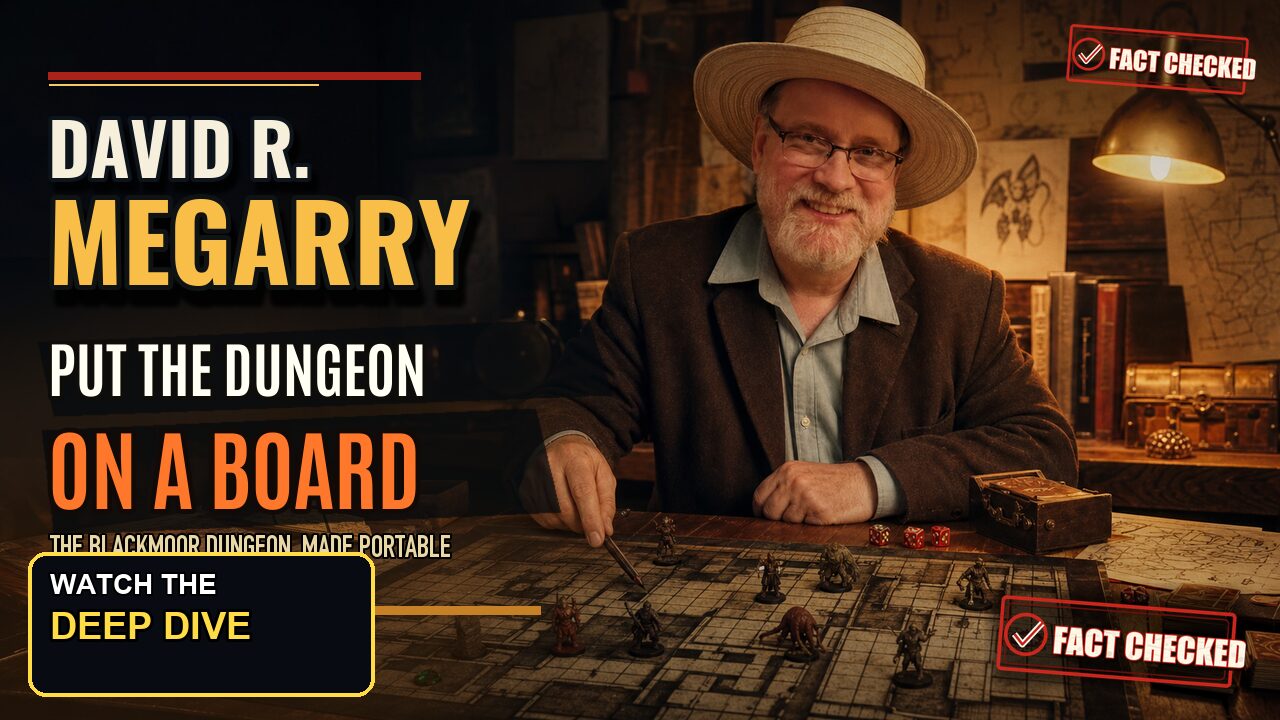
David R. Megarry did not create Dungeons & Dragons.
He did not run Blackmoor. He did not build TSR. He did not become the public face of fantasy gaming. Those facts matter, because Megarry’s real achievement does not need to borrow credit from anyone else.
He did something more specific.
He took the dungeon crawl, removed the referee, and made the dungeon run on a board.
That game became Dungeon!
If Dungeons & Dragons became the open-ended language of fantasy role-playing, Dungeon! was the dungeon crawl made physical: rooms, levels, treasure, monsters, dice, risk, and the terrible little voice that says one more room before you leave. No campaign binder. No hidden notes behind a screen. No referee deciding what waits in the dark. The board supplied the space. The cards supplied the danger. The player supplied the greed.
That was Megarry’s design instinct: take the pressure of Blackmoor and make it portable.
The Twin Cities Table
Megarry came out of the Twin Cities gaming scene around Dave Arneson, David Wesely, Richard Snider, John Snider, and the Midwest Military Simulation Association. This was the place where wargaming was already mutating into something stranger than fixed battles and clean victory conditions.
Wesely’s Braunstein games had shown that players could take individual roles inside a fictional situation. Arneson’s Blackmoor pushed that idea into fantasy adventure. Players entered a living setting, ran individual characters, explored dangerous spaces, died often, and came back with new names on new sheets.
Megarry was not the referee of Blackmoor. That was Arneson. He was also not one of the co-creators of D&D. That credit belongs to Gygax and Arneson.
But Megarry was not a spectator.
He became one of the people who understood how Blackmoor worked from inside the table. Research notes point to surviving character records tied to his play, showing a roster of characters across more than two years of dangerous sessions. Later recollections from the Lake Geneva demonstration describe Megarry as a player who helped orient Gygax’s group because he understood the procedures, the rhythm, and the danger of Arneson’s dungeon.
That is the right place to put him. Not above Arneson. Not beside Gygax as a third author of D&D. Inside the same room, watching a new form of play take shape and asking a different design question.
Could the dungeon work without Dave Arneson in the chair?
Blackmoor Without The Referee
Blackmoor had a bottleneck. It depended on Arneson.
That dependence was part of the magic. Arneson could improvise, adjudicate, change the world, react to player choices, and make a campaign feel alive. It was also a practical problem. If the referee was not available, the world stopped moving. If too many people wanted in, the human being at the center became the limit.
Megarry’s answer was not to create another role-playing game. His answer was to isolate the dungeon expedition and turn it into a self-contained machine.
The board became the referee.
Rooms were fixed. Levels were visible. Monsters and treasure came from cards. Character types had different chances and different goals. The deeper a player went, the more dangerous the dungeon became, but the reward improved too. The game taught its lesson without a speech: caution keeps you alive, greed wins games, and the hard part is knowing when those two truths have changed places.
That design loop is still sharp.
Enter the dungeon. Go deeper. Fight. Find treasure. Decide whether to risk one more door. Escape before the dungeon takes it all back.
That is not a lesser version of role-playing. It is a different formal solution to the same early problem. Blackmoor was a living campaign. Dungeon! was the dungeon crawl compressed into a board game engine.
The Dungeons Of Pasha Cada
The early history has to be handled carefully.
Megarry’s first playable prototype appears to date from late 1972, though the exact month should be kept soft. Some accounts say October. Some say November. The safest public wording is that a playable prototype existed by late 1972 and was demonstrated before the surviving July 1973 D&D draft.
The earliest complete surviving version is not necessarily that first prototype. It is a handmade later version called The Dungeons of Pasha Cada, preserved through a copy Megarry gave to Sandy Rosenberg in August 1973. That matters because Pasha Cada was already a developed version. Megarry has said the title was added in early 1973 while preparing the game for publisher submission, and that some additions came through conversations with Gygax.
So the clean history is this: there was an earlier Dungeon! prototype, then a revised Pasha Cada version, then the TSR publication.
The game already had the core idea. A dungeon map. Character types. Treasure goals. Monster encounters. Depth as danger. Depth as reward.
One reported design byword captures the whole thing: "The deeper you go, the better they are but the worse it gets."
That line is not just colorful. It is structure. Deeper levels mean harder monsters and richer treasure. The board makes risk legible. A player can see the temptation on the table.
That is why Dungeon! belongs in the same origin conversation as D&D. Not because it was D&D. Not because D&D copied it wholesale. Because both games came out of the same Blackmoor pressure chamber, and Dungeon! shows one of the earliest attempts to turn that pressure into a product strangers could play.
The 1973 Crossing
For years, some early histories placed the famous Lake Geneva demonstration in late 1972. More recent document-based work has pushed that meeting into the second half of February 1973.
That correction matters.
At that meeting, Megarry demonstrated Dungeon! and Arneson ran Blackmoor for Gygax and the Lake Geneva players. This was one of the key moments when the Twin Cities dungeon experience crossed into Gygax’s circle. Gygax was already an experienced wargame designer, a sharp organizer, and a man with a strong sense for publishable systems. What he saw in Blackmoor and the surrounding Twin Cities experiments changed the path of the hobby.
Megarry’s board game was part of that crossing.
Afterward, Gygax and Megarry discussed the game. Megarry later described phone conversations in which Gygax suggested additions, including player-versus-player combat. That does not make Gygax the designer of Dungeon!, but it does make him part of the game’s early development history.
Then comes the April 1973 claim.
According to Megarry, he submitted the revised Pasha Cada prototype directly to Don Lowry at Guidon Games in April 1973, after Gygax recommended the game. Megarry has also said Lowry accepted it for publication and executed a royalty agreement. The claim is specific and important, but the contract and transmittal documents have not been publicly reproduced in the research we have. So the public article should say "according to Megarry" unless those documents are independently shown.
That still leaves a strong point.
A playable Dungeon! prototype existed before the extant July 1973 D&D draft. The July 1 date belongs to the foreword of the surviving draft; it should not be overstated as the exact day Gygax and Arneson jointly finished the game. But the sequence is clear enough for responsible language: Megarry’s design was already in motion before D&D reached print, and probably before the first major surviving D&D draft took its known form.
That changes how Dungeon! should be described.
It was not simply a board-game adaptation made after D&D became successful. It was a parallel Blackmoor-derived design that entered the same 1973 exchange of ideas.
The Long Road To Print
Dungeon! did not publish first.
Dungeons & Dragons appeared in 1974. Dungeon! reached the market through TSR in 1975.
That order can mislead people. If all you see is the publication date, Dungeon! looks like a later product inspired by D&D. The evidence suggests something more interesting. It was developed earlier than the box date suggests, then delayed by practical publishing realities.
Board games cost money.
Original D&D could be printed as small booklets and reference sheets. Dungeon! needed a large board or map, cards, components, graphic work, packaging, and the cash to manufacture all of it before sales came back. Guidon Games was not in a strong position to take on that kind of production risk. The company had its own financial problems, and by the time the dust settled, neither D&D nor Dungeon! came out through Guidon.
Megarry later described retrieving his prototype from Lowry in Maine and bringing it to Gygax in Lake Geneva. TSR eventually published Dungeon! in 1975.
Gygax’s role in that final version should be credited honestly. A surviving April 1975 letter shows that TSR and Gygax made real product-development changes: board adjustments, contents, rules organization, presentation, and components. The core design remained Megarry’s. The commercial edition also passed through TSR’s hands.
Both facts matter.
The correct credit is not "Gygax made Dungeon!" It is also not "Gygax had nothing to do with it." Megarry designed the game. Gygax recognized it, advocated for it, suggested some development, and later helped shape its TSR release.
That is a better story because it is true.
The Game That Stayed Itself
Most early fantasy games survive as artifacts. Dungeon! survived as a game.
Its design does not need much explanation. Players choose characters, enter the dungeon, defeat monsters, collect treasure, and try to return before the dungeon punishes them. Different characters need different amounts of treasure to win. Some are better suited for danger. Some have to be clever about how far they push.
The genius is the visible risk curve.
The player can look at the board and understand the bargain. Stay near the top and live. Go deeper and get rich. Every turn makes the same promise and the same threat.
Later editions changed presentation, rules details, art, and character names. Wizards of the Coast brought the game back in modern editions in 2012 and 2014. As of now, it is safer to say those editions remain commercially obtainable through secondary or scattered retail channels than to claim Wizards is actively manufacturing it today.
But the deeper truth is that Dungeon! remained recognizable.
That is rare.
The game did not need a mountain of lore to keep breathing. It had one clean engine: the dungeon as a risk-reward machine.
What He Actually Built
David Megarry did not create the role-playing game industry.
He did not create Blackmoor. He did not write Dungeons & Dragons. He did not found the company that turned fantasy gaming into a worldwide business. Those credits belong elsewhere, and taking them from Gygax or Arneson would make the history worse, not better.
Megarry built a parallel branch.
He took the dungeon expedition, one of the most powerful new ideas inside Blackmoor, and proved it could run without a referee. He turned hidden exploration, monster danger, treasure hunger, and escalating depth into a visible board-game system. He showed that the dungeon was not just a location. It was a design engine.
That is why he belongs in this series.
The early dungeon was not a single invention waiting for one name. It was a cluster of discoveries made by people playing hard, arguing rules, making maps, dying repeatedly, and trying to turn table magic into repeatable form.
Arneson made the dungeon live.
Gygax and Arneson made the role-playing version publishable at scale.
Megarry made the dungeon run on a board.
Those are not the same achievement. They are all part of the same origin story.
Where To Find Him
David R. Megarry remains one of the key living witnesses to the prehistory of fantasy gaming. His comments, interviews, surviving materials, and early game records matter because they help correct the oversimplified version of the story.
That may be the quietest part of his legacy.
Megarry did not only design Dungeon! He helped preserve a route back to the room before the room became an industry.
The game itself is still the clearest statement: a board on the table, rooms in the dark, treasure waiting below, and one question every player understands.
How deep are you willing to go before you turn back?
Fact Check Notes
Publication notes
This site is AI-assisted and human-reviewed. We use artificial intelligence to help gather research, organize source material, and draft profile content. Human editors then read, revise, and check each profile before it goes live. Most profiles are built through deep AI research and two separate rounds of fact-checking.
Leave a Reply
You must be logged in to post a comment.