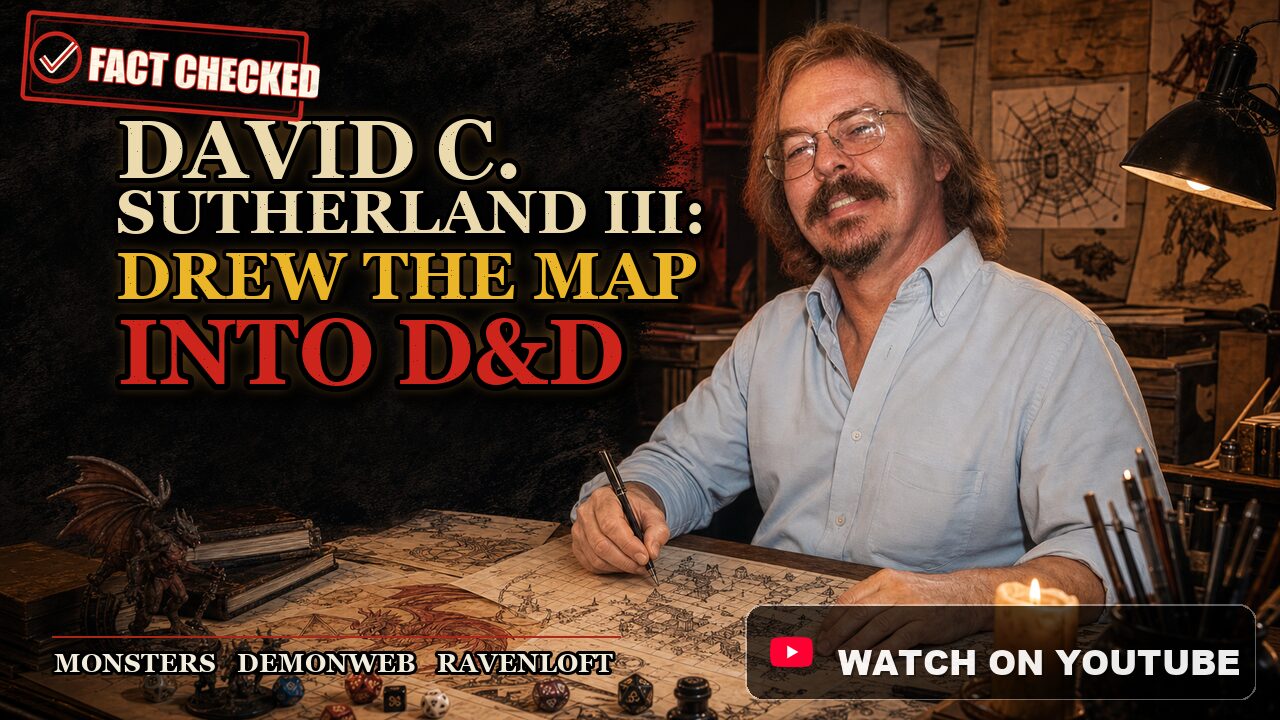
Before Dungeons and Dragons had glossy covers and full-color paintings, it had a problem to solve.
The game was already packed with rules. Numbers were easy to print. A shared picture was harder. When a Dungeon Master said, "You open the door," the table needed more than Armor Class and Hit Dice. They needed something they could see in their head.
David C. Sutherland III helped make that possible.
He was one of the early TSR artists who gave the game a usable visual language. Monsters had bodies. Gear had weight. Maps turned into places with stairs, towers, and rooms that actually connected. His line work is still part of how many people remember what early D and D felt like.
The Soldier With The Pen
Sutherland was born on April 4, 1949, in Minneapolis, Minnesota.
He trained as a commercial artist, and that background shows in the best way. The work is built to reproduce cleanly. It is built to stay legible when the paper is cheap and the printing is not kind.
He served in the United States Army as a military police officer during the Vietnam War era, with 1969 and 1970 commonly cited.
He later spent time in the Society for Creative Anachronism, where the fantasy overlaps with real gear and real weight. That kind of experience changes how you draw a strap, a helm, a shield. The equipment stops being decoration and starts being something a person has to carry.
The Tsr Door Opens
The early hobby ran on small networks. You met people at tables, in clubs, at conventions, or in historical reenactment circles, and then somebody introduced you to somebody else.
In the mid-1970s, Sutherland was introduced to M. A. R. Barker and the Tekumel circle. From that orbit, he found his way to TSR at the moment the company needed artists who could work fast and who understood that illustration was also a production tool.
Sutherland became part of the group that defined the early look of Advanced Dungeons and Dragons, alongside artists like David A. Trampier, Erol Otus, Darlene, and others. They were not simply decorating books. They were building the shared mental images that let one table recognize what another table was talking about.
The Monsters Got Their Shapes
A good monster drawing does something that rules cannot do.
It locks a shape into the reader’s mind. It gives a table a common reference point. After that, the creature is not just a paragraph. It is a thing you can picture when the DM pauses and smiles.
Sutherland drew many early monster illustrations, and his work helped cement some of the classic ideas. The mimic as a treasure chest you should not trust is the clean example. More broadly, his monsters feel physical. They look like they belong in corridors and caves, not only on a poster.
That kind of work is quiet. People rarely praise it directly. They just use it, for decades.
A Dungeon Made Of Iron Web
Sutherland also designed and wrote.
One of his signature credits is Q1: Queen of the Demonweb Pits. It is the kind of adventure that makes space itself part of the danger. It does not feel like a simple underground maze. It feels like a structure designed to trap you, confuse you, and pull you deeper.
Some creators are remembered for characters. Some for rules. Sutherland kept returning to structure. Where does the passage go. What happens when the party runs. What does a place feel like when it is drawn clearly enough that you can navigate it in your head.
The Castle That Stood Up
If you want one clean example of his impact, look at I6: Ravenloft.
Ravenloft needs mood, but it also needs a castle that feels believable. A vampire story collapses if the building feels like a board game board. The DM has to believe the place before the table can.
Sutherland’s isometric maps of Castle Ravenloft made the castle stand up.
Towers rise over halls. Stairs drop into crypts. Balconies and rooms stack in ways an overhead map struggles to communicate. Players might never see the maps, but the DM does, and that changes the way the adventure is spoken out loud.
What He Actually Built
David C. Sutherland III did not build D and D alone. Early TSR was a collaboration, and the era had more than one defining artist.
His contribution is easier to name as a pattern than as a single invention.
He made fantasy usable. He gave the game a physical sense of monsters, objects, and space. He brought commercial discipline into a hobby publisher that was learning, in public, how to turn homegrown imagination into real books.
Time To Map Heaven
Sutherland worked at TSR through the 1990s. When the company changed hands in that era, he was not carried forward into the new structure.
In 2004, an auction of his artwork and memorabilia was widely reported as raising money for his daughters. It is a practical detail, and it is also a reminder. The work that shaped a hobby still had to pay for real life.
He died on June 6, 2005. He is buried at Fort Snelling National Cemetery in Minneapolis.
His memorial line is short and strangely right:
Time to Map Heaven.
He helped give D and D its early monsters and some of its most memorable spaces. For a lot of Dungeon Masters, his maps were the moment the world stopped being abstract and started feeling real.
Fact Check Notes
Publication notes
This site is AI-assisted and human-reviewed. We use artificial intelligence to help gather research, organize source material, and draft profile content. Human editors then read, revise, and check each profile before it goes live. Most profiles are built through deep AI research and two separate rounds of fact-checking.
Leave a Reply
You must be logged in to post a comment.