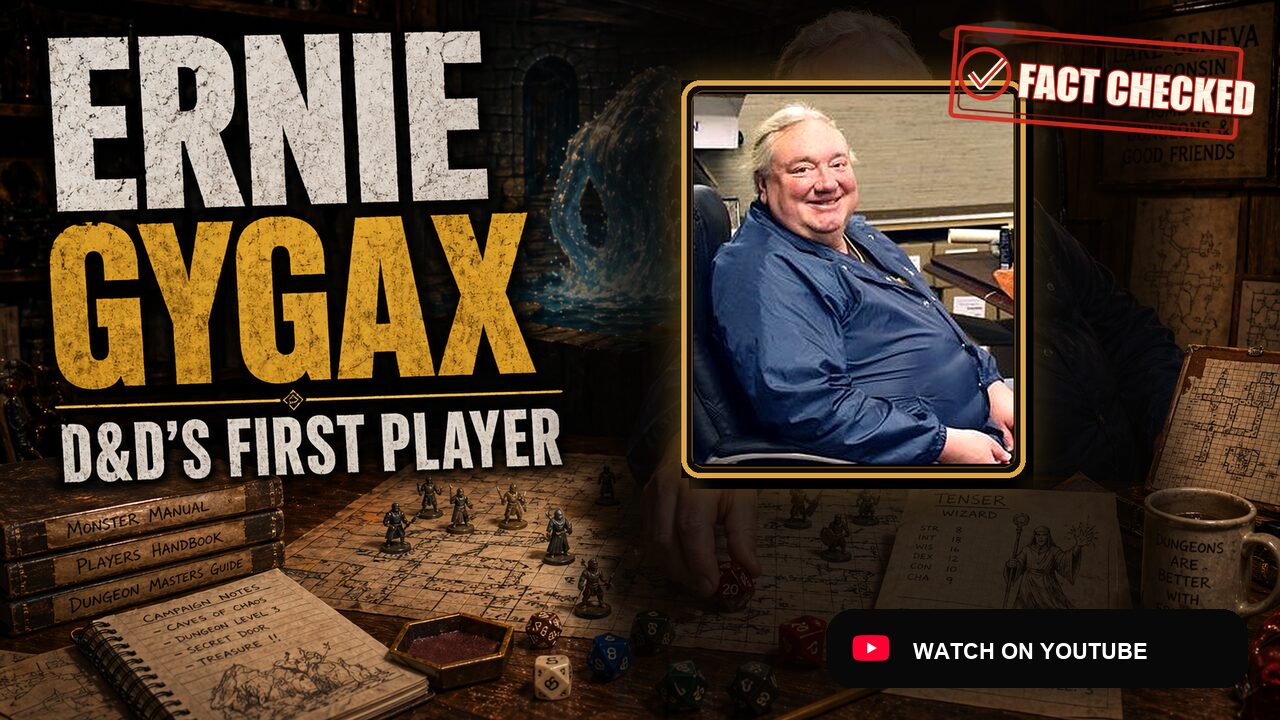
That has to be said first.
If you judge him only by published systems, mechanics, and books other designers built upon, the record is modest. A co-authored geomorph set. A Gamma World adventure. A long gap. Gaxmoor. The Marmoreal Tomb. Hobby Shop Dungeon material. Always collaborative. Always inside existing RPG traditions.
But if the question is who belongs in the deep story of Dungeons & Dragons, Ernie is there before almost everyone else.
He was at the family table when the game was still becoming itself. He rolled dice in the Gygax household before the rulebooks became artifacts, before the basement experiment became an industry, before anyone could know that a handful of maps and rules would change how people imagined play.
The public shorthand calls him D&D’s first player. The careful version is that Ernie and his sister Elise were among the first players in Gary Gygax’s earliest Greyhawk play.
Either way, Ernie was there at the beginning.
That beginning matters.
It just matters differently than a design credit.
TENSER
Ernie’s most famous contribution is a name.
Tenser, an anagram of Ernest, was his wizard character from the earliest days of D&D play. The name survived for half a century. Tenser’s Floating Disk became one of those spells that moved from rulebook text into the shared language of the hobby. Tenser’s Transformation carried the same memory forward in a more dangerous form: the wizard who stops standing behind the fighters and steps into the fight himself.
Players have been speaking Ernie’s character name at tables for generations, most without knowing where it came from.
That is a strange kind of immortality.
It is not the same as designing a spell system. It is not the same as writing the Player’s Handbook. But it is also not nothing. Early D&D was built from play. Characters became lore. Player habits became design pressure. Table stories became rules, spells, monsters, and campaign history.
Ernie lived inside that feedback loop before it had a name.
The Water Weird is the cleanest example of a specific creation that moved from Ernie’s imagination into published D&D. The original Monster Manual tradition credits him with creating the creature, and the Water Weird has remained part of D&D’s monster vocabulary across editions.
That kind of survival is rare.
Still, the distinction holds. Tenser and the Water Weird are part of D&D’s legacy. They are also contributions inside Gary Gygax’s larger system and TSR’s publishing machine. They do not make Ernie a system architect.
They make him something older.
They make him one of the first sources from which the game drew living play.
The Hobby Shop Dungeon
The place where Ernie’s craft mattered most was not the printed page.
It was the table.
The Hobby Shop Dungeon grew from the Lake Geneva world around TSR, the Dungeon Hobby Shop, and the early culture of D&D as something played in public, taught by example, and carried from table to table. Ernie ran games for decades. His obituary remembers him as a storyteller who taught thousands of people of all ages to enjoy games. Friends and players remember the same basic figure: generous with time, steeped in old-school play, and willing to let the dice bite.
That is a real craft.
A great dungeon master is doing several jobs at once. He presents space. He tracks factions. He judges risk. He reads players. He improvises consequences. He remembers what the map hides and decides when to be merciful, when to be neutral, and when to let the trap close.
The live Hobby Shop Dungeon was Ernie’s truest medium.
It was deadly, local, inherited, improvised, and alive. It belonged to a tradition where the dungeon is not a scripted story but a place full of pressure, opportunity, monsters, treasure, grudges, and foolish choices. That kind of dungeon works best when the person behind the screen can feel the room.
Ernie could feel the room.
The problem, for anyone trying to describe the work cleanly, is that live dungeon mastering is not the same craft as published game design.
The Published Record
Ernie’s first credited published design was Dungeon Geomorphs Set Two: Caves & Caverns in 1977, co-authored with Gary Gygax. It is a fitting first credit: not a full game, not a module in the modern sense, but a tool for building dungeons. Pieces of space. Rooms, caves, corridors, maps waiting for someone else to stock and run.
GW1: Legion of Gold followed in 1980 for Gamma World, credited with Luke Gygax and Paul Reiche III. Then the public design record goes quiet for a long time.
That long silence matters.
Ernie did not spend the 1980s and 1990s building a large catalog of published modules. He was involved in the business and culture around games, including the Dungeon Hobby Shop, mail order, Gen Con, and RPGA work, but he was not producing a steady stream of design credits. When he returned to publishing, it was through old-school adventure work and campaign material.
The Lost City of Gaxmoor appeared in 2002, co-authored with Luke Gygax and David Moore. It later received Castles & Crusades and 5E versions. It is exactly the sort of thing one would expect from the Gygax family line: lost city, old-school danger, factions, exploration, and a table-first sensibility.
The Marmoreal Tomb and Hobby Shop Dungeon projects came later, with Benoist Poire and GP Adventures, trying to bottle more of Ernie’s long-running dungeon sensibility for other tables.
That last phrase is the hard part.
Trying to bottle it.
The Translation Problem
A live dungeon master can fix things in motion.
If the room description is unclear, he explains it. If a faction relationship is messy, he acts it out. If the players miss the obvious clue, he decides whether the world gives them another angle or lets them suffer. If the monster is too deadly, he knows whether this table needs terror, mercy, or a hard lesson.
A published adventure cannot do that.
The text has to carry the experience to a stranger. The organization has to make sense at midnight before a game. The encounter math has to survive without the original designer’s instinct. The faction notes have to be findable. The map has to talk to the key. The key has to talk to the referee.
This is where Ernie’s published work struggles compared with his reputation as a live DM.
The ideas are often there: faction ecology, old-school danger, sandbox looseness, dense dungeon history, the sense that a place existed before the players arrived and will keep moving after they leave. But the printed form does not always make those ideas easy for another DM to run. What came alive with Ernie in the chair could become heavy on the page.
That is not a failure of imagination.
It is a difference of medium.
The Man And The Record
This is why Ernie is one of the hardest people in the series to describe without sounding unfair.
The published record looks small beside the scale of the name. It looks smaller still beside the table history. But a list of published credits is not asking who was closest to the origin point, or who gave the most players their first taste of old-school danger, or whose character name became a spell that outlived nearly everyone at the first table.
It asks what published design work can be examined by someone who was not there.
On that question, the record narrows. The best evidence is collaborative, intermittent, and rooted in adventure publication rather than system invention. The living reputation is larger than the printed architecture.
That gap is not a dismissal.
It is the exact story.
What He Actually Built
Ernie Gygax built table memory.
That is the cleanest way to say it.
His published design output is real but limited. He worked inside existing systems. He did not create a new resolution mechanic. He did not publish a major solo system. He did not build a broad catalog across many formats. His most substantial late work remained collaborative and deeply tied to old-school dungeon practice.
That is why the design record stays narrow.
But the legacy is not low.
Tenser is still in the game. The Water Weird is still in the game. The stories of those first Greyhawk sessions are still part of the hobby’s creation myth. The Hobby Shop Dungeon became a living link to the origin point, a place where players could sit with someone who had been there when the first rooms were being drawn.
No number can make that ordinary.
The honest boundary is simple. Published design can stand without the designer in the room. Ernie’s strongest work happened when he was in the room.
Where He Remains
Ernie Gygax died on February 28, 2025, in Lake Geneva, Wisconsin. Gary Con marked the loss publicly that year, fittingly, in the same community where the game began and where the Gygax name still draws players back to the table.
Find Ernie in Tenser’s Floating Disk, a spell name that carried a boy’s wizard through fifty years of rulebooks.
Find him in the Water Weird, still rising from the pool.
Find him in Dungeon Geomorphs Set Two, in Legion of Gold, in Gaxmoor, in The Marmoreal Tomb, and in the Hobby Shop Dungeon material, where the published record tries to catch the smoke of a live campaign.
Most of all, find him in the image of a player sitting down before anyone knew what Dungeons & Dragons was going to become.
The published work measures one thing.
The table remembers something larger.
Fact Check Notes
Publication notes
This site is AI-assisted and human-reviewed. We use artificial intelligence to help gather research, organize source material, and draft profile content. Human editors then read, revise, and check each profile before it goes live. Most profiles are built through deep AI research and two separate rounds of fact-checking.
Leave a Reply
You must be logged in to post a comment.