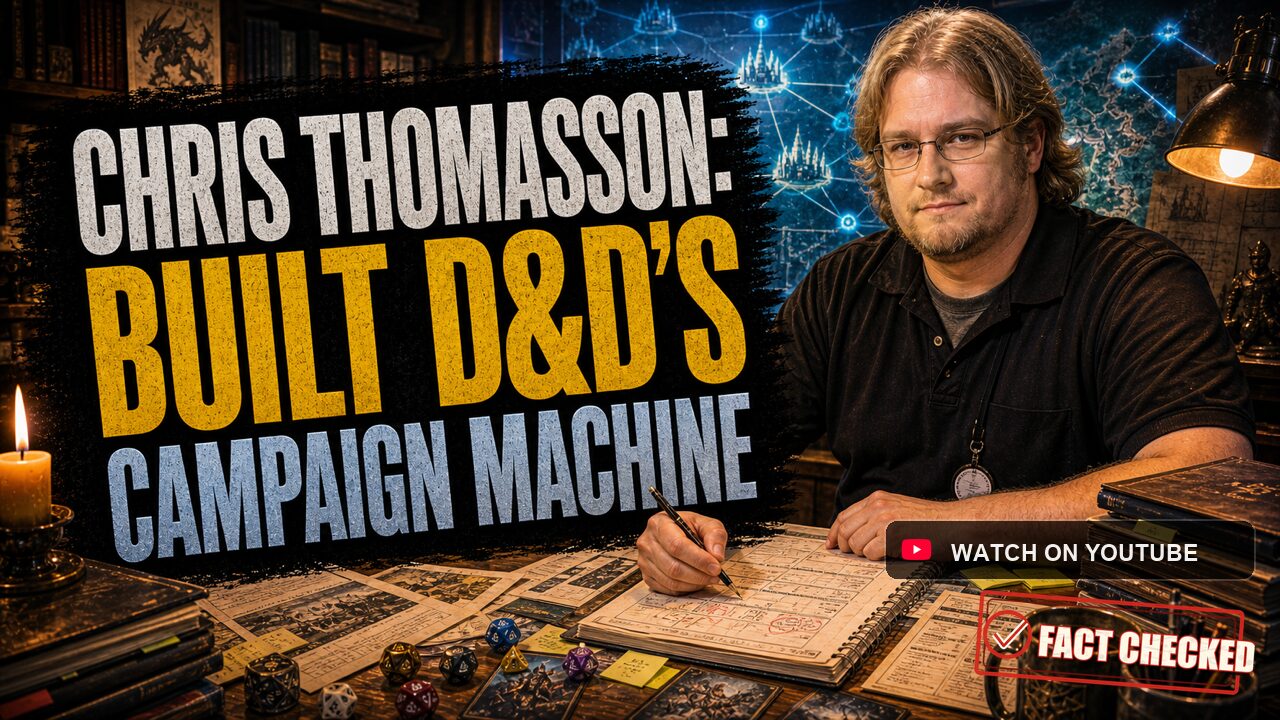
Most people remember tabletop history by the loudest titles and the loudest names. Chris Thomasson is remembered best in the quiet places.
He shows up in credits pages, in the shape of a monster entry that actually tells you how to run it, in a campaign tool that turns a stack of options into a session that works, and in the editorial hand that makes a magazine feel like a living line instead of a pile of disconnected articles.
If you played Dungeons & Dragons during the 3rd Edition and 3.5 era, you probably touched the kind of structure he helped build. Not because he was the only person shaping that era, but because he kept working in the layer that turns design into use.
That layer is not glamorous. It is the layer that keeps a campaign alive after the first night.
The Magazine Years
The public record on Thomasson’s private life is thin. The professional record is much stronger.
In a 2010 farewell editorial, he wrote that his first issue of Dragon was #254 and his first issue of Dungeon was #72. He also wrote that he spent nine years working on those magazines, moving through a ladder of editorial roles as the magazines changed hands and eventually changed form.
That matters because Dragon and Dungeon were not just magazines. For a lot of groups, they were the month to month oxygen of the hobby. New monsters. New player options. New adventures. New arguments that got played out at kitchen tables and game stores. The extra fuel that kept people thinking about their campaign between hardcover releases.
When Thomasson looked back on his start, he described the simple shock of realizing that the job was reading D&D and getting paid to do it. That sentence lands because it names what the work feels like from the inside. Joy and pressure at the same time, with deadlines attached.
In that same farewell, he sketched the arc in plain language. He wrote that he watched the odometer roll past Dungeon #100 and Dragon #300. He watched the magazines trade hands. He watched them move from print to digital. In other words, he did not just write for a stable format. He helped steer it through the years when the infrastructure itself was changing under his feet.
In the early 2000s, he worked on Dungeon magazine during the Paizo years, in the stretch where Dungeon started acting less like a rack of one shots and more like a machine for delivering campaigns.
The First Adventure Path Era
In 2003, Dungeon began publishing what Paizo would later call its first Adventure Path: The Shackled City.
That shift sounds normal now because longform campaigns are everywhere. At the time, it was a structural bet. You were asking readers to come back. You were asking dungeon masters to trust that the next installment would fit. You were asking players to commit to a story that would not be finished in one night.
Thomasson was not the sole inventor of that model, and he should not be treated that way. But he was part of the editorial spine that made it possible for a magazine to behave like campaign delivery instead of a handful of isolated set pieces.
Monsters And The Runnable Book
Thomasson’s credits include a run of D&D books from 2003 through 2007: Fiend Folio, Monster Manual III, Dungeon Master’s Guide II, Magic of Eberron, Complete Psionic, and Complete Champion.
Those are team books. They are not one-person inventions, and they should not be treated as such.
The more useful way to read that list is as a pattern. A lot of D&D material is easy to admire and hard to run. A monster can be clever and still leave the dungeon master doing extra work in the moment. A subsystem can look elegant and still buckle when it hits actual table play. A setting can sound rich and still offer no usable handles.
This is where editing becomes design. The difference between a monster that looks cool and a monster that plays well is often a few sentences the reader will never praise. Clear tactics cues. A cleaner presentation. The kind of phrasing that stops an argument before it starts. The kinds of choices that keep a session moving when the clock is against you and everyone has work in the morning.
The credits where Thomasson keeps appearing are often the places where the line is trying to reduce that friction. Not by making D&D smaller, but by making it more usable.
Tools For The Person Behind The Screen
Dungeon Master’s Guide II was not a replacement for the core Dungeon Master’s Guide. It was a support book for the work that happens between sessions.
Campaign management. Organizations. NPC structure. Practical tools. A detailed write-up of Saltmarsh that can function as a real campaign anchor instead of a name you promise yourself you will fill in later.
There is a particular kind of relief a dungeon master feels when a book does the boring work. Not the flashy part. The connective part. The part that keeps prep from turning into a second job.
Late 3.5 D&D was dense. Players had options everywhere. Dungeon masters had to turn all that possibility into something playable. A lot of Thomasson’s best work sits at that pressure point.
Opening The Subsystems
Complete Champion is a clean example.
Instead of treating religion as something that only belonged to clerics and paladins, the book tried to make faith and affiliation playable across more kinds of characters. It leaned on structures like organizations, affiliations, and alternative class features, so belief could show up in play as a living part of a campaign.
Magic of Eberron and Complete Psionic sit in the same neighborhood. Specialized material still has to stay connected to the larger game. If it turns into a sealed mini game, it stops being campaign material.
What He Actually Built
Chris Thomasson did not invent the Adventure Path by himself. He did not single-handedly redesign how D&D monsters were written. He was not the public face of D&D in the way some of his peers became.
What he helped build was connective structure.
That phrase can sound abstract, but you feel it at the table. A campaign runs smoother when the tools are clearer, the examples are usable, and the material is organized for real play instead of for shelf appeal. The editor who keeps doing that work changes how many groups can actually use the game.
He worked on Dungeon magazine when serialized campaigns became a real delivery format. He has credits on books that cared about how material functioned at the table. He helped shape support work that treated dungeon mastering as a real design problem, not a personal failing.
That contribution is easy to miss. It disappears when we only talk about big inventions and big personalities.
But tabletop games do not survive on invention alone. They survive on editing, usability, and the repeated act of turning raw material into something a group can run on a Friday night.
Thomasson’s career sits right there.
The Digital Turn
The name trail around Thomasson can be confusing, but he described his own credited name changes in his 2010 farewell editorial.
In that same piece, he wrote that he was leaving the magazines and moving into a Digital Games Manager role, with work tied to the tools and other digital projects around D&D Insider.
Even without the details, you can feel what that move means. You spend years building a rhythm. You learn the shape of a line. You learn the difference between a good idea and a usable one. Then you step away from the thing you have been steering, because the work is moving somewhere else.
That editorial is the last strong public career marker in the narrow check used for this revision pass.
I did not find a reliable public death notice. I also did not find a stable current official homepage that clearly updates his present work. So the safest close is modest: after the documented magazine and D&D digital era, the public trail gets quieter.
Where To Find Him
If you want to find Chris Thomasson in tabletop history, start with the credits rather than a persona.
Start with Dragon and Dungeon in the years when the magazines were acting like a campaign engine. Follow the Shackled City era. Then pull down Fiend Folio, Monster Manual III, Dungeon Master’s Guide II, Magic of Eberron, Complete Psionic, and Complete Champion and see what kind of work keeps repeating.
Pay attention to the places where the text is trying to help a table use the rules instead of just adding more of them.
Some creators are remembered for invention.
Thomasson is better remembered for the craft that comes after invention: arranging, editing, developing, connecting, and making the machinery playable.
He helped build the campaign machine.
Fact Check Notes
Publication notes
This site is AI-assisted and human-reviewed. We use artificial intelligence to help gather research, organize source material, and draft profile content. Human editors then read, revise, and check each profile before it goes live. Most profiles are built through deep AI research and two separate rounds of fact-checking.
Leave a Reply
You must be logged in to post a comment.