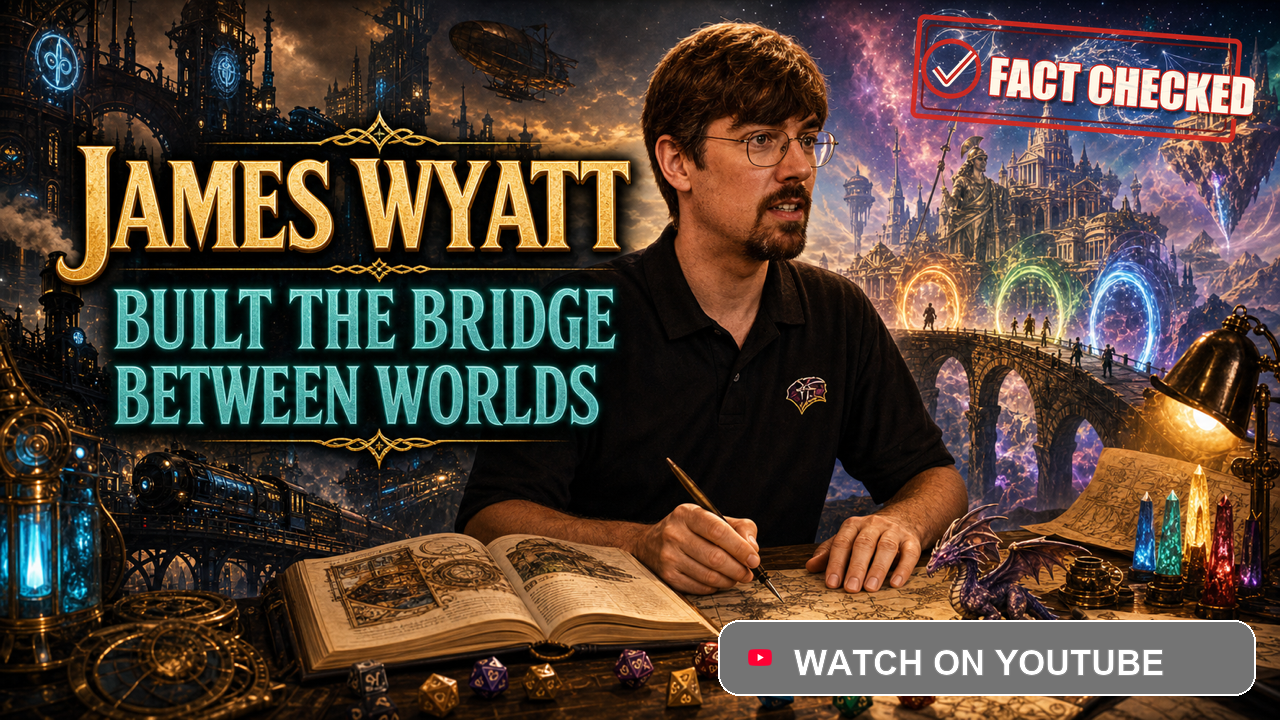
James Wyatt’s career is not best understood as a stack of credits.
It is better understood as a bridge.
He helped turn Eberron from a winning concept into one of D&D’s most durable modern settings. He became one of the game’s clearest Dungeon Master-facing voices. He helped carry Magic: The Gathering worlds into Dungeons & Dragons without turning D&D into a card game. Across editions, brands, fiction, and ministry, the recurring pattern is translation.
Wyatt turns one kind of language into another.
Lore into play.
Setting into tools.
Advice into table practice.
Worldbuilding into something a Dungeon Master can actually run on a Thursday night.
That is a quieter kind of influence than inventing one famous mechanic. It is also harder to replace.
The Minister Who Wrote For Dungeon Masters
Wyatt’s path into D&D did not begin as a straight corporate ladder.
Public biographies place him in Ithaca, New York, then at Oberlin, then at Union Theological Seminary. He was ordained in the United Methodist Church in 1993 and served small churches in southeastern Ohio before leaving ministry and turning toward games full-time.
That biographical detail can be overstated if handled badly. A pastor does not automatically become a better game designer. A theology student does not automatically write better rules.
But with Wyatt, the resonance is hard to ignore.
His strongest Dungeon Master writing often treats the DM less like a courtroom judge and more like a table facilitator. The concern is not simply whether a rule is correct. The concern is whether the game is working for the people in the room. How do you teach the role? How do you lower fear? How do you give the person behind the screen enough confidence to keep going?
That voice would become one of Wyatt’s defining marks.
First, though, he had to get into the building.
He freelanced for Dragon and Dungeon, moved through the late-1990s path of magazine articles, adventures, and RPG work, and joined Wizards of the Coast full-time in January 2000. From there his publication list becomes one of the more substantial modern D&D resumes: adventures, sourcebooks, setting books, core rules, novels, short fiction, columns, Magic worldbuilding, and later 5e hardcovers.
The volume matters.
The pattern matters more.
Eberron Needed Translation
Keith Baker created Eberron.
That line matters because the setting’s origin should not be blurred. Baker’s concept won Wizards’ setting search. The lightning rail, pulp-noir energy, postwar scars, dragonmarked houses, pulp action, magical industry, and moral ambiguity all start with that creative spark.
Wyatt’s role was different.
He helped translate that spark into an official D&D campaign setting alongside Baker, Bill Slavicsek, and the Wizards team. That is not a minor job. A setting pitch is a world in potential. A campaign setting book has to become usable architecture. It must tell a DM what the place feels like, what players can do there, what factions matter, how magic changes daily life, and why this is still D&D even when the assumptions shift.
Eberron worked because it did not merely add new countries to a map.
It changed the texture of play.
D&D could be pulp. D&D could be noir. D&D could have magitech, war trauma, trains, towers, espionage, and faith under pressure without losing the core engine of adventuring parties, dangerous places, and impossible choices.
That is Wyatt’s bridge work in its cleanest form.
He did not replace D&D.
He helped widen the doorway.
The Dungeon Master’S Guide That Taught The Job
Wyatt’s 4th Edition Dungeon Master’s Guide may be the cleanest single expression of his public design voice.
Edition politics around 4e can get loud. They often flatten the work into slogans: too tactical, too structured, too much like a board game, too far from older D&D. But the 4e DMG has outlived a lot of that noise because it does something every edition needs.
It teaches the job.
It talks to the Dungeon Master as someone who needs practical help, not mystical initiation. How do you build encounters? How do you pace a session? How do you handle players? How do you adjudicate without becoming adversarial? How do you make the game move?
That advice-first posture is why people who do not play 4e still praise the book.
The mechanics belong to their edition. The table wisdom travels.
Wyatt’s work on 4e was broader than one book. He was part of the edition’s central design conversation, one of the people tied to its sharper tactical choices, class structure, and encounter-facing clarity. Not every player wanted that version of D&D. Some loved it. Some bounced hard. That controversy belongs to the edition as a whole, not to one designer.
What stayed useful was the teaching voice.
A Dungeon Master’s Guide should not merely list subsystems. It should help someone run a game. Wyatt understood that.
Madness, Dragons, And Setting Machines
Wyatt’s best work often lives where lore becomes a machine.
Madness at Gardmore Abbey is a good example. It is remembered as one of 4e’s strongest adventures because it did not simply march players through tactical rooms. It gave the Dungeon Master moving parts: factions, locations, quests, rivals, and the Deck of Many Things as both artifact and structure. It understood that a strong adventure is not only a sequence. It is a place with pressure inside it.
His dragon work shows another side of the same habit.
Wyatt’s bibliography is full of dragons: Draconomicon, dragon fiction, later dragon lore, and Fizban’s Treasury of Dragons. The strongest version of this work does not treat dragons as large stat blocks with wings. It treats them as cosmological actors, cultural forces, symbols, patrons, enemies, mysteries, and campaign engines.
Again, the point is translation.
Lore becomes usable.
The monster becomes a campaign tool.
The old mythology gets a new rules chassis without being thrown away.
The Magic Door
Wyatt’s Magic work could have become a gimmick.
It did not.
That is important.
When he moved into Magic creative work, he was not just leaving D&D behind. He was working inside another worldbuilding machine: planes, colors, factions, art descriptions, story teams, style guides, and visual identity. The Art of Magic books turned that material into prose and setting texture.
Then came Plane Shift.
Those PDFs did something deceptively simple. They asked: what if the work already being done to describe Magic worlds could become a D&D starting point? Zendikar, Innistrad, Kaladesh, Amonkhet, Ixalan, Dominaria. Not as card-game simulations. As places a D&D table could inhabit.
That distinction is everything.
The smarter crossover is not "make D&D play like Magic." It is "make this world playable in D&D."
Guildmaster’s Guide to Ravnica and Mythic Odysseys of Theros proved that the idea could hold as hardcover D&D products. Ravnica brought guild identity, civic fantasy, and planar urban politics into campaign form. Theros translated mythic fantasy into divine relationships, heroic identity, and monsters that could carry a different scale of legend.
The bridge held because Wyatt understood both sides.
He knew D&D needed tools.
He knew Magic had worlds.
Dragons As Continuity
Wyatt’s dragon work is another version of the same architecture, but quieter.
Dragons are easy to flatten. They can become big monsters, old treasure guards, color-coded enemies, or symbols so familiar that nobody feels them anymore. Wyatt’s best dragon work treats them as more than that. Draconomicon, his Eberron dragon fiction, later dragon lore, and Fizban’s Treasury of Dragons all point toward the same instinct: keep the old mythic weight, then give Dungeon Masters ways to use it.
That is conservation through design.
The dragon stays recognizable, but the frame widens. It becomes cosmology, culture, patronage, prophecy, enemy, ancestor, echo, and campaign pressure. A dragon is not only a fight waiting at the end of the map. It is a reason the map exists.
That is very Wyatt.
Do not discard the old symbol.
Make it playable again.
What He Actually Built
James Wyatt did not invent Eberron.
He did not single-handedly design modern D&D. He did not personally solve every problem of 4e, 5e, Magic crossovers, or Dungeon Master advice. He also worked on books that deserve criticism, including Oriental Adventures, whose later reception is inseparable from broader critiques of exoticism and orientalist framing in D&D’s history.
What Wyatt built was infrastructure.
He helped turn other people’s worlds into playable architecture. He helped write core books that taught players and DMs how to speak the modern language of D&D. He helped build bridges between brands without collapsing the difference between them. He carried dragon lore, Eberron, Magic planes, and Dungeon Master advice across edition boundaries.
That work is not flashy in the way a single famous invention is flashy.
It is load-bearing.
When D&D needs a setting to become playable, Wyatt’s kind of work matters. When a DM needs guidance instead of mystique, Wyatt’s kind of writing matters. When a world from one game has to cross into another without losing its identity, Wyatt’s kind of translation matters.
He is not the designer of one door.
He is one of the people who kept building corridors.
Where To Find Him
Wyatt is not a retired historical figure.
Current public biographies place him still at Wizards of the Coast as a principal game designer, with a publication list that runs through recent D&D books such as the 2024 Dungeon Master’s Guide, Dragon Delves, and Eberron: Forge of the Artificer. At the same time, he has returned to ordained ministry and serves half-time as vicar of Faith Episcopal Church in Poulsbo, Washington.
That dual track makes sense in the context of the work.
One vocation builds worlds for tables.
The other tends a community in the real one.
The bridge is still there.
Fact Check Notes
Publication notes
This site is AI-assisted and human-reviewed. We use artificial intelligence to help gather research, organize source material, and draft profile content. Human editors then read, revise, and check each profile before it goes live. Most profiles are built through deep AI research and two separate rounds of fact-checking.
Leave a Reply
You must be logged in to post a comment.