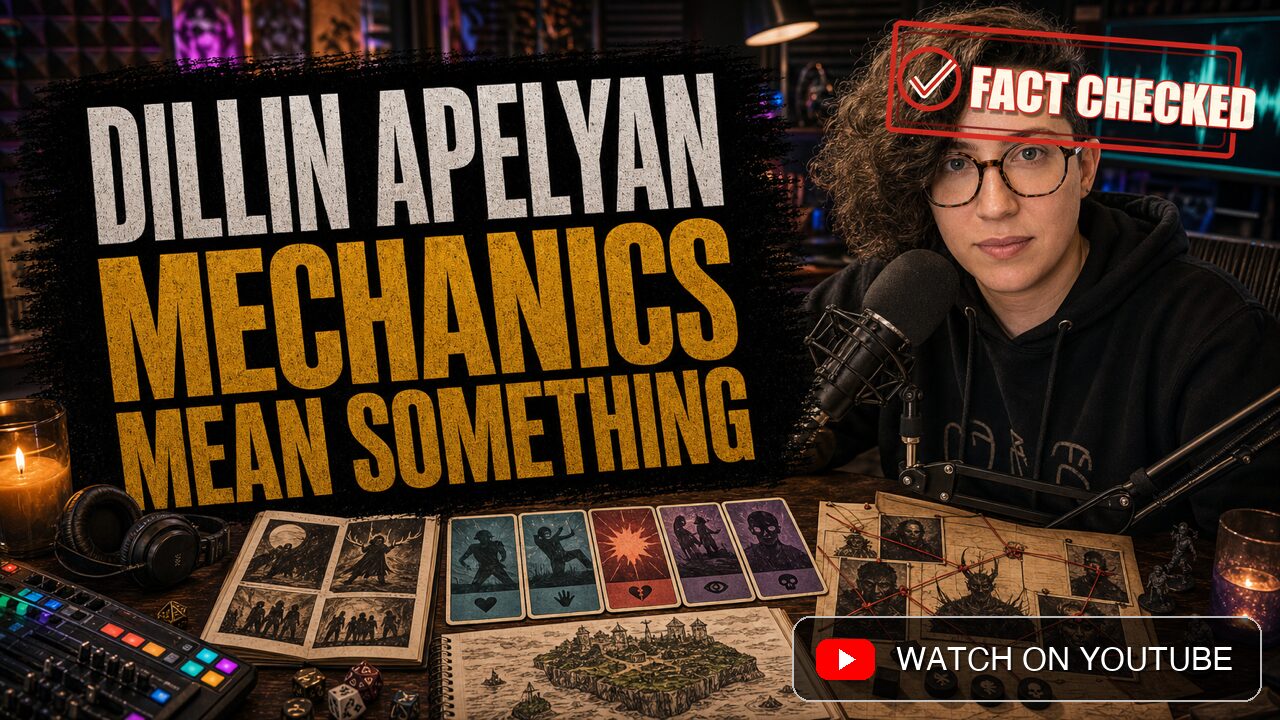
A tabletop rule is never just sitting there.
It rewards something. It punishes something. It nudges the table toward one kind of behavior and away from another, even when nobody says that out loud.
That is where Dillin Apelyan does their most interesting work: in the gap between what a game says it wants and what its mechanics actually make people do.
Apelyan is a designer, performer, host, collaborator, and advocate for games that understand their own emotional job. Their work keeps circling the same pressure point. If a story is about grief, pursuit, sanctuary, power, resistance, identity, or mutual survival, the rules cannot stand off to the side and pretend they are only math.
They have to carry some of the weight.
That is why Apelyan matters. Not because they invented actual play, narrative RPGs, emotional mechanics, or the idea that system matters. They did not.
Their contribution is more specific.
They help make those ideas visible.
## THE ANTHOLOGY AS A BRIDGE
For years, actual play trained audiences to think in long campaigns.
Same cast. Same system. Same world. Episode after episode until the table started to feel like a place you knew.
One Shot works differently. It is an anthology show built around short runs, new games, different casts, and quick entrances into systems many listeners might never have touched otherwise. That changes what actual play can do.
A campaign asks the audience to settle in.
An anthology asks them to notice.
When Apelyan stepped into the host role for One Shot in 2024, the fit made sense. Hosting that kind of show is not just about booking guests and keeping the conversation moving. It is curation. It is translation. Sometimes, honestly, it is matchmaking.
A good one-shot does not merely preview a rulebook. It demonstrates a contract.
Here is the game. Here is what it asks from the table. Here is the kind of story it can hold. Here is where it refuses to behave like Dungeons & Dragons, Pathfinder, Starfinder, or any other larger game a listener may already know.
That refusal matters.
Apelyan’s hosting sits inside that function. A performer known for one major game can be invited into a smaller system that asks for a different set of instincts. A listener who mostly knows big fantasy engines can hear another design answer a question those engines were never built to ask. A designer gets their work played in public by people who understand pacing, tone, and audience.
That is not promotion in the old sense.
It is a bridge.
## THE WRONG GAME WILL FIGHT YOU
Apelyan’s clearest public argument is also the most useful one: do not force the wrong game to carry the wrong story.
Simple, right?
Until you watch tables ignore it.
A group says it wants a story about community care, but the rules mostly reward extraction and combat. A premise promises romance, identity, grief, or survival, then hands players procedures built for tactical dominance. The table may try to pull toward the intended feeling, but the system keeps dragging the room back.
Games do that. Quietly. Over and over.
This is where Apelyan’s design posture breaks from the older maximalist instinct. A certain tradition of RPG design treated more as better. More stats. More edge cases. More powers. More procedures. More things the system could technically handle.
Apelyan’s work points in the other direction.
What does this game need?
Not what can it include. Not what can it simulate. What does it need in order to make the table feel the right pressure?
That is why the physical procedure matters. A tumbling block tower is not only a randomizer. It makes a player’s hand shake. A candle is not only a timer. It changes the air in the room. A deck of cards is not only probability. It can create interruption, rhythm, suit-based meaning, and the sense that the story has a hand on the wheel.
The lesson is not that every game should be small.
The lesson is sharper than that: every rule should know why it is there.
## A GAME ABOUT WHO OWNS THE STORY
Metalepsis makes Apelyan’s design position unusually clear.
The game, published through their itch page, is a two-player RPG about narrative control. It uses a standard deck of playing cards instead of dice. One player is the Protagonist. The other takes the role of the Author and the characters around the Protagonist.
That setup turns the central question into play.
Who gets to decide what this story is?
That is not the same question as whether a sword hits armor. It is not about success chance in the usual adventure-game sense. Metalepsis brings authorship into the fiction and makes the Game Master-like function visible. The structure that normally hides behind the screen becomes part of the conflict.
A character pushes back against the thing that claims to write them.
That gives the game its force. Free will, destiny, control, and the violence of being shaped by someone else’s narrative all become playable. Not as a lecture. Not as lore stacked on top of rules.
As a two-person procedure with cards on the table.
Small design. Large question.
## NEVERLAND WITH TEETH
Neverland: The Impossible Island shows the same instinct through setting instead of direct narrative conflict.
As a sourcebook, it is not trying to be a universal machine. It is a place built around escape, danger, childhood myth, and the wish to find somewhere the ordinary world’s pain cannot follow.
That premise is not decoration.
A setting tells a table what kinds of stories are possible before the first roll happens. It can invite comfort. It can create threat. It can make wonder feel safe, or make refuge feel unstable. Neverland is not only a map full of locations. It is a fantasy of sanctuary with teeth.
Older setting books often treated place as accumulated lore: timelines, factions, gods, continents, proper nouns, and history stacked high enough to feel real.
Modern setting design can still use those tools. But Apelyan’s lane asks a different question.
What emotional behavior does this place produce?
That question matters because a table does not experience a setting as information. It experiences it as permission. This is where you can hide. This is where you can be hunted. This is where childhood becomes beautiful and dangerous at the same time.
Apelyan keeps coming back to that kind of design pressure.
## HUNTER, HUNTED, AND THE SLASH BETWEEN THEM
HUNT(er/ed), co-designed with Meghan Cross, narrows the frame even further.
The title carries the instability. Hunter. Hunted. The slash is not cosmetic. It is the wound in the middle.
The game belongs to a modern tradition of focused RPGs built around one charged relationship rather than a campaign frame that tries to hold everything. That choice gives the design its edge. If the game is about pursuit, it does not need rules for every possible activity in a fantasy universe.
It needs to make pursuit hurt.
That focus opens a different set of questions. Who gets called monstrous? Who gets to name the monster? What happens when survival becomes the only thing left? What changes when the hunter and the hunted begin to resemble each other?
A broader game might include pursuit as one activity among many.
HUNT(er/ed) treats it as the spine.
Again, the pattern holds. Apelyan is drawn to systems that understand what emotional work they were built to do.
## BETTER VILLAINS ARE A DESIGN PROBLEM
In 2026, Apelyan and James D’Amato published The Ultimate RPG Villain Backstory Guide through Adams Media, an imprint associated with Simon & Schuster.
It is not a core RPG.
That does not make it minor.
Villain design is one of the places where older adventure writing often took the easiest road. The villain wanted power. The monster was evil. The enemy existed so the heroes could defeat something and feel clean afterward.
Apelyan and D’Amato’s guide pushes against that flatness. It gives Game Masters and players prompts, activities, and frameworks for building antagonists with motives, wounds, contradictions, and human-scale reasons for doing harm.
That does not mean every villain needs redemption. No one needs that rule tattooed on the inside of every campaign.
It means opposition becomes stronger when it has internal logic.
A faction, a monster, a rival, or a villain can still be dangerous. They can still be wrong. They can still need to be stopped. But when the table understands why they move the way they move, conflict gains weight.
That is design, even when it appears as a guidebook rather than a rules engine.
It changes what the table prepares to notice.
## A CAREER BUILT LIKE A NETWORK
Apelyan’s career does not fit the older model of one designer moving from hardcover to hardcover.
It looks more like the indie ecosystem around itch, crowdfunding, zines, podcasts, guest appearances, short-form games, and creator-owned collaborations. The work travels through networks rather than a single institutional ladder.
All’s Fair, created with Robin Ekberg and Elliot Davis and produced through Many Sided Media, belongs to that world. So do smaller works such as Guys in Chairs and Spin the Bottle.
The scale is different from the old hardcover model. So is the path.
A game can live on itch. A design idea can move through an actual play episode. A collaboration can begin through community trust before it becomes a product. A host can help an audience find systems they would never have searched for on their own.
That web is not a side effect of Apelyan’s career.
It is part of the work.
They move across roles: designer, performer, host, collaborator, interviewer, advocate. Each role feeds the others. The designer understands what the host needs to demonstrate. The performer understands what the system asks from a body at the table. The advocate understands that discovery is now one of the hardest problems in tabletop culture.
The old problem was scarcity.
The new problem is abundance.
## WHAT THEY ACTUALLY BUILT
Dillin Apelyan did not create actual play. They did not create narrative RPG design. They did not invent emotional mechanics or the principle that system matters.
Their contribution is more precise.
They have become one of the people making system choice legible to a wider audience.
Metalepsis shows the designer interested in authorship and control. One Shot shows the host using actual play as a bridge between audiences and smaller systems. The Ultimate RPG Villain Backstory Guide shows the teacher pushing tables toward better opposition. Neverland and HUNT(er/ed) show the attraction to settings and relationships that know their own emotional charge. Their public arguments about choosing the right system show the critic underneath the performer.
That combination matters because modern tabletop culture is overloaded with possibility.
There are too many games for most people to find alone. Too many systems, too many storefronts, too many crowdfunding pages, too many creator networks, too many brilliant small designs waiting outside the main road.
So the questions change.
Which game should we play?
Who was it built for?
What will it make us feel?
What does it reward?
What does it refuse?
Apelyan’s career keeps answering those questions in public, one table at a time.
## WHERE TO FIND THEM
Dillin Apelyan can be found through One Shot, their itch.io catalog, actual play appearances, and the wider network of indie tabletop projects connected to The Atomless, Patchwork Productions, Dorkspawn, and Many Sided Media.
The Ultimate RPG Villain Backstory Guide, co-authored with James D’Amato, is available through major booksellers.
The throughline is clean.
Some designers build systems large enough to contain almost any story. Apelyan works from the opposite direction. Name the story. Name the pressure. Name the feeling the table needs to reach.
Then choose the rule that knows why it is there.
Fact Check Notes
Publication notes
This site is AI-assisted and human-reviewed. We use artificial intelligence to help gather research, organize source material, and draft profile content. Human editors then read, revise, and check each profile before it goes live. Most profiles are built through deep AI research and two separate rounds of fact-checking.