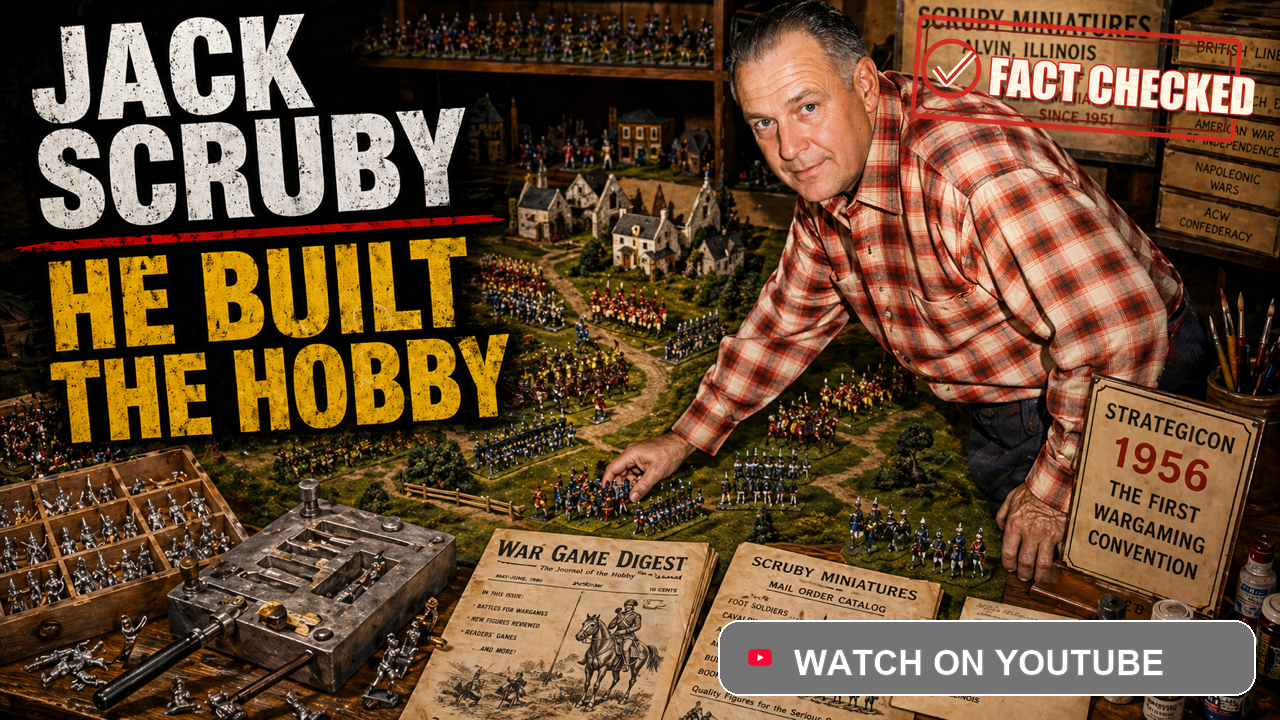
Jack Scruby did not become famous because one rules system conquered the hobby.
He became famous because he made the hobby possible.
That is a different kind of achievement. It is harder to explain and easier to underrate. Designers usually get remembered for systems, mechanisms, settings, and books. Scruby gets remembered for molds, figures, newsletters, conventions, and the stubborn act of connecting people who thought they were alone.
In the early 1950s, American miniature wargaming was scattered.
There were isolated hobbyists. There were home rules. There were toy soldiers if you could find or make them. There were sand tables and living room floors and private battles played by grown men who did not always want the neighbors to know what they were doing.
What did not yet exist was infrastructure.
Scruby built it.
The Desert
Before miniature wargaming became a recognizable American hobby, it was mostly a set of private obsessions.
Players invented rules for themselves. They painted or converted figures if they had them. They borrowed from H. G. Wells, from military history, from toy soldier traditions, from old books, and from whatever ideas made a battle feel right. But geography kept them apart. No easy internet. No national convention circuit. No steady magazine network. No common marketplace full of compatible figures.
That is the world Scruby entered.
He was not a philosopher first. He was a practical man. He was interested in electronics, casting, tools, miniatures, and the physical problem of making a battle appear on a table. He understood that a hobby needs more than rules. It needs pieces. It needs a way to buy those pieces. It needs a way for players to find one another.
That was Scruby’s genius.
He saw the missing supports.
Then he started building them.
The Figures
In the 1950s, Scruby became one of the key American suppliers of historical miniatures.
The exact business details vary depending on which account you read, but the larger arc is clear. Scruby moved from hobby casting into commercial miniature production and became one of the names American wargamers associated with available, affordable metal soldiers. Smaller figures made tabletop armies more practical. Better mold techniques made production more viable. Catalogs and mail order turned private desire into reachable supply.
That changed the economics of play.
If figures are rare, expensive, or inconsistent, the hobby stays small. If figures can be ordered, painted, organized, and fielded in numbers, the table changes. Armies become possible. Campaigns become possible. Clubs become possible because the material culture can spread.
Scruby’s figures were not remembered because every sculpt was a masterpiece.
They were remembered because they existed.
That sounds like faint praise only if you miss the point. In a young hobby, availability is design pressure. The size of a figure, the cost of an army, the range of periods offered, and the reliability of supply all shape what games people can actually play.
Scruby gave American wargamers soldiers to command.
The Digest
War Game Digest began in 1957.
It was small, mailed, practical, and culturally explosive. A magazine does not need glossy paper to change a hobby. It needs readers who have been waiting to discover that other people exist.
War Game Digest gave them that.
Players sent in rules, ideas, reports, arguments, variants, and observations. Someone in one place could test an idea, write it down, and put it into another player’s hands weeks later. That is slow by modern standards. For the 1950s, it was electricity.
This may be Scruby’s most important act.
He turned miniature wargaming from solitary eccentricity into correspondence culture. The magazine did not only publish Scruby’s ideas. It published the hobby talking to itself. Points systems, morale ideas, written orders, roster tracking, campaign concepts, and countless practical rules conversations moved through that network.
That matters because design rarely emerges from one mind in a vacuum.
It emerges from argument.
War Game Digest created a place where those arguments could travel.
The Room With Fourteen People
Scruby also helped make wargamers visible to one another in person.
The first American miniature wargaming convention is usually tied to Scruby’s California gathering in 1956, with a small group of players who could fit in one room. The number is often given as fourteen.
That sounds tiny.
It was enormous.
Fourteen people meant the hobby was no longer only private. Fourteen people meant someone else painted armies, wrote rules, cared about formations, argued over morale, and understood why a table full of little soldiers could matter. From there, clubs and meetings could grow. The San Joaquin Valley wargaming community became one of the long-running pieces of that history.
A convention is not only an event.
It is a declaration that a hobby exists.
Scruby helped make that declaration early, before the hobby had confidence, polish, or social permission.
The Compiler
An honest article about Scruby has to be clear about authorship.
He published. He synthesized. He manufactured. He organized. He designed too, but not always in the clean solitary way later lists prefer.
War Game Digest and Scruby’s later publishing work carried ideas from many people. Contributors explored points-based army selection, morale, roster tracking, written orders, troop differentiation, campaign systems, and other tools that would become part of miniature wargaming’s normal language. Scruby recognized, collected, arranged, and circulated those ideas.
That is not the same as inventing all of them.
It is still essential.
Every hobby needs editors and compilers. Someone has to notice that a scattered set of house rules, letters, experiments, and club practices are starting to form a shared grammar. Someone has to print the thing, mail the thing, sell the figures, answer the letters, and keep the circle moving.
Scruby did that work.
His own rules often read less like a cathedral and more like a workshop bench. They are practical. They solve problems. They borrow, refine, simplify, and leave room for local judgment. They do not always feel architecturally complete in the modern sense. They belong to a period when wargaming rules were living documents and table custom was expected.
That is why judging Scruby only as a rules designer misses him.
He was not only writing games.
He was building the conditions where games could be written.
The Rules He Did Build
Scruby did have a design voice.
It leaned toward accessible realism. He wanted games that gave players historical flavor without drowning them in paperwork. His rules explored stand-based combat, pre-declared fire and charges, fog-of-war devices, campaign continuity, supply, command ranges, and the relationship between tactical decisions and larger operational context.
Fire & Charge stands out because it shows the appeal of his approach.
The point is not that Scruby created the final form of miniature wargaming. He did not. British writers such as Donald Featherstone, Tony Bath, Charles Grant, and Peter Young produced more polished and more widely played rulebooks. Joe Morschauser pushed numerical clarity and scalable systems. Avalon Hill and Charles S. Roberts were building a different branch of the wargame industry through board wargames.
Scruby’s rules sit beside those achievements, not above them.
But the work is not empty.
He cared about decisions before contact. He cared about uncertainty. He cared about command choices creating consequences beyond one die roll. He cared about games that could actually be played by human beings with limited time, limited record keeping, and a table full of figures.
That is a real craft position.
Not the grandest one.
A useful one.
The Chain That Led Elsewhere
Scruby’s influence also traveled through people more than mechanics.
Donald Featherstone, one of the great British popularizers and writers of miniature wargaming, was connected to Scruby through the transatlantic flow of magazines, ideas, and encouragement. The British and American hobby scenes did not develop in isolation. They fed each other through letters, newsletters, rules, figures, and a shared belief that historical miniatures could be more than private amusement.
From there, the influence web becomes complicated.
Featherstone, Bath, medieval rules, Chainmail, Gary Gygax, fantasy miniatures, and the emergence of role-playing all sit in the larger wargaming ecosystem that Scruby helped nourish. Scruby produced fantasy figures in the 1970s, including material for the early fantasy gaming market. He was not the designer of Dungeons & Dragons. He was not a named core mechanical source for it.
His role was environmental.
He helped create the air.
That is not a small claim. It is just a different kind of claim. Some people invent a rule that everyone copies. Some people write a book that becomes a manual. Scruby built supply lines, communication lines, and meeting places.
The later explosions needed that ground.
The Man And The Cathedral
The old ranked story called Scruby "the man who built the hobby but not the cathedral."
That is the right frame.
His cultural importance is larger than his direct rules-design footprint. The Historical Miniatures Gaming Society named its lifetime achievement honor the Jack Scruby Award. That is not because one Scruby rulebook became the eternal standard. It is because the historical miniatures community knows what it owes him.
He made figures available.
He mailed the ideas.
He gathered the players.
He gave the hobby a nervous system before it had a body.
That kind of work does not always look like design when you stare only at rules text. But tabletop games are never only rules text. They are communities, supply chains, physical objects, publishing networks, conventions, and shared language. Scruby understood that before most of the hobby had words for it.
He was not the cathedral architect.
He was the one who got the stones to the site.
What He Actually Built
Jack Scruby did not invent miniature wargaming.
He did not write the most elegant rules of the old-school period. He did not create the point system alone, invent morale from nothing, build the commercial board wargame industry, or become the dominant mechanical ancestor of modern tabletop design.
What he built was infrastructure.
He built figures, catalogs, magazines, conventions, communication networks, and a practical American wargaming culture at a time when the hobby could have remained scattered and embarrassed. He designed rules, but his larger design was social and material: a way for wargamers to find pieces, ideas, opponents, and permission.
That is the honest measure.
Scruby’s games matter.
His groundwork matters more.
The Tools Came First
Jack Scruby died in 1988.
The hobby did not.
Historical miniatures gaming kept growing. The Jack Scruby Award still carries his name as one of the highest honors in the field. Historians and old-school wargamers still return to his magazines, his figures, his conventions, and his role in making American miniature wargaming visible to itself.
That is where his legacy lives.
Not in one perfect rules engine. Not in a brand every family knows. Not in a single board, card, die, or combat table that defines the modern hobby.
His legacy is more basic.
The tools came first. Then the tables. Then the opponents. Then the rules got better because people could finally argue with one another across distance.
Scruby built the tools.
Everything else had somewhere to stand.
Fact Check Notes
Publication notes
This site is AI-assisted and human-reviewed. We use artificial intelligence to help gather research, organize source material, and draft profile content. Human editors then read, revise, and check each profile before it goes live. Most profiles are built through deep AI research and two separate rounds of fact-checking.
Leave a Reply
You must be logged in to post a comment.