One Die And A Story
Cezar Capacle built an indie RPG engine by making it almost vanish.
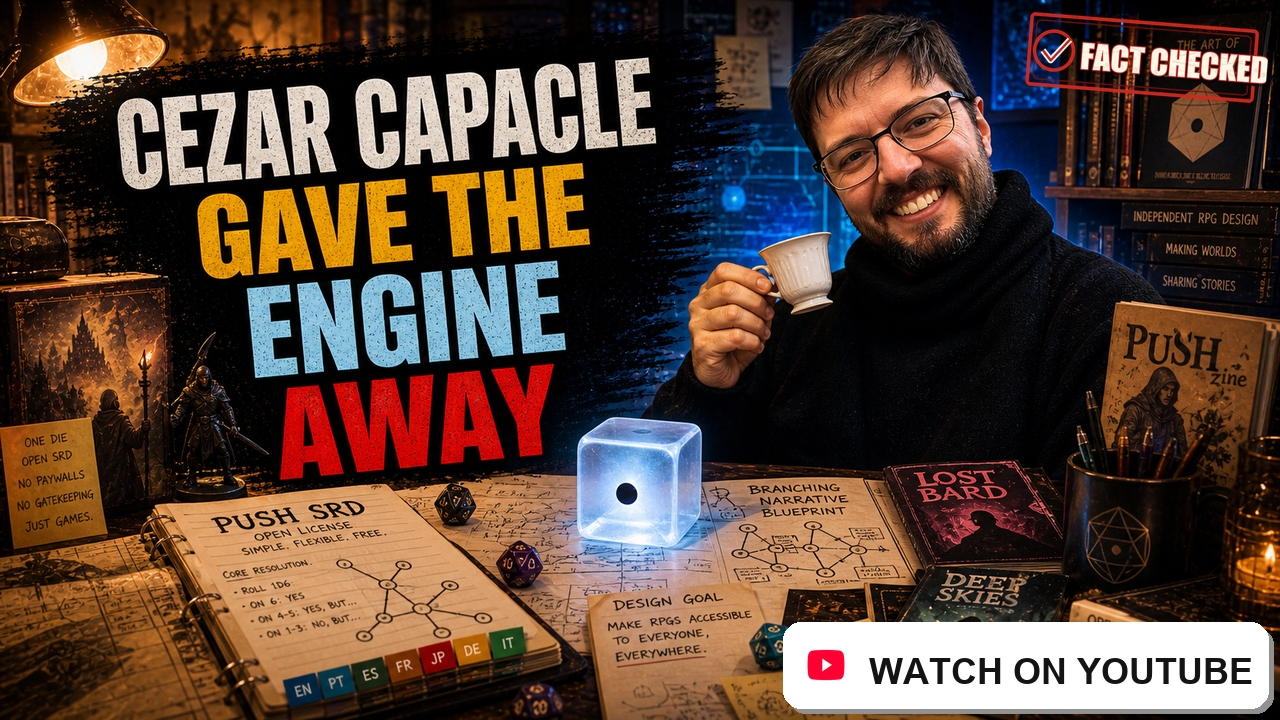
Push uses one six-sided die. No character stats. No required rolls. No tactical loadout to optimize before the story begins. When something feels dramatically interesting, you roll. A low result is a weak hit. A five or six is a strong hit. If the weak hit is not enough, you can roll another die and add it. Keep pushing and the result can become better, or it can break into a miss.
That is the game.
Or rather, that is the engine.
The important part is not that the mechanic is small. The important part is what the smallness does to the room. Push does not ask you to spend your first hour proving your character is allowed to matter. It waits. Then, when the moment turns unstable, it gives you a lever.
A roll is not mandatory procedure. It is a choice. It is you saying: I want pressure here.
That makes Push feel less like a universal rules system and more like a story lever. Use it when the fiction wants heat. Leave it alone when the scene is already moving.
Then Capacle gave it away.
The Push SRD sits online as an open tool for other designers. The Push SRD materials on itch.io include templates, logo files, example projects, and design notes that make the engine easy to pick up and reshape. On Capacle’s own Push SRD page, he describes the system as having more than sixty games made from it and translations into seven languages.
There is a specific kind of relief in that. Not relief that the rules are simple, but relief that the door is not guarded. You can walk in, build something small, and publish it.
The Architecture Of Less
Capacle’s games often feel like small structures built around one strong load-bearing idea. A single die. A single page. A single emotional premise. A single constraint that tells the designer what must stay and what can be cut.
That is not the same as making thin games.
A thin game is merely underbuilt. A Capacle game is usually trying to be light because the form itself is part of the argument. If the game is about memory, grief, resistance, dreams, hope, exhaustion, or freedom, the rules are often reduced until there is less between the player and that feeling.
Push is the clearest example because it is both a system and a statement. It says characters do not need numerical stats for their stories to matter. It says dice can create drama without modeling competence. It says the player has the right to decide when uncertainty deserves a mechanic.
That philosophy matters because it changes the emotional posture at the table. It tells the players that the story is not a test. The rules are there to press on the moment, not to police it.
It also helps explain why the SRD became useful to other creators. A heavy system gives designers machinery to master. Push gives them a room to furnish. The walls are simple enough that the new designer can immediately ask: what is my game about, and what prompt, table, role, or scenario makes this mechanic sing?
That is generous design. Not just because it is open, but because it leaves space.
The Many Small Games
Capacle’s catalog can look chaotic from the outside.
Solo RPGs. GM-less games. One-page experiments. Story prompts. Zines. Card-driven designs. Push-powered games. Tiny emotional tools. Larger fantasy projects. Games about dreams, jazz, exploration, cows, demons, ghosts, strange worlds, and walking away from productivism.
The variety makes more sense if you stop reading the catalog as a line of products and start reading it as a sketchbook.
Capacle often builds to test an idea. What if a whole game could fit on a mug? What if a solo RPG could be played while sleeping? What if a game about saying goodbye could fit into eighteen cards? What if an oracle page could hold sixty possible sparks? What if fantasy adventure said yes more often instead of treating freedom as a balance problem?
Some of these games are small enough that they feel closer to poems than systems. Some are commercial releases with fuller presentation. Some are experiments that seem built to find out whether a premise can survive contact with play.
Not every game needs to be a monument. Not every game needs to support years of campaign play. Capacle’s work often argues that a tabletop game can be a precise instrument for one evening, one mood, one question, or one kind of story.
Sometimes the value is not durability. Sometimes the value is permission.
Not A Demon
Not a Demon shows how Capacle’s small-game instincts can become emotionally legible.
The premise is immediately clear: you are a guardian spirit misunderstood as a demon. That one reversal carries the game. It gives the player tension before the procedure even begins. You are powerful, maybe frightening, maybe seen through the wrong story. But the emotional center is care.
Capacle’s itch.io materials describe Not a Demon as winning Best Solo Game of the Year at the Crit Awards in 2023, recognition that matters because solo design asks for a different kind of discipline. A solo RPG has no table chatter to cover weak structure. No facilitator to patch holes on the fly. The game has to create rhythm, pressure, and response for a single person sitting with the text.
Capacle’s best solo work understands that. It gives the player enough frame to act, enough prompt to keep moving, and enough empty space for the player’s own imagination to become the missing partner. That emptiness is not a missing feature. It is where the player is allowed to show up.
Everspark And The Bigger Room
Everspark is important because it shows Capacle pushing beyond the micro-game image.
It is still recognizably his work: light rules, open story, player freedom, solo and group friendliness, a desire to make fantasy feel welcoming rather than fenced in. But it reaches for a broader fantasy structure, the kind of game that can hold more recurring play and more world-building weight.
A catalog of tiny games can prove voice. A larger game tests architecture. Can the same commitment to lightness survive a bigger container? Can a system that says yes more often still create tension? Can an open fantasy game avoid becoming vague?
Those are the right questions for Capacle’s next phase.
The old story framed him as early in the arc, and that still feels true. He has published a great deal, but much of the work is intentionally small. The strongest designs are often compact, focused, and niche. The broader tabletop public does not know his name the way the indie RPG scene does.
But the trajectory is real. Push became a tool other people use. Not a Demon brought award recognition. Everspark and later projects point toward larger forms. His itch catalog keeps growing, and his public creator profiles still describe him first as an RPG designer making quirky games.
Global South, Open Doors
Capacle’s generosity is not only mechanical.
His Global South Shoutout project spotlights indie tabletop designers from the Global South and its diaspora. That matters because tabletop visibility is uneven. English-language indie scenes can talk about openness while still reproducing the same centers of attention. A recurring spotlight changes whose work enters the conversation.
This sits naturally beside Push. Both projects are about lowering barriers. Here is an engine you can use. Here is a template. Here is a way to publish something small. Here is a designer you may not have seen.
Capacle’s work does not treat openness as branding. It treats openness as a practice.
That is part of why the Push SRD matters even if the mechanic itself is modest. Statless narrative-first games existed before it. Push-your-luck existed before it. One-page RPGs existed before it. But Capacle assembled those instincts into a format that other creators could actually use, then made the on-ramp friendly.
That last part is design too.
What He Actually Built
Capacle did not invent minimalist RPGs. He did not invent statless play, solo RPGs, one-page design, push-your-luck dice, or open licensing.
What he built was an approachable open engine and a body of small games that show how constraint can become creative pressure.
Push SRD gave designers a single-die story tool that could be learned quickly, translated, remixed, and rebuilt. Not a Demon showed his solo design instincts landing with emotional clarity. Everspark showed him testing a wider fantasy canvas. Global South Shoutout turned some of the same open-door philosophy toward community visibility.
The limits are honest.
His career is still young. His best-known work lives inside the indie RPG scene. Many of the games are deliberately compact, which makes them harder to judge by the standards used for sprawling systems. Some are experiments more than landmarks. The catalog is wide, but the longest-term impact is still forming.
But the foundation already holds weight.
A designer can influence the field by building a cathedral. Capacle’s influence has come from handing out blueprints and saying: build your own room.
Where To Find Him
As of May 2026, Cezar Capacle appears active through his itch.io catalog and his own creator hub sites. His itch profile describes him as a Brazilian tabletop game designer who has been creating and publishing original games for the past five years, with more than forty games released across genres and formats.
Start with Push SRD if you want the engine.
Start with Not a Demon if you want emotional precision.
Start with Everspark if you want to see him testing a larger fantasy room.
The die is small.
The door it opens is not.
Fact Check Notes
Publication notes
This site is AI-assisted and human-reviewed. We use artificial intelligence to help gather research, organize source material, and draft profile content. Human editors then read, revise, and check each profile before it goes live. Most profiles are built through deep AI research and two separate rounds of fact-checking.
Leave a Reply
You must be logged in to post a comment.