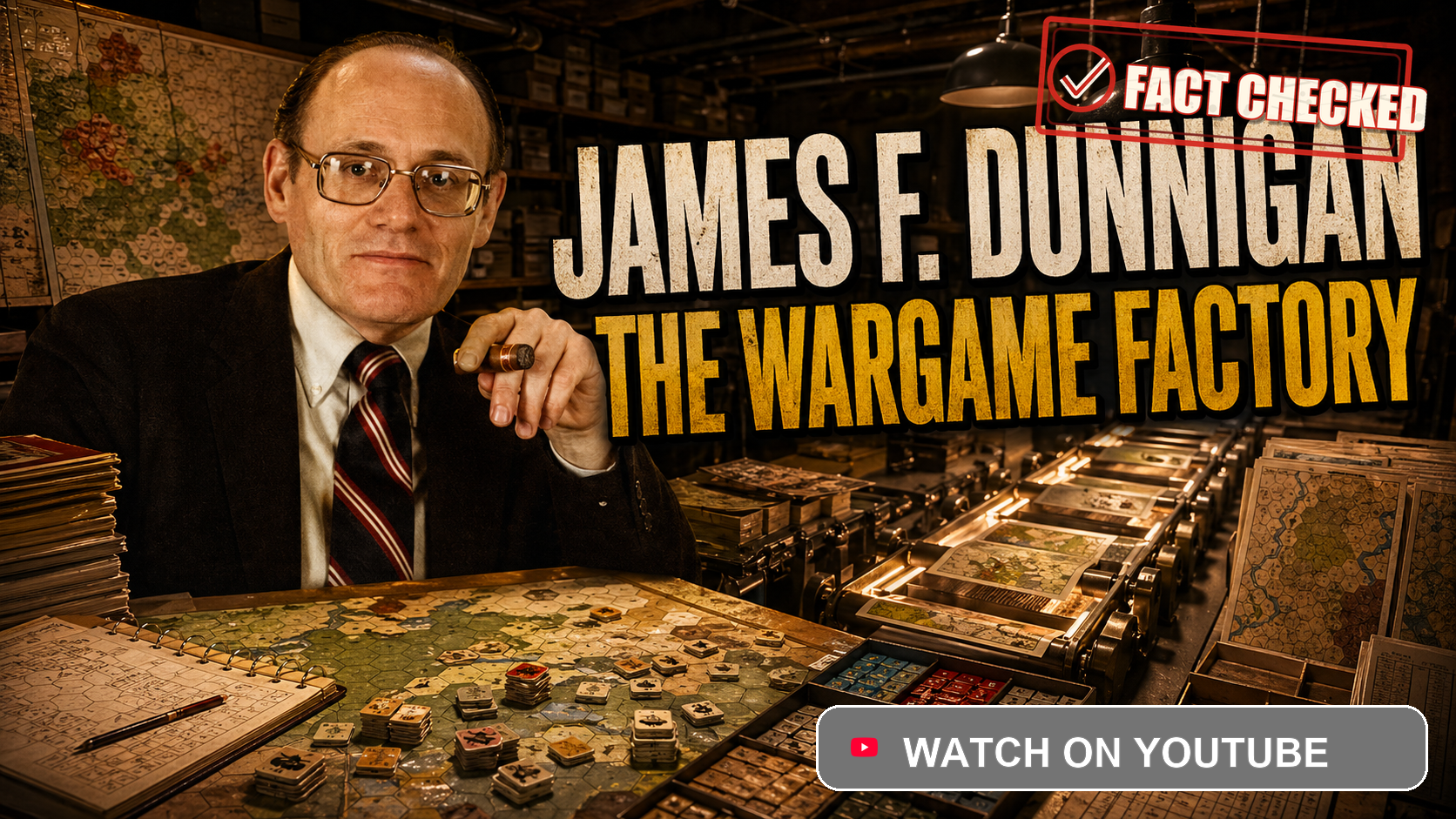
In 1969, James F. Dunnigan acquired a struggling magazine called Strategy & Tactics and turned it into the center of a new kind of wargame publishing.
He installed the operation in New York, built Simulations Publications, Inc., and set out to do something the hobby had not yet seen at scale: run wargaming like a production system.
The existing model was slow. Avalon Hill, the dominant publisher, released a small number of titles each year. Each game was a standalone product, individually marketed and distributed.
Dunnigan looked at that and saw a newspaper trying to behave like a book publisher.
He wanted volume. He wanted data. He wanted iteration.
His solution was brilliant: include a complete, ready-to-play wargame in every issue of Strategy & Tactics. A magazine subscription became a game delivery system. Predictable revenue. Captive audience. Rapid feedback. A factory disguised as a periodical.
From that structure, SPI helped power wargaming’s Golden Age.
The output was staggering. Across the 1970s and early 1980s, SPI published hundreds of games covering ancient warfare, Napoleonic campaigns, modern mechanized combat, future wars, and strange edge cases almost nobody else would have touched.
If it involved conflict, Dunnigan wanted to model it.
The Tactical Watershed
Before PanzerBlitz, commercial board wargames usually lived at the operational or strategic level.
Players moved armies across countries. Divisions, corps, and armies filled the map. The battlefield was an abstraction viewed from a general’s desk.
Dunnigan brought the camera down to the ground.
PanzerBlitz, published by Avalon Hill in 1970 after evolving from Dunnigan’s earlier Tactical Game 3, became the first true board-based tactical-level commercial conflict simulation wargame. Individual vehicles. Platoons and companies. Tank silhouettes instead of only abstract symbols. Modular mapboards that could be rearranged into many configurations.
The word "geomorphic" entered the hobby’s vocabulary because of that map design.
The game also taught combined arms doctrine through mechanics instead of lecture. Infantry screened armor. Artillery shaped assaults. Terrain channeled movement. A player who understood PanzerBlitz understood why units needed each other.
The market response was enormous for a hobby wargame. Dunnigan later stated that PanzerBlitz sold 320,000 copies over 25 years, making it one of the most successful board wargames in the history of the hobby.
The design was not merely popular.
It was structurally inventive.
Geomorphic maps changed how designers thought about replayability. Tactical scale changed how players thought about battlefield command. Scenario construction invited players to extend the game themselves.
An entire genre followed.
The Paper Computer
Dunnigan codified much of his design philosophy in The Complete Wargames Handbook, first published in 1980.
The book became one of the field’s core design texts because it treated wargaming not as nostalgia, not as toy soldiers, and not as pure entertainment.
It treated wargaming as analysis.
Dunnigan’s central idea was that a manual wargame is a kind of paper computer. Every working part is exposed. Unlike a digital simulation, where code can hide unrealistic assumptions, a board wargame forces the player to see and execute the model.
The mechanics are not separate from the learning.
They are the learning.
He laid out a reproducible method. Define the historical situation. Identify the key decision points. Choose the scale and scope that make those decisions visible. Build combat results from historical patterns and available data. Test. Revise. Test again.
The Handbook’s deeper contribution was philosophical. Every wargame is the designer’s argument for why events might unfold a certain way. Not a perfect recreation. An argument.
The designer chooses which factors matter, which to simplify, and which to foreground. That transparency is what makes a simulation useful. Hide the model and you have a black box. Expose it and you have a teaching tool.
That idea traveled beyond the hobby.
Professional wargaming, military education, and defense analysis all live or die by the same principle: the model should be debatable, not just executable.
Bridging The Basement And The Pentagon
Dunnigan’s work sat at the border between commercial gaming and professional military analysis.
He was not just selling games to hobbyists. He was building models that people in uniform could understand, argue with, and adapt.
Firefight, designed in connection with U.S. Army training needs and later released commercially, is one example of that bridge. It modeled small-unit combat between American and Soviet forces in a way that hobby players could play and military professionals could recognize.
Dunnigan also worked as a defense advisor and writer, and later carried the same analytical habits into books and military commentary.
The important point is not that every Dunnigan game was a government tool. They were not.
The important point is that his design method was legible to professionals because it was built on explicit assumptions, data, scale, and decision points.
That is why his work could cross the boundary.
The Collaborative Engine
SPI was not a one-man operation.
That matters.
Redmond Simonsen professionalized the visual language of wargaming. His graphic innovations, counter design, map presentation, and information layout helped make SPI products readable at the table. Before Simonsen, wargame graphics were often merely functional. After Simonsen, they became part of the design.
Albert Nofi brought historical rigor and research depth. His work helped anchor SPI’s output in military history rather than pure game abstraction.
Dunnigan was the systems architect and business engine. Simonsen was the interface designer. Nofi was part of the data and historical layer.
The collaboration was real, and it matters for attribution.
Some of Dunnigan’s most ambitious work came from a culture of intense, shared production. In that kind of environment, the line between lead designer and team product can blur.
That is one reason the article treats him as a master craftsman rather than a flawless solo auteur.
The body of work is vast. The influence is documented. The methods are studied. But the SPI factory was genuinely collaborative.
The Fall Of The Empire
SPI’s intellectual influence was enormous.
Its finances were not.
By the late 1970s and early 1980s, the company faced serious pressure: inflation, distribution problems, product-line misfires, and a shifting hobby market. The high-volume model that made SPI powerful also made it vulnerable.
By 1982, SPI was insolvent. TSR, publisher of Dungeons & Dragons, acquired SPI’s assets after a loan and foreclosure process.
The controversy that followed became part of hobby memory. TSR did not fully honor outstanding Strategy & Tactics subscriptions, alienating a core audience. Many former SPI staffers eventually moved on to other companies, including Victory Games.
The Golden Age did not end cleanly.
The factory broke.
The methods survived.
The Second Career
Dunnigan pivoted.
He always had more than one gear.
His literary output accelerated. How to Make War became a major text for civilians, journalists, and defense-minded readers who wanted to understand modern military systems without drowning in jargon.
The Dirty Little Secrets books, written with Albert Nofi, specialized in correcting popular misconceptions about military history through short, sharp, data-driven pieces.
In 1999, Dunnigan co-founded StrategyPage.com with partners including Nofi. The site applied his analytical method to current military affairs: procurement, logistics, attrition, weapons systems, doctrine, and ongoing conflicts.
It reads like a Dunnigan game turned inside out.
Instead of modeling a war from history, it models the present as history in progress.
The Honest Assessment
Dunnigan’s reputation rests on evidence, not nostalgia.
Invention lands at 9. PanzerBlitz created tactical-scale board wargaming as a recognizable commercial category. The ingredients existed separately: hex maps, combat results tables, military unit counters, miniatures traditions. But nobody had combined them at vehicle and platoon scale in a board wargame with that clarity, replayability, and commercial force.
Geomorphic maps. Vehicle silhouettes. Combined arms integration. Scenario construction.
The hobby recognized the format immediately.
Not a 10 because frames of reference existed. Operational wargames existed. Miniatures gaming handled small units. Dunnigan compressed and recombined brilliantly, but people had something to compare it to.
Architecture holds at 8. PanzerBlitz had interconnected subsystems supporting long-term play. Panzergruppe Guderian’s untried-units mechanic captured fog of war with elegant information design. War in Europe remains one of the most ambitious manual simulations ever attempted.
Others adopted specific structural elements Dunnigan helped popularize. Geomorphic maps became industry vocabulary. Combat results table methods and tactical hex-wargame logic spread widely.
But designers usually borrowed elements rather than extending Dunnigan’s whole systems directly.
The evidence is plain: more than a hundred designs, The Complete Wargames Handbook, clear craft refinement, range across tactical, operational, and strategic scales, and methods studied by later designers.
Not a 10 because the SPI environment was collaborative enough to blur attribution on some of the greatest works.
The Hidden Pattern
Dunnigan treats war the way an accountant treats a balance sheet.
That is not just metaphor. He studied accounting before moving deeper into history and simulation. The two habits merged in his design philosophy: every conflict is a ledger of attrition, supply, movement, capability, friction, and decision points.
The romance gets stripped away.
What remains is the system.
Most wargame designers start from narrative. They pick a battle because it is dramatic, then build mechanics to recreate the drama.
Dunnigan starts from data. He picks a conflict because it illustrates a systemic principle: logistics failure, intelligence asymmetry, doctrinal mismatch, attrition, terrain, timing. The drama, if it comes, emerges from the model.
It is not designed in.
This is why The Complete Wargames Handbook endures. It does not teach you how to make exciting games first. It teaches you how to build honest models.
Excitement is a byproduct of transparency.
When the player can see the assumptions, factors, and tradeoffs, the decisions carry weight because they feel real.
The accountant’s eye explains the whole career: reader feedback cards, production volume, professional consulting, military analysis, StrategyPage, and the blunt matter-of-fact prose style.
He is not interested in how war feels.
He is interested in how it works.
What Remains
The tactical wargame genre.
Geomorphic maps as industry vocabulary.
The magazine-game business model.
The Complete Wargames Handbook as a design text.
The SPI/Dunnigan rapid-prototyping culture.
A bridge between commercial gaming and professional defense analysis.
Dunnigan industrialized wargaming. He took a cottage hobby run by enthusiasts releasing a small number of titles each year and turned it into a high-volume, data-driven, professionally staffed operation that produced simulations across every era of human conflict.
The factory closed.
The methods survived.
If Gygax proved that games could create worlds, Dunnigan proved that games could model them.
One built the cathedral of imagination.
The other built the analytical engine that makes the architecture visible.
The wargaming hobby’s Golden Age lasted a little over a decade in and around a Manhattan basement.
The method it produced will outlast the century.
Fact Check Notes
Publication notes
This site is AI-assisted and human-reviewed. We use artificial intelligence to help gather research, organize source material, and draft profile content. Human editors then read, revise, and check each profile before it goes live. Most profiles are built through deep AI research and two separate rounds of fact-checking.
Leave a Reply
You must be logged in to post a comment.