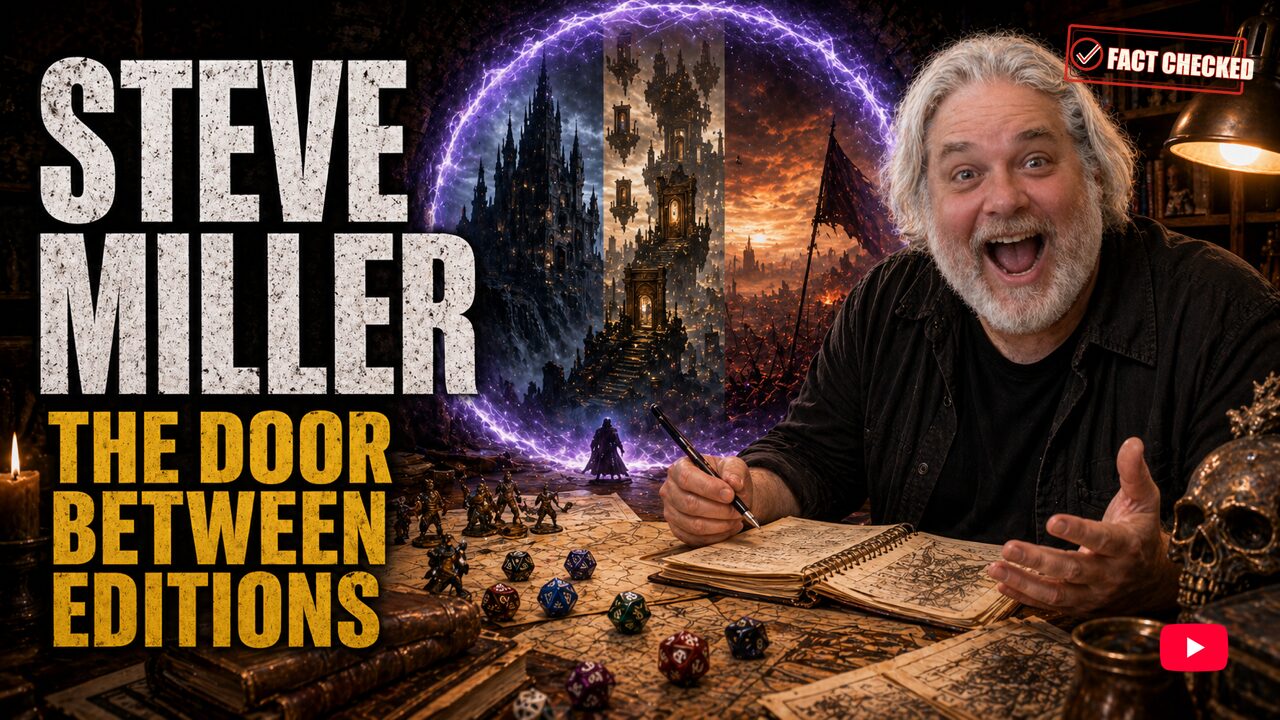
That is the strange thing about his career. AD&D Second Edition is gone. Dragonlance’s SAGA card system is gone as a living commercial engine. The early d20 moment that followed it has been replaced, revised, and archived. Even TSR, the company that brought him into professional game design, was already collapsing while he was doing some of his strongest work.
The systems moved on.
Some of Miller’s settings did not.
Ravenloft still has domains. Carnival still has Isolde. The Gentleman Caller still works because he was never just a monster to kill. Die Vecna Die! still sits at the hinge between two eras of Dungeons & Dragons, one foot in the last days of TSR branding and the other in the cosmological cleanup that made Third Edition feel like a new universe.
Miller was not a great mechanical inventor. He was not the architect of a universal engine. His design record lives mostly inside inherited systems, with stronger designers and line leads often sharing the byline. But inside those systems, he understood a particular kind of durability: a setting element that gives later writers something to keep using.
That is stewardship. Not ownership. Not invention from nothing. Stewardship.
The Writer Who Found Tsr
Miller came to games as a writer.
The public biographical trail gives him a BA in English from the University of Utah, with a creative writing emphasis. Before TSR, he worked as a television publicist and freelanced as a feature writer and entertainment critic. He had wanted to write from childhood and had tried to break into comics before the game industry opened a different door.
That door opened in a slightly sideways fashion. A fellow gamer suggested that he try writing role-playing material. Miller contacted Bruce Heard at TSR, received editing and design tests, freelanced for a few months, then wrote Tim Brown a thank-you letter. Brown later called him with a staff offer.
There is nothing mythic about that path.
That is part of why it matters. Miller was not a founding-era hobbyist inventing a new medium in a basement. He entered a mature, stressed company that needed people who could write, edit, finish, and keep product lines moving. TSR in the mid-1990s was not a stable kingdom. It was a machine with too many obligations and too little oxygen.
Miller arrived with prose instincts. He would use them in game design, sometimes beautifully, sometimes inside products whose structures were larger than his individual contribution.
Ravenloft’S Map Of Fear
Ravenloft was the place where Miller’s strengths made the most sense.
The setting already existed before him. Tracy and Laura Hickman’s original Ravenloft adventure had turned gothic horror into D&D vocabulary. The 1990 boxed set had made the Demiplane of Dread into a campaign setting. William W. Connors was the larger Ravenloft figure of Miller’s era, and any honest account of Domains of Dread has to keep Connors in the frame.
But Domains of Dread, credited to Connors and Miller, is the book that gives Miller his strongest architectural claim.
It did something Ravenloft needed. It organized fear.
The setting had always been made of trapped places: Barovia, Darkon, Falkovnia, Kartakass, and all the other nightmare countries wrapped in mist. Domains of Dread gathered those places into a more legible structure. The Core. Clusters. Islands of Terror. Pockets. It treated Ravenloft not just as a collection of spooky locations, but as a geography of punishment and obsession.
That taxonomy mattered because it gave Dungeon Masters a way to think about the setting. A domain could be part of a connected continent. It could be isolated. It could exist as a small reality bubble. The Mists were not just atmosphere. They were infrastructure.
The book also wrestled with a problem Ravenloft had always carried: time periods rubbing against each other. Gothic horror wants castles, torches, fog, noble families, muskets, plague villages, alchemical laboratories, and sometimes near-modern habits. The Cultural Level system helped classify how technologically and socially developed a domain was. It did not solve every tonal problem, but it gave the setting a tool.
That is Miller’s design shape at its clearest. He was not changing how dice worked. He was helping organize how fiction worked at the table.
Carnival And The Caller
Carnival is where the shape gets stranger.
Co-written with John W. Mangrum, the 1999 Ravenloft sourcebook followed a traveling carnival led by Isolde, an otherworldly figure hunting a charming fiend known as the Gentleman Caller. The book was not just another haunted castle. It was mobile, intimate, grotesque, and sad. The horror came from performance, deformity, longing, secrets, and the question of whether anyone in the carnival was truly free.
The Gentleman Caller is Miller’s best-known original character contribution.
He works because he is not built like a normal D&D villain. A normal villain enters the adventure as a problem to fight. The Gentleman Caller enters as a social and narrative infection. He is charming. He is useful. He leaves damage behind him. He creates consequences that other people have to live with.
That design is not primarily mechanical. It is a way of giving the Dungeon Master a recurring force who can move through campaigns without needing to appear as a final boss.
That helps explain the character’s long shelf life. In Fifth Edition Ravenloft material, the figure returns in altered form as the Caller. Isolde and her carnival also return to the modern Ravenloft frame, and The Wild Beyond the Witchlight connects its own carnival mythology to Isolde’s older story. The line between direct inheritance and later reinvention is not always clean, but the continuity is visible.
Miller built something other writers could pick up.
That is the whole case.
Die Vecna Die
Then came the end of the world.
Die Vecna Die!, co-written by Bruce R. Cordell and Steve Miller, was published in 2000 as the last product under the TSR brand. It was a 160-page adventure that moved through Greyhawk, Ravenloft, and Planescape, using Vecna as the engine for a cosmological crisis. The adventure’s conclusion helped explain why the universe would feel different in Dungeons & Dragons Third Edition.
As a design object, it is both impressive and awkward.
The ambition is enormous. A single adventure tries to stitch together three beloved settings, elevate one of D&D’s great villains, and provide an in-world explanation for an edition transition. That is not normal adventure design. That is ritual design for a product line.
The play structure is less graceful. Big event adventures often struggle because the published story needs certain things to happen. If the players wander away, refuse the obvious path, or break the intended chain, the entire premise can buckle. Die Vecna Die! carries that risk. It is remembered partly as an event, not simply as an adventure people ran cleanly from cover to cover.
Still, the event mattered.
Vecna was already important before Miller and Cordell touched him. The adventure helped keep him central at a moment when D&D was changing owners, editions, assumptions, and audience. Decades later, Vecna remains one of the few D&D villains with name recognition outside ordinary tabletop circles.
Miller did not create Vecna. He helped place Vecna at the door between worlds.
The Workhorse Years
Miller’s career was not only Ravenloft.
He worked on Dragonlance during the SAGA period, including Heroes of Defiance, which he has described as personally meaningful. That work matters because SAGA was not standard AD&D. It used cards instead of the familiar dice procedures, and it required writers to think in a different rhythm. Miller did not create the SAGA engine, but he could write for it.
He also worked on Star Wars material and later co-wrote Into the Dragon’s Lair with Sean K. Reynolds, the first Third Edition Forgotten Realms adventure. Across those years, Miller moved between gothic horror, fantasy, licensed science fiction, and edition-change D&D. That kind of range is not glamorous. It is professional muscle.
There is a reason staff designers and editors matter in a company like TSR or Wizards of the Coast. Not every assignment is a personal masterpiece. Sometimes the job is to take a property, a deadline, a system, a line requirement, and a stack of continuity constraints, then make something that functions.
Miller did that.
The point is not that every product was excellent. They were not. The point is that his strongest work shows what a writer-designer can do when asked to give inherited settings usable structure.
Nuelow And The Small Press Turn
After the corporate RPG years, Miller did not disappear.
In 2011, he began releasing digital material through NUELOW Games, eventually building a long tail of small products, fiction, comics hybrids, and role-playing material. The most memorable title from this period is ROLF!: The Rollplaying Game of Big Dumb Fighters, a deliberately silly, stripped-down comedy game.
That late-career turn is revealing.
Freed from the burden of maintaining Ravenloft or Dragonlance tone, Miller went smaller, cheaper, stranger, and more comic. NUELOW does not make the same historical argument that Domains of Dread or Carnival does. It does not lift him into the category of major independent system designer. But it shows a working creator choosing output and freedom over prestige.
There is something likable about that.
A designer who spent years inside other people’s intellectual property eventually built a little shop where he could publish what amused him.
The Honest Assessment
Steve Miller scores 20 because the work is real, durable, and bounded.
Invention is a 5. His original contributions are mostly narrative: the Gentleman Caller, the structure around Carnival, the multi-setting edition-bridge event of Die Vecna Die!, and the way Domains of Dread made Ravenloft easier to navigate. These are meaningful ideas. They influenced a niche. They are not new game engines.
Architecture is a 5. Domains of Dread and Carnival have real structural strength. The Core, Clusters, Islands, and Pockets taxonomy gave Ravenloft useful shape. Carnival gave Ravenloft a traveling horror environment that later writers could revive. But the best work is co-designed, and the frameworks propagated mostly inside D&D’s own continuity rather than across the wider field.
Mastery is a 6. Miller had a sustained professional career, strong peak years, and later small-press persistence. He could work across gothic horror, fantasy, science fiction, licensed material, and comedy. The limitation is consistency and attribution. His best-known achievements are collaborative, and the later NUELOW period is more prolific than landmark.
The adjustment points come from longevity, full-time professional game work, genre range, and design propagation inside D&D’s settings.
That is a clean 20.
What Remains
The Domains of Dread remain one of D&D’s most useful horror ideas: places shaped by punishment, obsession, and story logic rather than ordinary geography. Carnival remains one of Ravenloft’s most distinctive creations, and Isolde’s shadow stretches into Fifth Edition. The Gentleman Caller remains the kind of villain who survives edition changes because his danger is not contained in his stat block.
That is Miller’s real pattern.
He designed inside other people’s systems, but the things he built inside them did not all stay trapped there. Characters moved. Settings returned. Taxonomies endured. Later writers found handles on his work and used them.
That is not the same as inventing the game.
It is still design.
Where To Find Him
Find Steve Miller in the old Ravenloft books: Domains of Dread, Carnival, The Doomgrinder, Servants of Darkness, and the strange connective tissue of Die Vecna Die! Find him in Dragonlance’s SAGA-era material and in early d20 products. Find the later Miller through NUELOW Games, where the serious gothic writer turns around and publishes deliberately ridiculous fights under the banner of ROLF!
The settings outlived the rules.
That is the line that matters.
20 points. 2000. The setting steward whose characters outlived the mechanics.
He did not build the house. He kept rooms inside it lit long after the wiring changed.
Fact Check Notes
Publication notes
This site is AI-assisted and human-reviewed. We use artificial intelligence to help gather research, organize source material, and draft profile content. Human editors then read, revise, and check each profile before it goes live. Most profiles are built through deep AI research and two separate rounds of fact-checking.
Leave a Reply
You must be logged in to post a comment.