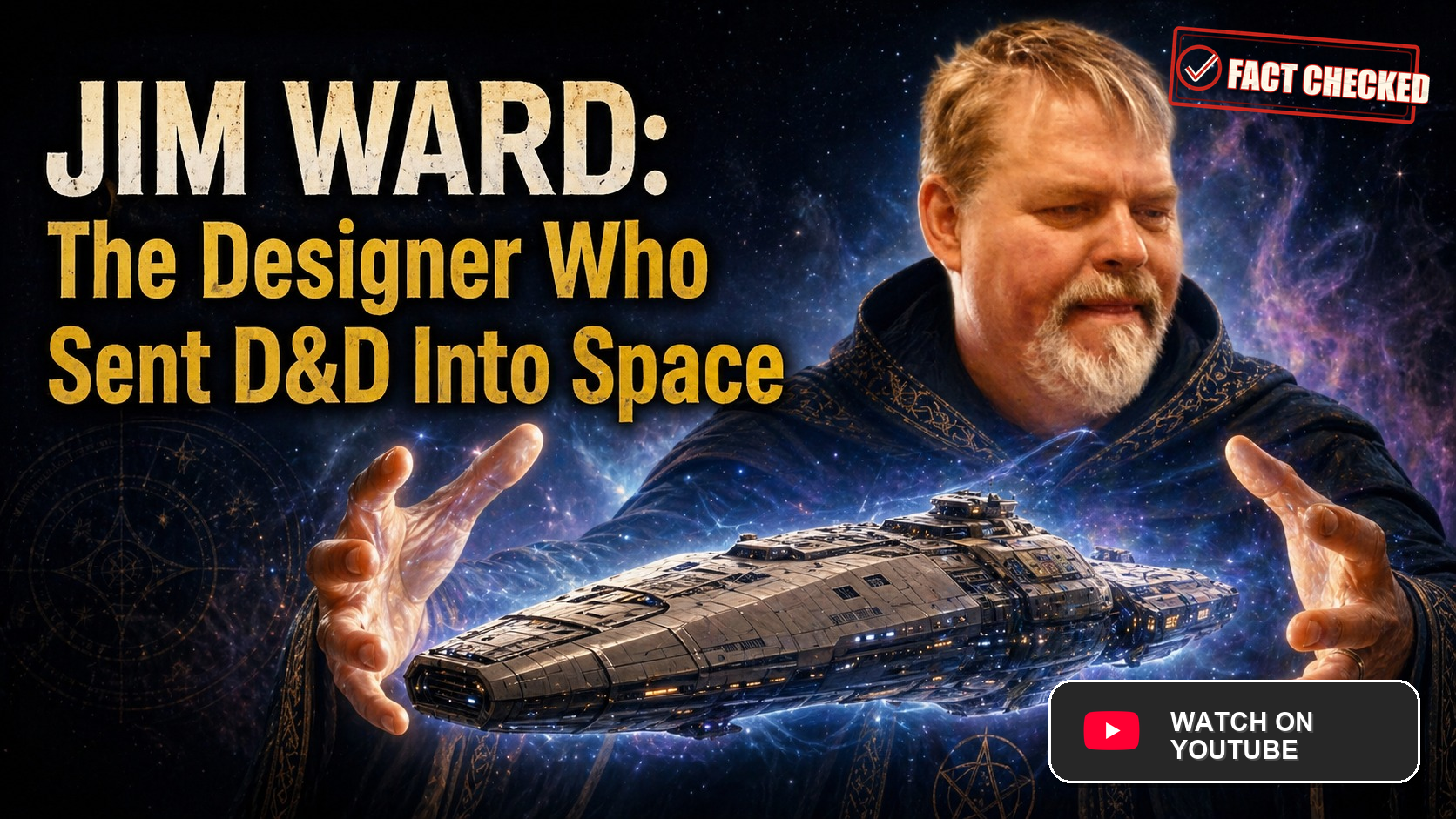
Jim Ward looked at Dungeons and Dragons and saw a machine that could travel.
That was not obvious in 1976. Role-playing games were still young enough that people were arguing over what they were. D&D had castles, swords, gods, monsters, treasure, traps, and the strange intimacy of a referee describing a world while players tried to survive it. Plenty of people were still figuring out how to make that one idea work.
Ward asked a different question. What if the dungeon was not a dungeon at all? What if it was a damaged starship, miles long, drifting through space, filled with descendants who had forgotten they were aboard a ship? What if the treasure was not a magic sword, but a piece of technology nobody quite understood? What if the monsters were mutants, robots, plants, animals, and people changed by radiation?
That question became Metamorphosis Alpha, TSR’s first science-fiction role-playing game and one of the first games to prove that role-playing could leave medieval fantasy behind. Ward did not just add ray guns to D&D. He changed the shape of the adventure.
The Wisconsin Pipeline
James Michael Ward III was born in Elkhorn, Wisconsin, in 1951, close enough to Lake Geneva that the early history of D&D was not a faraway legend. It was local gravity.
He studied English and history at the University of Wisconsin-Whitewater, then taught high school in Patch Grove. Before game design became an industry, Ward was already doing the work that would serve him later: explaining complex ideas, building context, organizing information, and making old stories feel usable to a room full of people who hadn’t asked for them yet.
Through the International Federation of Wargamers, he entered Gary Gygax’s circle and became one of the early players in the Greyhawk campaign. His wizard, remembered through the name Drawmij, became one of those odd little fossils still embedded in D&D lore. Drawmij is Jim Ward reversed. Drawmij’s Instant Summons carried the joke forward into the spell lists.
It is a small detail, but it matters. Ward was there when the line between player, designer, editor, and mythmaker was still soft. The people at the table were also helping invent the table. Nobody had fully agreed on what the table was supposed to be yet, and that uncertainty was exactly where Ward thrived.
The Starship Warden
Metamorphosis Alpha was built around the Starship Warden, a gigantic generation ship whose inhabitants had lost the truth of their world. The ship had become a wilderness. Its decks were territories. Its machines were mysteries. Its life forms were damaged, altered, dangerous, and often tragic.
The game kept the exploratory pleasure of D&D but changed the reader’s mental furniture. A door might not hide a goblin. It might seal off a radiation zone. A treasure might not be gold. It might be a card, a weapon, a device, or a working piece of a broken civilization. Players did not only ask whether they could defeat something. They had to ask what they were even looking at.
That was a major shift. Fantasy games had trained players to recognize the language of myth. Ward asked them to read the language of technology as if it were magic, to treat a broken machine with the same reverence and fear they had learned to give a cursed sword. In a hobby that would later produce decades of science-fantasy, post-apocalyptic survival, mutant powers, megadungeons, space hulks, and lost-civilization adventures, Metamorphosis Alpha looks less like a side road and more like an early map.
It was strange, dangerous, uneven, and alive. That combination was part of its force.
Mutants After The End
Two years later, Ward and Gary Jaquet expanded the idea outward with Gamma World.
If Metamorphosis Alpha made the starship into the dungeon, Gamma World made the ruined Earth into the campaign. It took mutation, forgotten technology, faction play, and survival after collapse and gave them a bright, bizarre, playable form. The game is widely credited as the first post-apocalyptic role-playing game, and its DNA is easy to spot in later tabletop and video game design.
Gamma World was not grim in the modern prestige-drama sense. It could be funny, cruel, absurd, deadly, and wildly inventive from one page to the next. That combination became part of its charm. A rabbit might be a person. A toaster might be more valuable than a sword. A broken artifact from the old world could decide the fate of a settlement, if anyone survived long enough to understand how it worked.
Ward had a gift for turning uncertainty into play. His best settings are not clean worlds. They are broken systems full of clues, and the joy comes from being unqualified to understand what you’ve found.
The Gods On The Table
Ward’s work on D&D itself was just as important, though it moved in a different direction.
With Robert J. Kuntz, he co-authored Gods, Demi-Gods and Heroes for original D&D and later Deities and Demigods for Advanced Dungeons and Dragons. Those books did something bold and a little dangerous. They took gods, mythic beings, and legendary powers and gave them game statistics.
Once a god has armor class and hit points, the game has changed.
That does not mean every table was supposed to go murder Zeus on Saturday night. It means the rules had crossed a threshold. Mythology was no longer only background flavor. It could be encountered, measured, resisted, negotiated with, or challenged. For high-level campaigns, that opened a new scale of play.
Deities and Demigods also became one of the great collector stories in RPG history because early printings included Cthulhu and Elric material that later disappeared. The usual rumor says TSR stole the material and got sued. The better-supported version is more complicated. Ward had pursued permission, Chaosium held overlapping RPG rights, and the matter was handled through publisher negotiation rather than the courtroom legend fans often repeat. That is a good Ward story. The myth is flashier. The real version tells you more about how messy the young industry actually was.
The Manager In The Storm
Ward was not only a designer. He became a senior creative executive at TSR, often described as a vice president overseeing creative services during the AD&D 2nd Edition era. The exact title shifts across sources, so the larger point is safer than any one business card: he was one of the people responsible for creative direction when D&D was no longer just a hobby product. It was a major brand under pressure, and pressure was arriving from directions nobody had planned for.
That period gave Ward one of his more controversial legacies. During the Satanic Panic, TSR faced parents, moral campaigners, distributors, and public suspicion. Ward wrote and spoke about what became known as "Angry Mother Syndrome," the idea that the game had to avoid triggering the fear of angry parents if it wanted to keep reaching stores and homes.
That thinking affected AD&D 2nd Edition. Demons and devils were renamed. Assassins and half-orcs disappeared from the Player’s Handbook. The game’s public face became cleaner, less occult, and less eager to provoke.
Some players never forgave those choices. Others understood the business reality. Both reactions make sense. Ward’s position sat at the uncomfortable crossing of imagination, commerce, and cultural panic. He was trying to keep a weird game alive in a country that had started to treat weirdness as evidence. There is no clean version of that job. You make the choices that keep the doors open, and you carry what they cost.
That is not as romantic as designing mutants on a starship. It may have been just as important.
High Power, High Danger
Ward’s own taste at the table leaned big.
He is often linked to "Monty Haul" play, a nickname aimed at campaigns where treasure and power flowed freely. But Ward’s approach was not simply handing players magic items until the game broke. His idea, often discussed as game equilibrium, was that power could escalate on both sides of the screen. If the players became frighteningly strong, the world became frightening too.
That argument says something real about him. Ward did not seem afraid of excess. He wanted players to feel the voltage of impossible tools, huge risks, and strange rewards. The answer to power was not always scarcity. Sometimes the answer was a bigger room, a harder enemy, and a referee willing to let the whole machine run hot.
You can hear echoes of that philosophy in later high-fantasy D&D, in games that let characters become mythic, and in tables where the fun comes from watching players solve problems with too much power instead of too little. Ward understood that some players are not looking for constraint. They are looking for a world that can absorb everything they bring.
After Tsr
Ward left TSR in 1996 after being ordered to lay off roughly thirty editors and designers during the company’s financial crisis. Instead of carrying out the cuts, he resigned.
That story has endured because it fits the way many people remember him: loyal to the people who made the work, not just the company that sold it. It is the kind of decision that does not show up on a resume. It shows up in how people talk about you after you are gone.
After TSR, Ward kept moving. He worked in collectible card games, including the Dragon Ball Z CCG, and contributed to other licensed card game projects. He became President of Fast Forward Entertainment during the d20 boom. He wrote fiction, worked with Troll Lord Games, helped form Eldritch Enterprises with Tim Kask, Frank Mentzer, and Christopher Clark, and kept returning to Metamorphosis Alpha in new forms.
His later career was not as cleanly iconic as his TSR work. Few careers are. It was a working designer’s path: licenses, companies, old friends, new editions, health trouble, convention tables, small publishers, and the long shadow of the first things he made. He kept showing up. That is its own kind of stubbornness, and it is worth naming.
Jim Ward died on March 18, 2024, at age 72.
What He Actually Built
Jim Ward’s legacy is not one system or one product line. It is a habit of expansion.
He helped early D&D absorb mythology. He pushed role-playing into science fiction with Metamorphosis Alpha. He helped establish the post-apocalyptic RPG with Gamma World. He argued for high-powered play. He managed creative work at TSR when D&D had become both a game and a public target. He carried old-school design into later companies and kept creating after the industry had changed around him.
He was not the sole architect of D&D. He did not need to be.
Ward’s importance is that he kept finding new rooms inside the house. A dungeon could be a starship. A monster could be a mutant plant. A god could become a game statistic. A ruined future could be funny, deadly, and playable. A fantasy publisher could become a company wrestling with parents, retailers, licenses, novels, cards, and public fear. He moved through all of it and left something behind at each stop.
That range is the point.
Where To Find His Work
Start with Metamorphosis Alpha and Gamma World. They show Ward at his clearest: strange settings, dangerous discovery, and rules built around a world that has gone wrong in interesting ways.
For D&D, look at Deities and Demigods, Greyhawk Adventures, and the old lore around Drawmij. For the business and design history, Shannon Appelcline’s Designers and Dragons material, Ward’s own interviews and forum posts, and the posthumous research around his career give useful context.
His work also continues through the people and companies preserving it. Para Bellum Consulting acquired the Metamorphosis Alpha rights from Ward’s estate, and Catalyst Game Labs has announced a 50th anniversary edition. That matters.
The Starship Warden is still moving.
Jim Ward helped teach the hobby that role-playing was not a single genre. It was a machine. He sent it into space, and the trajectory has not stopped.
Fact Check Notes
Publication notes
This site is AI-assisted and human-reviewed. We use artificial intelligence to help gather research, organize source material, and draft profile content. Human editors then read, revise, and check each profile before it goes live. Most profiles are built through deep AI research and two separate rounds of fact-checking.
Leave a Reply
You must be logged in to post a comment.