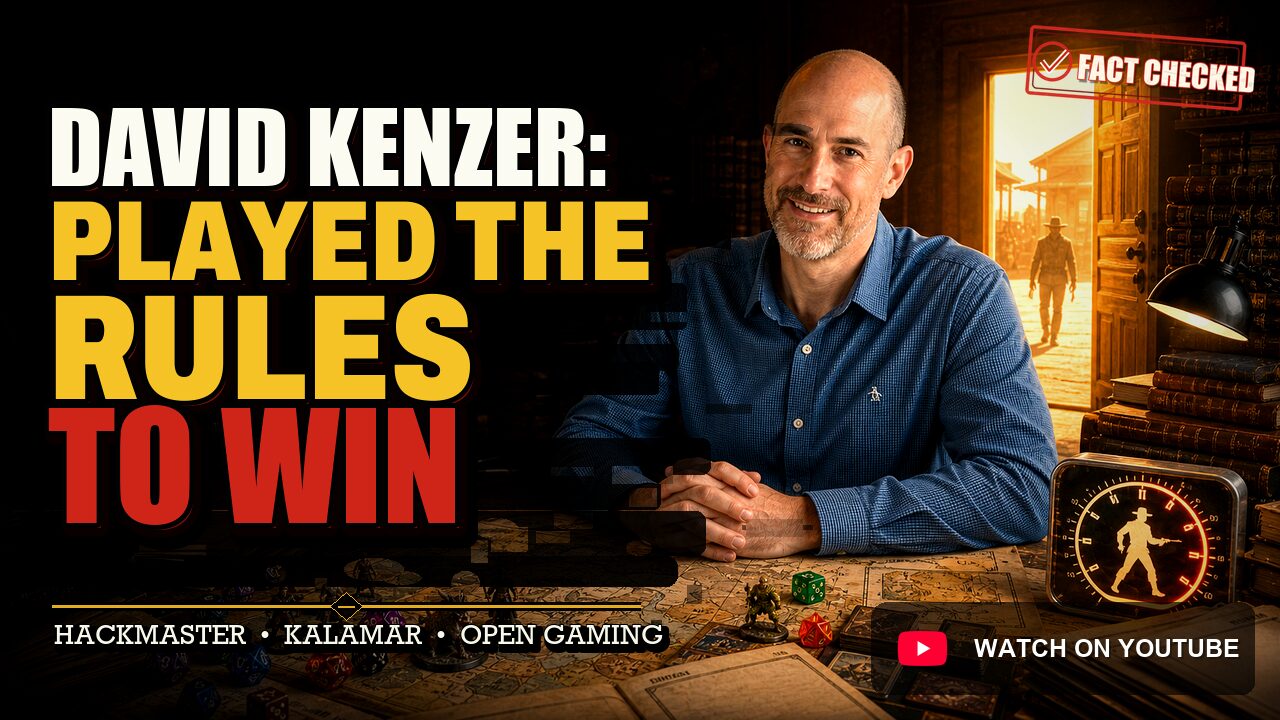
Most tabletop careers begin with a love story.
This one begins with a threat letter.
Not because David Kenzer wanted a fight, but because he understood what the hobby hides in plain sight. A game is not only dice and imagination. It is also trademark law, licensing language, contracts, disclaimers, compatibility wording, and the quiet border that decides what fans are allowed to build without getting crushed.
Kenzer did not only make games. He watched the legal structures around the games. He looked at the rulebook that sits outside the rulebook and asked where the line actually was.
Then he played close to it.
Not recklessly. Precisely.
The Company That Kept The Placeholder Name
Kenzer & Company formed in the early 1990s the way many real tabletop companies form, around a regular table.
Kenzer was in law school, playing Advanced Dungeons & Dragons with friends who included Brian Jelke and Steve Johansson. They wanted to publish material for the kind of game they were actually playing. Kenzer handled the paperwork, used Kenzer & Company as a temporary name, and waited for the group to choose something better.
They never did.
So the placeholder became the company.
That accident fits the rest of the story. Kenzer & Company can look casual from the outside. Underneath, it tends to be reading harder than everyone else. Not just the monster stats, but the ownership language. Not just the spell list, but the permission structure.
Their early proof was Kingdoms of Kalamar.
Kalamar was not built as disposable fantasy wallpaper. It cared about maps, borders, politics, geography, and internal logic. It also carried the company’s posture from the start. Compatible publishing could exist if it avoided copying protected text, used careful language, and did not pretend to be official.
That was not only a product choice.
It was a way of staying alive.
The Comic That Became The Engine
Knights of the Dinner Table changed Kenzer & Company from a small publisher into something stranger and more durable.
Jolly Blackburn’s comic worked because gamers recognized themselves in it. The strip was the table after the fantasy happened. Arguments about line of sight. Players negotiating every inch. Game Masters trying to keep order. Friends who loved the game enough to break it, fix it, and break it again.
As Kenzer & Company built around the comic, it became a kind of engine. The fictional tables and the real tables started feeding each other. The joke stayed sharp because it kept listening to real play.
The comic did not just make people laugh. It created an audience that understood a pitch before it arrived. It also created fictional games that could be turned into real ones.
HackMaster was the great example, a ridiculous, punitive, overbuilt fantasy RPG inside the comic that became an actual published game.
The Settlement That Became A Game
The story of HackMaster is one of the great strange turns in tabletop publishing.
In 1999, Wizards of the Coast released the Dragon Magazine Archive on CD-ROM. The archive collected old issues of Dragon magazine, including material whose original publication rights did not automatically include electronic redistribution. Knights of the Dinner Table strips were part of that problem.
Kenzer was not just a publisher whose work had been swept into a digital archive. He was an intellectual property lawyer.
The dispute ended in a settlement that produced something more useful than money. It produced a license arrangement that let Kenzer & Company publish a game that drew on older Advanced Dungeons & Dragons material. That arrangement became HackMaster 4th Edition.
The name itself was a joke. There had been no real first three editions. In the comic, the imaginary history was part of the fun. On the shelf, that fake continuity became a real product line.
HackMaster 4th Edition carried parody in its bones, but it was not only parody. Under the jokes, the charts, the brutal table culture, and the old-school attitude, it was a playable fantasy RPG for people who missed the dangerous weight of earlier dungeon play.
Kenzer’s signature move is right there.
He found a constraint and turned it into identity.
When Parody Grew Teeth
HackMaster 4th Edition could have been a novelty. It became more than that because it understood the old game it was exaggerating.
The books were huge. Honor mattered. The quirks stayed in. It kept sharp edges everywhere. It leaned into the part of tabletop culture that wanted danger, calculation, and consequences that did not apologize.
The joke was real because the game was real.
Before the phrase Old School Renaissance was widely used as a banner, HackMaster showed there was an audience for older, heavier, more demanding fantasy play. It hinted at something the hobby was about to rediscover. Some players did not want the safety rails. They wanted the weight.
Kenzer did not create the entire old-school revival by himself. No one did.
But HackMaster helped show that the past was not dead stock. It was a living design resource.
As the licensed era ran its course, Kenzer & Company had to decide what HackMaster really was, a licensed joke, or a system strong enough to stand on its own.
They chose the harder answer.
The System That Stopped Waiting For Turns
HackMaster Basic and HackMaster 5th Edition moved away from the licensed parody shell and into original design territory.
The result was still old-school in spirit, but it was not just a cleaned-up clone. It attacked some of fantasy gaming’s oldest abstractions directly.
The most important move was time.
Traditional RPG combat often asks players to wait for their turn, act inside a neat abstract round, then wait again. HackMaster’s count-up system treats battle as a moving clock. The Game Master counts upward. Actions take seconds. Weapon speed matters. A dagger and a halberd do not occupy the same slice of time.
That changes how combat feels.
Turns stop being the frame. Timing becomes the frame. You start thinking in reach, recovery, exposure, and interruption. A fight becomes less like a board queue and more like a dangerous room where everyone is moving at once.
HackMaster also uses active defense. A defender is not only a static number waiting to be beaten. The defender rolls, blocks, dodges, and participates in the moment. Armor absorbs damage instead of simply making a character harder to touch. Heavy protection can save your life while still slowing your body.
This was not rules weight for its own sake.
At its best, it was physical logic turned into play.
The Shot Clock
Aces & Eights: Shattered Frontier carried the same instinct into the Western.
Aces & Eights is credited to Jolly R. Blackburn, Brian Jelke, Steve Johansson, Dave Kenzer, Jennifer Kenzer, and Mark Plemmons. It won the 2007 Origins Award for Roleplaying Game of the Year and earned a Silver ENnie for Best Game.
Its most famous design object is the Shot Clock.
In many RPG gunfights, a shot either hits or misses. The table knows the outcome, but it does not feel it. Aces & Eights makes the shot visible.
The player places a transparent overlay over a silhouette and chooses a point of aim. A die roll and a playing card show how far the bullet drifts and in what direction. The miss does not vanish. It travels. It can hit the shoulder instead of the heart. It can cut across the wrong line. It can make the table see exactly how close disaster came.
That is Kenzer & Company’s mechanical philosophy in a single object.
Do not hide the consequence.
Put it where the table can see it.
The 4e Line In The Sand
Kenzer’s legal instincts surfaced again during the Dungeons & Dragons 4th Edition era.
Wizards of the Coast introduced the Game System License, a more restrictive framework than the earlier Open Game License. Many third-party publishers hesitated, objected, or walked away from 4e-compatible publishing under those terms.
Kenzer & Company took a different approach.
It released Kingdoms of Kalamar material for the new edition without signing the GSL, relying instead on careful compatibility language and the trademark doctrine generally known as nominative fair use. The point was not that a courtroom had blessed every possible third-party strategy. The point was that Kenzer & Company publicly modeled a lawyer-publisher argument, that compatibility publishing did not have to exist only inside a license written by the dominant brand owner.
For some creators who lived in the margins of the big brands, that argument mattered. It did not promise safety. It offered a way to think.
For a community built on shared systems, house rules, expansions, settings, and compatible tools, the distinction is not academic.
It is creative oxygen.
What He Actually Built
David Kenzer did not invent independent RPG publishing. He did not single-handedly create the Old School Renaissance. He did not end corporate control over tabletop licenses. He did not make HackMaster, Aces & Eights, Kingdoms of Kalamar, or Knights of the Dinner Table alone.
What he built was a working model of the lawyer at the game table.
He built a company that understood both the joke and the contract. He helped turn a comic about gamers into a publishing engine. He helped make a fake game real, then helped make that real game stand as its own system. He used compatibility law as a tool, not a slogan. He treated mechanical design and legal design as related disciplines. Both are about finding what the rules actually permit, then making the strongest move inside them.
That is why Kenzer’s influence is easy to miss if you only look for the flashiest designer credit.
His work is structural.
He kept doors from closing.
Where To Find Him
David Kenzer remains publicly active in both halves of the story.
HERE Technologies lists him as Senior Vice President, Chief Legal & Compliance Officer, responsible for global legal and compliance matters. HERE biography material also identifies him as a former senior intellectual property attorney at Motorola, former President and current board member of Kenzer & Company, and a Northwestern University School of Law graduate.
Kenzer & Company remains active as well, with ongoing public updates. Knights of the Dinner Table, Aces & Eights, Kingdoms of Kalamar, and HackMaster still form the spine of the catalog. Recent KenzerCo updates have discussed HackMaster 25th Anniversary Edition development.
The old joke is still being worked on.
The rules are still being read.
And David Kenzer’s best lesson still holds. Sometimes the most important person at the table is the one who knows which rules everyone else forgot to check.
Fact Check Notes
Publication notes
This site is AI-assisted and human-reviewed. We use artificial intelligence to help gather research, organize source material, and draft profile content. Human editors then read, revise, and check each profile before it goes live. Most profiles are built through deep AI research and two separate rounds of fact-checking.
Leave a Reply
You must be logged in to post a comment.