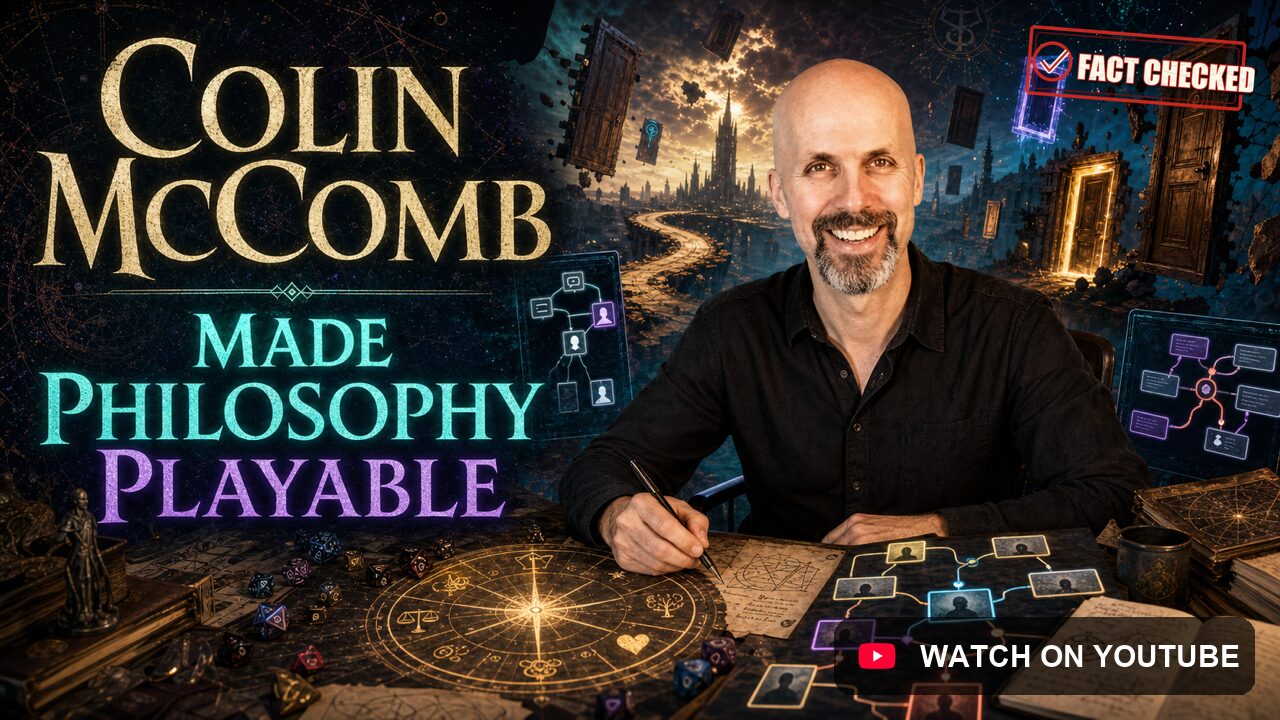
What can change the nature of a man? What does one life matter? What kind of person are you if every moral decision comes from a worldview, not a clean little good-or-evil switch?
Those questions did not stay in essays. McComb put them in boxed sets, planar factions, haunted cities, post-apocalyptic towns, companion dialogue, Australian wastelands, and computer RPG quest structures. He is one of the cleanest bridges between the philosophical weirdness of 1990s tabletop role-playing and the modern revival of dense, reactive CRPGs.
He did not invent that whole tradition by himself. No one did. Planescape was a coalition. Planescape: Torment was built by a team. Birthright, Fallout 2, Wasteland, Numenera, and Broken Roads all belong to larger studios and many hands.
But McComb kept showing up where role-playing games wanted to become stranger, more verbal, more ethically loaded, and less satisfied with simple hero fantasy.
That is his lane. Philosophy with dice. Philosophy in dialogue trees. Then consequences that do not politely reset.
It is also a kind of work that refuses to let the player hide behind the rules. In a McComb-shaped game, the mechanics are not a moral alibi. You still chose. The world still remembers.
The Philosophy Major At Tsr
McComb studied philosophy at Lake Forest College, which is one of those details that sounds like background until you read the work.
He has said that philosophy trained him to think in more than one direction at once, and that turns out to be a useful game-design skill. A philosopher learns to distrust the first answer. A game designer has to do the same thing, because players will always find the door you forgot to lock, the argument you forgot to test, and the moral corner you thought was decorative.
After college, McComb went to TSR, the company that owned Dungeons & Dragons. His early credits ran through the busy machinery of second-edition AD&D: Ravenloft, Dragonlance, Thunder Rift, Dragon Mountain, The Complete Book of Elves, Birthright, and Planescape.
Some of those products were ordinary TSR work. Some became stranger. Some became infamous. The Complete Book of Elves followed him around for years because fans remembered its excesses, and McComb has had enough humor about it to treat the book as part of his public mythology.
The more important lesson from the TSR years is that he learned how to write inside large shared systems. That is harder than it looks. You are not only making a cool idea. You are fitting that idea into rules, lore, schedules, art direction, and a brand that already has players arguing about what it is supposed to mean.
That training mattered later.
Birthright And Power
Birthright, built by a TSR team that included McComb and Rich Baker, was one of his strongest tabletop statements.
D&D had always had kings, bloodlines, armies, maps, and castles. Birthright made rulership into play. Characters were not only adventurers clearing ruins. They could govern domains, manage political pressure, inherit divine bloodlines, wage wars, and make decisions at the scale of provinces and institutions.
That shift matters because it changes what fantasy is about. A dungeon asks whether you can survive the room. A domain asks whether you can live with the consequences of power.
McComb’s later career keeps returning to that pressure. What happens when power is not just a spell slot or a sword bonus? What happens when power is a duty, a faction, a memory, a town, a reputation, a philosophy, or a legacy other people have to survive?
Birthright did not become the dominant face of D&D, but it proved that D&D could carry political play without abandoning adventure. It also showed McComb working in a mode that suited him: turning abstract ideas into playable obligations.
Planescape And Belief
Planescape is where McComb’s sensibility becomes easiest to see.
The setting had already been launched by David "Zeb" Cook, with Tony DiTerlizzi giving it a visual language that looked nothing like standard fantasy. But after launch, Planescape needed writers and designers who could make its metaphysics playable across book after book. McComb became one of those people.
His Planescape work included projects such as The Well of Worlds, Planes of Law, Planes of Conflict, On Hallowed Ground, Hellbound: The Blood War, Faces of Evil: The Fiends, and The Great Modron March. That is not a small side credit. That is a lot of the setting’s moral weather.
Planescape was built on a wild premise: belief shapes reality. Philosophies become factions. Afterlives become geography. Ethics, law, chaos, evil, mercy, cruelty, and obsession are not only ideas. They are places you can visit and survive badly.
That premise hits harder than it sounds when you play it straight. If belief is real in the physics of the world, then you do not get to call your worldview a private hobby. It becomes architecture. Then it becomes policy. Finally it becomes what happens to other people when you walk into a room.
McComb fit that perfectly. His writing leaned toward the Lower Planes, fiends, dread, authoritarian systems, and the parts of belief that curdle into control. He was not using philosophy as decoration. He was using it as pressure.
That is why Planescape still feels unusual. It does not just ask players to fight monsters from heaven and hell. It asks what kind of universe would make those monsters think they are right.
The Torment Bridge
When McComb moved from TSR to Interplay and Black Isle, he carried that tabletop training into computer RPGs.
He worked on Fallout 2, including dialogue and area work tied in later interviews to Broken Hills and San Francisco. That job mattered because Fallout was already doing something tabletop-like on a computer: letting places feel argumentative, messy, funny, cruel, and reactive.
Then came Planescape: Torment.
Chris Avellone was the central creative force, and the game is not McComb’s solo authorship. The honest version is better anyway. Planescape: Torment was the meeting of a strange tabletop setting, a studio full of sharp designers, and a writing team willing to bet that players would read, think, and care.
McComb helped that bet land. He understood Planescape from the TSR side. He understood that Sigil was not just a city with odd architecture. It was a machine for making belief uncomfortable. He understood that factions should not feel like clubs with uniforms. They needed arguments, wounds, and reasons to keep existing.
Planescape: Torment became one of the great examples of the literary CRPG. Not because it had a lot of text, although it did. Text alone is cheap. The game mattered because the text was tied to identity, memory, regret, bodies, companions, and choices that made the player ask whether the protagonist’s life had been a catastrophe for everyone else.
That question lands because it is not abstract. It is personal. It turns into the kind of uncomfortable inventory you do not want to open: the people you hurt by accident, the people you hurt on purpose, and the stories you told yourself so you could sleep anyway.
That is McComb’s world again: a metaphysical question with a user interface.
The Return Of Torment
After Black Isle, McComb did not disappear. He wrote, freelanced, worked in and around games, and eventually re-entered the big CRPG conversation through inXile.
Wasteland 2 brought him back into post-apocalyptic area design and writing. Torment: Tides of Numenera put him in a more visible role as creative lead and lead writer. That game could not simply copy Planescape: Torment. It had to prove that Torment was a method rather than a logo.
In public commentary, McComb has described that method in unusually direct terms. A Torment game needs a deep story, a strange world, a personal narrative, and meaningful reactivity. It also needs a central question. For Planescape: Torment, the question was what can change the nature of a man. For Tides of Numenera, it was what does one life matter.
That is a useful design lesson. A game can have lore for days and still lack a center. McComb tends to look for the center first. Then the companions, factions, locations, and choices orbit it.
Tides of Numenera did not replace the original Torment in public memory. That was never likely. But it is an important McComb project because it makes his design philosophy explicit: worldbuilding is strongest when it keeps returning to a wound.
Broken Roads And Moral Shape
Broken Roads continued that pattern from another angle.
Drop Bear Bytes brought McComb on as creative lead for a post-apocalyptic Australian RPG built around a Moral Compass system. The interesting part was not just the Australian setting, although that gave the game a texture different from the usual American wasteland. The real McComb-shaped idea was that moral choice should not behave like a tidy saint-or-monster meter.
Broken Roads tried to frame moral decisions through philosophical positions. Characters were not only choosing nice or cruel options. They were leaning into ways of seeing the world.
That is exactly the sort of design problem McComb keeps returning to. How do you make belief visible? How do you turn ethics into something more than a reward track? And how do you let a player inhabit a worldview and then feel the cost of it in play?
Most games want morality to be a meter. McComb keeps circling a harsher idea: morality is a shape you take. It determines what you notice, what you excuse, what you call necessary, and what you call someone else’s fault.
The game’s reception was mixed, and that belongs in the story. Ambitious morality systems are hard. Text-rich RPGs can overburden pacing. A fascinating design idea does not automatically solve every production problem.
Still, Broken Roads belongs in McComb’s legacy because it shows him still trying to make philosophy operational. Not quoted. Not gestured at. Operational.
What He Actually Built
McComb did not create Planescape alone. He did not create Planescape: Torment alone. He did not invent the philosophical RPG.
What he built was a body of work that kept proving philosophical play could be concrete.
In Birthright, philosophy becomes rulership and inheritance. In Planescape, belief becomes geography. In Planescape: Torment, identity becomes a mystery the player has to inhabit. In Tides of Numenera, legacy becomes the central wound. In Broken Roads, morality becomes a visible structure. Even in his post-apocalyptic work, the interesting question is rarely only who survives. It is what survival turns people into.
That is why his career matters beyond a credit list. McComb’s best work does not treat strange settings as wallpaper. It treats them as arguments players can walk through.
There is a limit to that approach. It can become word-heavy. It asks patience from the table or player. It depends on collaborators, editors, interface design, production discipline, and a willingness to let ideas become playable rather than merely clever.
But when it works, it gives role-playing games one of their highest forms: not fiction you consume, and not philosophy you read, but a choice you make while the world pushes back.
Where To Find Him
McComb remains publicly active through his own website, his fiction and game bibliography, 3lb Games, and recent game work.
His official site collects his tabletop, video game, and writing credits. 3lb Games, the XR studio he co-runs, continues to point toward VR and mixed-reality work. Broken Roads is available as his most recent major CRPG creative-lead credit, and public event listings in 2025 listed him teaching craft, including character design.
That is the right current shape for him: not trapped in nostalgia, but still chasing form. Tabletop books, computer RPGs, XR spaces, fiction, talks. Different doors. Same old question behind them.
What does a choice mean when the world remembers it?
Colin McComb made philosophy playable by refusing to leave it in the lecture hall. He put it in the planes, in the wasteland, in the body, in the dialogue box, and in the player’s hands.
Fact Check Notes
Publication notes
This site is AI-assisted and human-reviewed. We use artificial intelligence to help gather research, organize source material, and draft profile content. Human editors then read, revise, and check each profile before it goes live. Most profiles are built through deep AI research and two separate rounds of fact-checking.
Leave a Reply
You must be logged in to post a comment.