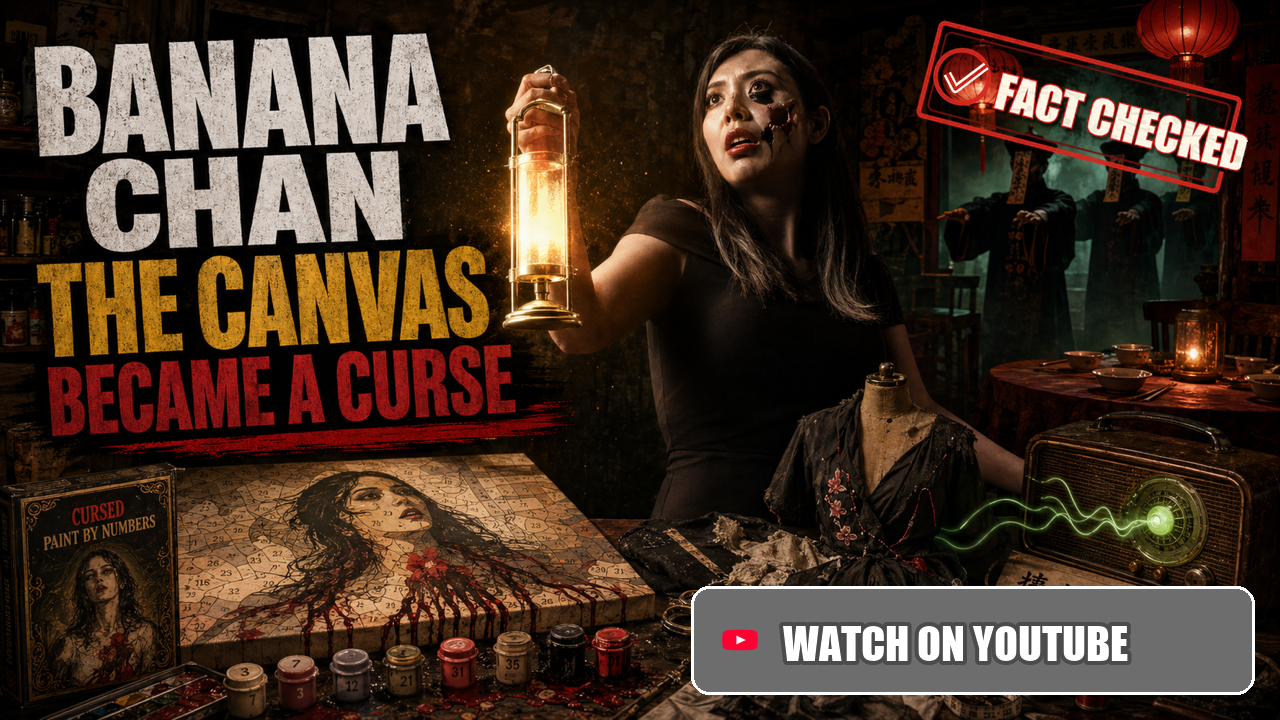
Banana Chan makes games where the object in your hand starts looking back.
The painting is not just a prop. The fabric is not just a craft supply. The radio broadcast is not just atmosphere. The family restaurant is not only a setting. In Chan’s work, the thing you make, protect, perform, or inherit becomes the place where the horror enters.
That is the signature.
The monster is rarely just outside the door. It is in the act of making. It is in the pressure to perform culture correctly. It is in the artist’s bargain. It is in the family business. It is in the late-night voice coming through the speaker while the player realizes listening is already participation.
Chan’s games do not treat horror as a costume thrown over mechanics.
They make the mechanic carry the curse.
That is part of why the work stands out in modern tabletop design. Chan moves comfortably between indie RPGs, solo games, licensed board games, Dungeons & Dragons writing, Pathfinder work, Dune, and horror experiments, but the personal work keeps returning to the same uncomfortable question:
What did making this cost you?
The Restaurant After Dark
Jiangshi: Blood in the Banquet Hall is the game that brought Chan’s work to a wider audience.
Co-designed with Sen-Foong Lim, Jiangshi tells the story of a Chinese immigrant family running a restaurant in 1920s Chinatown while facing supernatural danger after dark. The pitch has often been summarized as a family restaurant story with hopping vampires, and that contrast is part of the appeal. By day, the family works. By night, the dead come.
The smart part is that neither half is disposable.
The restaurant is not downtime between monster scenes. It is the heart of the pressure. Customers, family roles, money, exhaustion, racism, generational strain, public face, private fear, and survival all push into the game before the vampires ever arrive. The jiangshi matter because they enter a world that already has weight.
That is a different kind of horror design.
Many games make the supernatural the main event. Jiangshi makes the supernatural share the room with work, family, food, immigration, cultural expectation, and the constant labor of staying open in a country that does not make survival easy.
The game also treats cultural specificity as part of the rules infrastructure.
Chan and Lim did not simply add Chinese folklore to a generic horror chassis. The book includes guidance for portraying Chinese and Chinese-American family life with care, especially for players who do not share that background. That matters because culture in a game is not only lore. It shapes what counts as pressure, what counts as respect, what counts as shame, what counts as family duty, and what kinds of mistakes hurt the table.
Jiangshi understands that.
It teaches players how to approach its cultural frame the way other games teach range bands or combat maneuvers.
That is design work.
The Canvas That Answers Back
Forgery pushes Chan’s design voice into a stranger and more tactile place.
The game is a solo tabletop role-playing experience about an art forger. The player colors a paint-by-numbers image, and the colors chosen shape the path of the story. On paper, that sounds almost gentle. Painting is quiet. Coloring is familiar. The table can look harmless.
Then the paintings begin to change.
Forgery works because the player is not only recording the horror. The player is making the artifact through which the horror arrives. The brush stroke is not decoration. It is input. The colors become choices. The finished image becomes evidence.
That is a sharp move in solo game design.
Many solo RPGs ask players to write journal entries. That can be powerful, but it usually leaves the player with text. Chan asks the player to make an object with their hands. The object is part record, part performance, part accusation.
The story is about forgery, but the mechanic makes the player copy, fill, choose, and complete. The game does not only say that art can be compromised. It gives the player a small compromised act and asks them to keep going.
That is why the horror lands.
The player cannot stand outside the making.
The Dress, The Bargain, And The Body
Knockoff continues the Mephistopheles thread through fashion.
Where Forgery uses paint, Knockoff turns toward fabric, clothing, fast fashion, and the social danger of building beauty in an industry that eats people. Public coverage has described it as the second book in the Mephistopheles Trilogy, following a struggling designer and the toxic pressures around high-end fashion, imitation, ambition, and disposability.
Again, the material matters.
Fabric is not a neutral interface. Clothing touches the body. It signals class, taste, gender, labor, aspiration, and exploitation. A game about fashion horror cannot work if the clothes are only topic. The design has to make the player feel construction, selection, and compromise.
That is the pattern Chan keeps chasing.
The game mechanic should not sit beside the theme.
It should do the thing the story is afraid of.
In Forgery, the player colors the cursed work. In Knockoff, the player confronts fashion through material and assembly. In the planned larger Mephistopheles frame, artistic creation becomes the bargain. Painting, fabric, and music are not skins over a generic solo system. They are different ways to make the player responsible for the object that changes them.
This is where Chan’s work becomes most distinctive.
Not every experiment is broad. Not every game has the reach of Jiangshi. But the idea is clear: horror can live in the interface.
A rule can be a brush.
A component can be a confession.
The Broader Table
Chan’s work is not limited to intimate horror experiments.
There are major-publisher credits and licensed projects too. Chan has writing credits on Dungeons & Dragons titles, including Van Richten’s Guide to Ravenloft, and has also contributed to Pathfinder material for Paizo and to Dune: Adventures in the Imperium.
There is board game work as well.
Chan has also worked on board game and licensed projects, with credits including Betrayal at House on the Hill: 3rd Edition and the Chucky board game, alongside co-designed games like Questlings with Sen-Foong Lim.
That range matters because it keeps the profile honest.
Chan is not only the designer of one eerie solo game. Chan is a working tabletop creator moving between freelance writing, co-design, small-press publishing, family games, horror, licensed brands, and personal experiments. That means the signature is not equally visible in every credit. A D&D chapter, a board game haunt, and a solo paint-by-numbers RPG do not carry the same authorial fingerprint.
But the personal projects show the throughline.
Horror. Identity. Performance. Cultural pressure. Objects that remember what the player did.
The Cost Of Making
Every Chan game is about the cost of making something.
Jiangshi asks what it costs a family to keep a restaurant alive under pressure. Forgery asks what it costs an artist to copy someone else’s vision until the copy starts rewriting them. Knockoff asks what it costs to assemble beauty inside a system built on imitation and disposability. The Darkness at the Brink of Ohio turns listening, broadcasting, and parasocial attention into a horror machine.
That is not just theme.
It is design philosophy.
Chan’s strongest games make creation dangerous. The player does not only observe a corrupted artifact. The player helps produce it. Paint fills the page. Fabric becomes an outfit. A radio signal becomes a relationship. A family restaurant becomes a survival system. A cultural framework becomes something players must handle with care rather than treat as set dressing.
That is why the work feels current.
Modern tabletop design is full of games about feelings, trauma, identity, and intimacy. The weak versions only announce those topics. The stronger versions find a procedure that makes the table experience them. Chan is interested in procedures: coloring, cutting, listening, serving customers, answering prompts, and making the player complicit in the shape of the story.
The game says: make this.
Then it asks what making it did to you.
What They Actually Built
Banana Chan did not invent horror role-playing.
They did not invent solo journaling games, cultural specificity in RPGs, licensed horror board games, or tactile play. They are still in the middle of the career arc, and many of the best-known credits are collaborative or freelance rather than clean solo design statements.
What Chan built is a recognizable design voice around horror, identity, and artifact-making.
Jiangshi showed how cultural guidance could be game infrastructure rather than flavor text. Forgery made coloring into narrative horror. Knockoff extends that approach into fabric and fashion. The Darkness at the Brink of Ohio brings sound, radio, and solo journaling into the same anxious room. Across those projects, the player is rarely safe as an observer. The player is holding the instrument.
That is the honest measure.
Chan’s work is not yet a finished monument.
It is a live body of experiments with a clear pulse.
Where To Find Them
Banana Chan remains active through Read/Write Memory and their public itch.io presence, with Forgery available and related materials posted online. The Darkness at the Brink of Ohio moved through public crowdfunding and coverage in 2024, with later review coverage in 2025, and Knockoff has been covered as the second book in the Mephistopheles Trilogy.
The public record also shows continued major-publisher visibility. Chan’s credits include Dungeons & Dragons, Pathfinder, Dune, Betrayal at House on the Hill, Chucky, Questlings, Jiangshi, Forgery, and other indie and licensed projects. Dicebreaker’s 2022 Tabletop Awards named Banana Chan Designer of the Year, and the ENNIE record around Jiangshi, Questlings, and Dune gives the work visible peer recognition.
A lot of the story is still unfolding.
The Mephistopheles Trilogy is not finished. The personal horror line is still sharpening. The objects keep changing: painting, fabric, music, radio, family business, haunted house, cursed copy, borrowed voice.
That is where Chan’s work lives.
The player reaches for the brush.
The canvas waits.
And the game asks what part of you is about to end up inside it.
Fact Check Notes
Publication notes
This site is AI-assisted and human-reviewed. We use artificial intelligence to help gather research, organize source material, and draft profile content. Human editors then read, revise, and check each profile before it goes live. Most profiles are built through deep AI research and two separate rounds of fact-checking.
Leave a Reply
You must be logged in to post a comment.