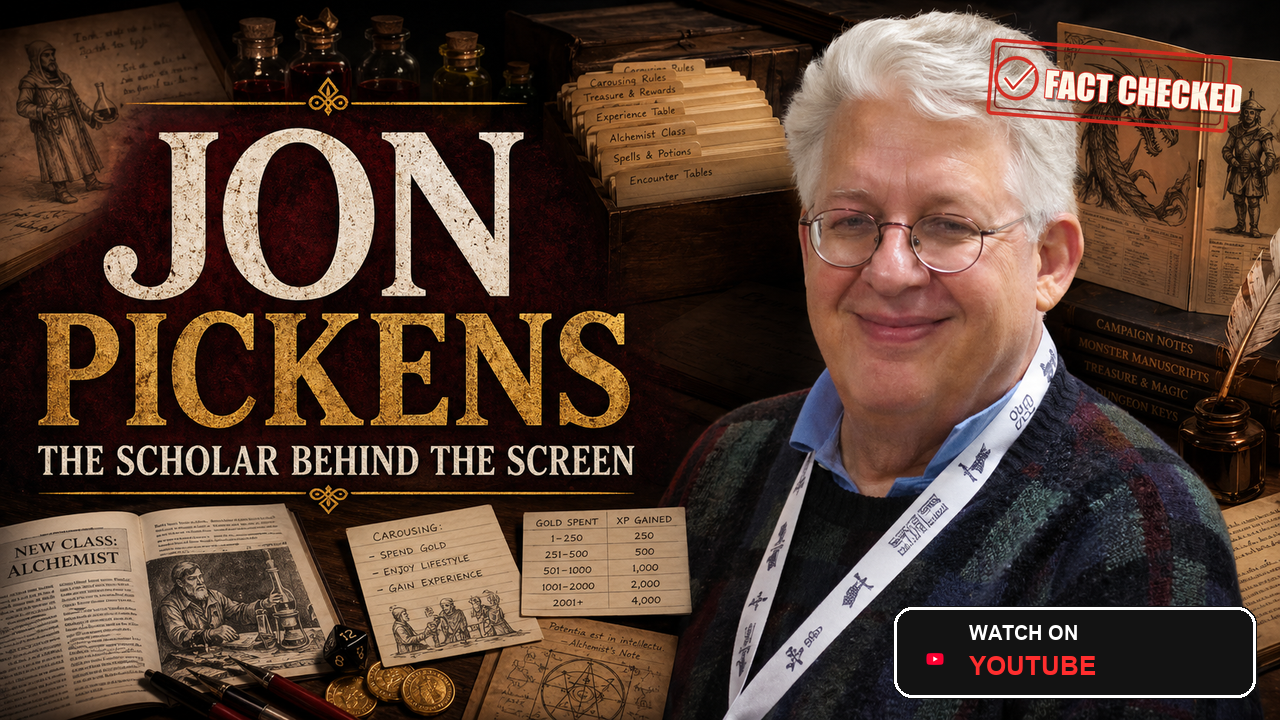
Jon Pickens is one of those early Dungeons & Dragons names whose importance is easy to misread.
He was not a headline system designer in the way Gary Gygax, Dave Arneson, Tom Moldvay, Zeb Cook, or Aaron Allston were. He did not leave behind a shelf of major authored rulebooks. His original solo design work mostly belongs to a short burst of Dragon magazine articles from 1976 to 1978.
Then he became something else the game needed just as badly: an editor, developer, coordinator, compiler, reference mind, and institutional memory inside TSR.
That makes his career look lopsided if you measure only by big authored books. But the early articles matter. They were small pieces of machinery dropped into a young game before anyone knew how big the machine would become. The Alchemist. The Berserker. Spending gold for experience. Demon generation. Each one was modular enough to be picked up, rewritten, rebalanced, and carried forward by other designers.
Pickens did not build a new game. He built components. Some components travel farther than systems do.
The Letter To Lake Geneva
Pickens came into the hobby through the old wargaming network before Dungeons & Dragons had become a mass-market identity. He was a reader, convention-goer, and participant in the early Midwestern gaming culture around Lake Geneva, Gen Con, Strategy & Tactics, fanzines, and the people who were still figuring out what fantasy role-playing was.
That context matters because early D&D design was porous. The rules were not sealed. The culture expected rulings, variants, new classes, home campaigns, borrowed procedures, and magazine experiments. A contributor could publish a few pages in The Dragon and put a new idea into circulation.
Pickens did exactly that.
He earned a degree in English and Economics from Valparaiso University in 1976. That combination almost sounds invented for his career. The English side shows in the editorial life that followed. The Economics side shows in the best of his early mechanics: a clear sense that games are incentive systems, and that players go where the reward structure points.
The Alchemist
In The Dragon #2, published in 1976, Pickens introduced "The Alchemist," one of the earliest printed new classes for Dungeons & Dragons outside the original rules.
The Alchemist was not a fighter, not a wizard, not a cleric, and not a thief. It was a specialist built around potions, poisons, and non-combat utility. That may sound ordinary now, after decades of prestige classes, subclasses, kits, archetypes, and character options. In 1976, it was not ordinary.
The important thing was not that Pickens’ version solved every balance problem. It did not. The important thing was that the article made a public argument: the D&D class list was open.
That was a design claim as much as a content claim. A class was not just a role. It was an interface between fantasy identity, advancement, equipment, restrictions, and expected behavior at the table. By creating the Alchemist, Pickens showed that the class system could absorb new fantasy professions outside the core combat-and-spellcasting assumptions.
Other designers kept returning to the idea. Dragon published later versions. Bard Games built The Compleat Alchemist. Pathfinder eventually made the Alchemist one of its most distinctive classes, a character type built around extracts, bombs, mutagens, and item-driven magical science.
That later lineage should not be credited to Pickens as if he designed all of it. He did not. But the first public component is there: the alchemist as a D&D class concept, printed early enough that the category was still wet cement.
The Spending Problem
Pickens’ strongest single design idea may be the one with the least respectable title.
"D&D Option: Orgies, Inc." appeared in The Dragon #10 in 1977. The title was a period joke, blunt and goofy in the way early gaming magazines often were. The underlying mechanic was serious.
D&D had a treasure problem. Gold came into the game as reward. Gold often produced experience. Characters accumulated wealth, but the rules did not always give them a strong reason to spend it in ways that expressed who they were. Treasure flowed in. The economy needed outlets.
Pickens’ answer was to award experience for gold spent, with different character types rewarded for different kinds of spending. Fighters caroused. Magic-users pursued research. Clerics tithed. Thieves gambled or spent in ways that fit the fantasy of the class.
That is a clean incentive loop. It ties advancement to downtime behavior. It turns treasure into future trouble. It makes spending a character expression instead of simple bookkeeping.
The mechanic also sends players back into adventure. If gold must be spent to matter, and spending empties the purse, then the dungeon keeps calling. The reward loop breathes in and out.
Decades later, the Old School Renaissance rediscovered this idea through carousing rules and downtime spending tables. Designers such as Jeff Rients explicitly pointed back to Pickens’ article. Variations spread through blogs, retroclones, and old-school campaigns. The tone changed from table to table, but the core insight remained: money should do something after the dungeon, and the thing it does should create more play.
That is Pickens at his best. Not a complete system. A portable circuit.
The Berserker And The Demon Tables
Pickens also published "The Berserker" in The Dragon #3, another early attempt to turn a mythic archetype into a D&D class or subclass structure.
The idea is familiar now: a warrior who enters battle fury, gains combat bonuses, and loses some measure of control. Modern players see the line running toward the Barbarian’s rage and many later frenzy mechanics. Pickens’ implementation was rough, as early magazine class designs often were. The concept was clearer than the balance.
That does not make it irrelevant. Early D&D was learning how to make character identity mechanical. A berserker is not just a fighter with a different costume. A berserker changes the behavior expected in combat. The player is rewarded for ferocity and punished by loss of control. That is class identity through procedure.
"Demon Generation" in The Dragon #13 did something different. It offered a procedural way to create unique demons through tables, levels, abilities, resistances, and traits. This kind of article seems small until you remember how important generators are to D&D’s culture. They let the referee create variety without inventing every piece from scratch.
The demon tables belong to a larger early tradition of random generation, but Pickens’ contribution shows the same modular instinct. Here is a procedure. Drop it into your campaign. Make something weird.
The Editor’S Fork
In 1978, Pickens joined TSR. The key fact is that TSR hired him as an editor.
That choice shaped the rest of his career. His early design burst slowed. His work moved behind the screen of production: editing, development, acquisitions, coordination, reference support, and institutional organization. He spent roughly a quarter century inside TSR and Wizards of the Coast, touching some of the most important D&D material in the game’s history.
This is where his credits can be easy to inflate if the distinction is not kept clean.
Pickens worked on important products. He contributed development, editing, coordination, indexing, and support. That is not the same thing as being the primary designer of every book his hands improved.
AD&D 2nd Edition belongs primarily to David "Zeb" Cook’s design leadership, with a larger TSR team around it. The D&D Rules Cyclopedia belongs to Aaron Allston as compiler and developer. The Arms and Equipment Guide was a shared project, not a solo Pickens statement. In all of these cases, Pickens’ work mattered. It should be credited accurately.
Editors and developers do not merely correct commas. At TSR, they shaped usability, consistency, rules clarity, product scope, and whether a manuscript could survive contact with actual players. They were part of the machine that made D&D publishable at scale.
Pickens became one of those machine minds.
The Reference Shelf
The best way to understand Pickens may be through the work that does not always put his name in the design slot.
He was a reference person. A library person. A "go ask Jon" person.
Accounts of TSR’s 1990s work point to his personal research materials helping other designers build richer products. His reference library supported projects where he was not the credited author. That kind of contribution disappears easily because it does not fit the clean line of author, designer, artist, editor.
But tabletop design depends on it. A setting book needs texture. A rules reference needs consistency. A historical fantasy supplement needs someone who knows where to find the right detail and how to keep the wrong detail from hardening into nonsense.
Pickens’ career sits in that space between authorship and infrastructure. He helped make other people’s work sturdier.
The Spell Compendiums show the same instinct on a larger scale. The Wizard’s Spell Compendium volumes and related priest-spell compilations gathered, organized, and updated huge bodies of D&D spell material from years of scattered sources. These books were not glamorous new design manifestos. They were systems of memory.
Players and Dungeon Masters needed a way to find what the game had already created. Pickens’ compilation work helped turn decades of accumulated spell text into usable reference.
That is not the same as inventing the spells. It is not nothing either.
What He Actually Built
Pickens did not design AD&D 2nd Edition. He did not compile the Rules Cyclopedia. He did not create the later Pathfinder Alchemist. He did not single-handedly build the modern Barbarian. His design career should not be inflated by turning editorial proximity into authorship.
What he built was smaller, cleaner, and more durable.
He built some of the earliest modular additions to D&D’s expanding design vocabulary. The Alchemist showed that new classes could enter the game through magazine publication. The Berserker explored combat identity through frenzy and loss of control. The spending-for-experience article gave D&D an economic loop that later old-school designers would revive and mutate. The demon tables gave referees another procedural tool for making the strange.
Then he built infrastructure: editing, development support, reference organization, spell compilation, and the quiet work of keeping a massive game line coherent enough to use.
That combination is rare. Pickens was not the kind of designer who announces a new era with a box cover. He was the kind whose small early ideas survive because they are easy to carry.
The Modular Mind
The hidden pattern in Pickens’ work is modularity.
Every notable early design can be lifted and dropped into a campaign. A class. A subclass. A downtime rule. A monster-generation procedure. None requires the referee to adopt an entire new game philosophy. None demands a rebuild of the campaign. They are components, and components travel.
That may be the editor’s mind showing through. Editors think about pieces. Does this section work? Does this rule connect? Can the reader find the thing? Can the part survive being moved?
Pickens’ early designs propagated because they were built like usable parts. Later designers could revise them without destroying them. A class concept could be rebalanced. A carousing rule could be given new tables. A frenzy mechanic could be folded into a Barbarian. A generator could be adapted to a new bestiary.
Most designers want their systems to last. Pickens’ components lasted.
Where To Find Him
Jon Pickens remains publicly connected to the old-school D&D community through convention appearances, interviews, and historical retrospectives. Gary Con has listed him among its old-school guests, a fitting place for someone whose path into the hobby began in the early convention culture around Lake Geneva and Gen Con.
His visible legacy sits in two places.
The first is the magazine work: short articles from the 1970s that kept being rediscovered by people looking for ways to make D&D stranger, more flexible, or more economically alive.
The second is the reference work: the editorial memory of TSR, the compendiums, the development support, the quiet scholarship behind other people’s books.
Jon Pickens is not an underappreciated superstar designer. He is something more specific and, in its way, more useful: a correctly appreciated editor whose early design components stayed in circulation.
The hobby needs those people. The ones who know where the rules came from. The ones who can find the missing spell. The ones who build a small piece cleanly enough that someone else can still use it fifty years later.
Fact Check Notes
Publication notes
This site is AI-assisted and human-reviewed. We use artificial intelligence to help gather research, organize source material, and draft profile content. Human editors then read, revise, and check each profile before it goes live. Most profiles are built through deep AI research and two separate rounds of fact-checking.
Leave a Reply
You must be logged in to post a comment.