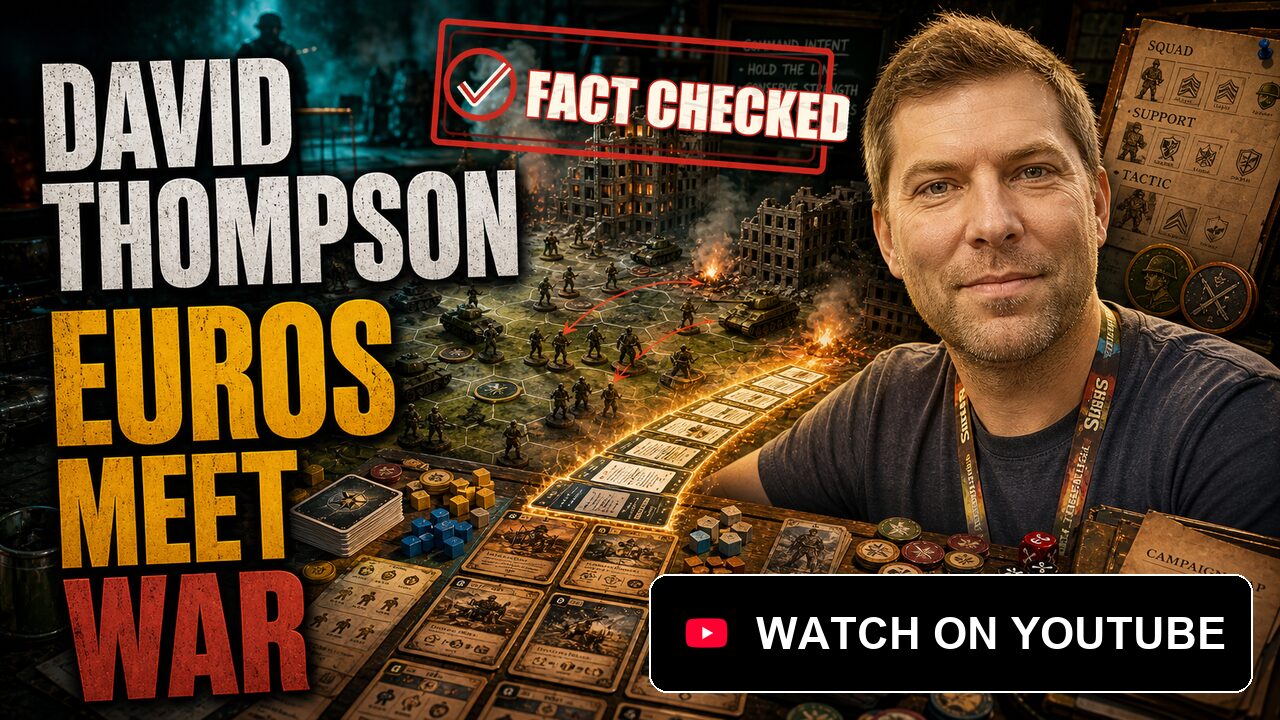
The Translator
David Thompson’s best games feel like translations.
Not simplifications. Not compromises. Translations.
He takes one tabletop language and lets it speak through another. Tactical wargaming through deck-building. Abstract strategy through military formations. Solitaire history through resource management. Campaign combat through hand management and scenario pressure.
That is harder than it sounds.
To translate a language, you have to respect what the speakers are trying to do. A wargame is not just a ruleset. It is a way of holding uncertainty and consequence without flinching. A Eurogame is not just efficiency. It is a promise that the table can stay readable and fair while the decisions stay sharp.
Wargames have their own grammar: lines of fire, suppression, command friction, terrain, casualties, odds, historical specificity, and the strange pleasure of making a bad situation only slightly less bad.
Eurogames have another grammar: resource conversion, clean turns, efficient choices, low rules overhead, and a design culture that often tries to remove friction until the machine hums.
A lot of designers treat those traditions as separate neighborhoods. Thompson keeps building roads between them.
That is the hidden pattern under Pavlov’s House, War Chest, Undaunted: Normandy, Undaunted: Stalingrad, and the larger body of work that followed. The games do not ask a Euro player to become a wargamer overnight. They do not ask a wargamer to give up tension, position, and consequence. They find a shared vocabulary.
The table can understand the battle.
The battle can understand the table.
The Playtest Uk Connection
Thompson has described coming to the hobby through Dungeons & Dragons and the wider world of modern board games. The professional design turn came later, after he relocated to England and started playtesting with the Playtest UK community.
That connection mattered.
Playtest UK is built around iteration, critique, and practical design. It is also where Thompson met Trevor Benjamin, who became his most important creative partner. Their collaboration would eventually produce War Chest and the Undaunted series, two of the clearest examples of Thompson’s gift for hybrid systems.
One early published credit was Armageddon (circa 2016). Then the pace accelerated.
By 2018, Thompson had two games in the world that announced the shape of the work to come.
Pavlov’s House was a solitaire historical game about defending one building during the Battle of Stalingrad.
War Chest was an abstract strategy game wearing military dress.
One looked like a wargame but moved with Euro resource pressure. The other looked like a war game from across the room but played like a crisp bag-building abstract. They did not come from the same corner of the hobby. That was the point.
The bridge was already there.
War Chest
War Chest, co-designed with Trevor Benjamin, is one of those games that looks obvious after someone has built it.
Players command units represented by weighted poker chips. The bag becomes your army. Drawing chips becomes command uncertainty. Spending a chip can deploy, move, attack, bolster, claim control, or use a special ability.
It gives the player a clean, physical feeling of fog of war. You can plan, but you cannot guarantee the next draw. The battlefield is small. The rules are readable. The choices are not small at all.
That is a Thompson move.
The military language helps the abstract structure make sense. Infantry, cavalry, archers, banners, controlled spaces, tactical timing. The theme does not turn the game into a simulation, but it gives players a way to read the board.
A pure abstract can sometimes feel like a private language. War Chest opens the door. You understand enough from the theme to begin playing, then the system teaches you how much depth is hiding under the surface.
The result is not a wargame in the traditional sense. It is not trying to reproduce a historical engagement. It is an abstract game with martial grammar, and that grammar matters because it makes the abstract decisions legible.
Again, translation.
The Undaunted System
The Undaunted series is Thompson and Benjamin’s most important architectural achievement.
Undaunted: Normandy takes squad-level World War II combat and powers it with deck-building. Your cards are not just options. They are your soldiers, your initiative, your command structure, and your ability to act.
That one idea does a lot of work.
If a unit takes casualties, cards leave your deck. If you need more control, you scout and shape the deck. If you want power, you add cards, but a bigger deck can become slower and less reliable. If you want to attack, you need the right card in hand and the right position on the board. The system makes command friction feel like a hand of cards.
It is elegant because the mechanic is not decorative.
The deck is the squad.
The hand is the moment.
And the draw becomes the thing you cannot fully control.
In a good scenario, you can feel it in your stomach. The card you need is somewhere in that deck, but the battle does not care about your timing.
The battlefield is not separate from the Euro-style engine. The engine is how the battlefield speaks.
That is why the system could move. Normandy handled infantry skirmishes. North Africa changed the texture of the fighting. Stalingrad expanded the idea into a campaign structure with persistent consequences. Battle of Britain moved the engine into air combat. Callisto carried the system into science fiction. Osprey has Undaunted 2200: Revolution listed for publication in 2026, which shows the line still pushing outward.
Not every system survives that much movement.
Undaunted does because its core is clean. Cards produce command. Command produces action. Action changes position. Position changes the next hand. That loop is strong enough to hold different theaters, scales, and fictional settings without losing its identity.
The Solo Front
Thompson’s solitaire historical games show a different side of the same instinct.
Pavlov’s House, Castle Itter, Soldiers in Postmen’s Uniforms, and Lanzerath Ridge are often grouped under the Valiant Defense line. Each focuses on a specific historical engagement where a small defensive position faces enormous pressure. The player does not command a whole war. The player tries to keep one desperate situation from collapsing.
Pavlov’s House is the cleanest example.
The game works across connected levels: the wider Soviet operational context, the area around the building, and the house itself. You manage supplies, troops, anti-aircraft fire, communications, attacks, and the grinding reality that every choice feels too small for the problem.
That is the emotional core of a good defensive wargame. You are not chasing victory points. You are trying to keep a line from snapping.
That is where Thompson’s Euro instincts matter.
The game is not a traditional hex-and-counter simulation. It uses resource management to evoke pressure. It asks the solo player to make triage decisions. You are not trying to optimize a machine for abundance. You are trying to keep the machine from breaking.
That is a different emotional register from War Chest or Undaunted, but the design handwriting is recognizable. Historical specificity becomes playable because the system gives players a clean way to hold the pressure in their hands.
The Other Bridges
Thompson’s catalog keeps returning to crossings.
Switch & Signal turns railway logistics into a cooperative timing problem. Sniper Elite: The Board Game adapts a video game stealth premise into hidden movement and tactical deduction. Resist!, co-designed with Trevor Benjamin and Roger Tankersley, uses card transformation and solo resistance-cell pressure to make a small historical conflict feel personal and tense. General Orders reduces World War II area control into a compact duel of command and timing.
The surface changes.
The pattern stays visible.
Find a genre with barriers. Find the part that makes the genre emotionally interesting. Build a cleaner machine that carries that feeling without requiring the whole old rulebook culture to come with it.
That is why Thompson’s work feels accessible without feeling thin.
Accessibility is not the same as condescension. A simplified wargame can feel like it has been sanded down until nothing sharp remains. Thompson’s stronger designs do something else. They preserve the sharpness and change the handle.
What He Actually Built
David Thompson did not merge every Eurogame and every wargame into one final form.
He did not invent deck-building, bag-building, solitaire wargaming, historical simulation, or abstract strategy.
He did not personally create every step in the modern movement toward more accessible wargames.
What he built was a body of work that made those borders easier to cross.
The Undaunted system made tactical combat readable to players who might bounce off traditional wargame presentation. War Chest made abstract strategy feel immediately graspable through military vocabulary. Pavlov’s House showed how Euro-style resource pressure could make solo historical defense feel tense, specific, and human.
The limitation is time. Thompson’s published design career is still relatively young compared with designers whose work has been tested across several decades of changing markets and changing player tastes. Some of the durability questions are still open. How long will Undaunted remain a living framework? Which titles will still be played in twenty years? Which experiments will become foundations for later designers?
Those are fair questions.
The present record is already strong.
Dozens of credits. Multiple publishers. Collaborations that keep producing. A recognizable design voice. A habit of moving between traditions that many players used to experience as separate worlds.
That is not a small thing.
Where To Find Him
David Thompson remains active.
BoardGameGeek lists recent credits through 2025, including Line of Fire: Burnt Moon and General Orders: Sengoku Jidai. Osprey lists Undaunted 2200: Revolution, co-designed with Trevor Benjamin, for publication on October 6, 2026. AEG still presents War Chest as an active publisher-facing title.
His personal site is davidthompsongames.com, and his BoardGameGeek designer page is the easiest public index of the breadth of the catalog.
The story is still in motion.
That matters for how to read him. Thompson is not a settled legacy figure whose whole career can be sealed in a final sentence. He is a working designer in the middle of the run, still expanding the systems that made his name and still testing how far the bridges can go.
The best translators do not simplify.
They find the words that let two languages hear each other.
That is what Thompson keeps doing.
Fact Check Notes
Publication notes
This site is AI-assisted and human-reviewed. We use artificial intelligence to help gather research, organize source material, and draft profile content. Human editors then read, revise, and check each profile before it goes live. Most profiles are built through deep AI research and two separate rounds of fact-checking.
Leave a Reply
You must be logged in to post a comment.