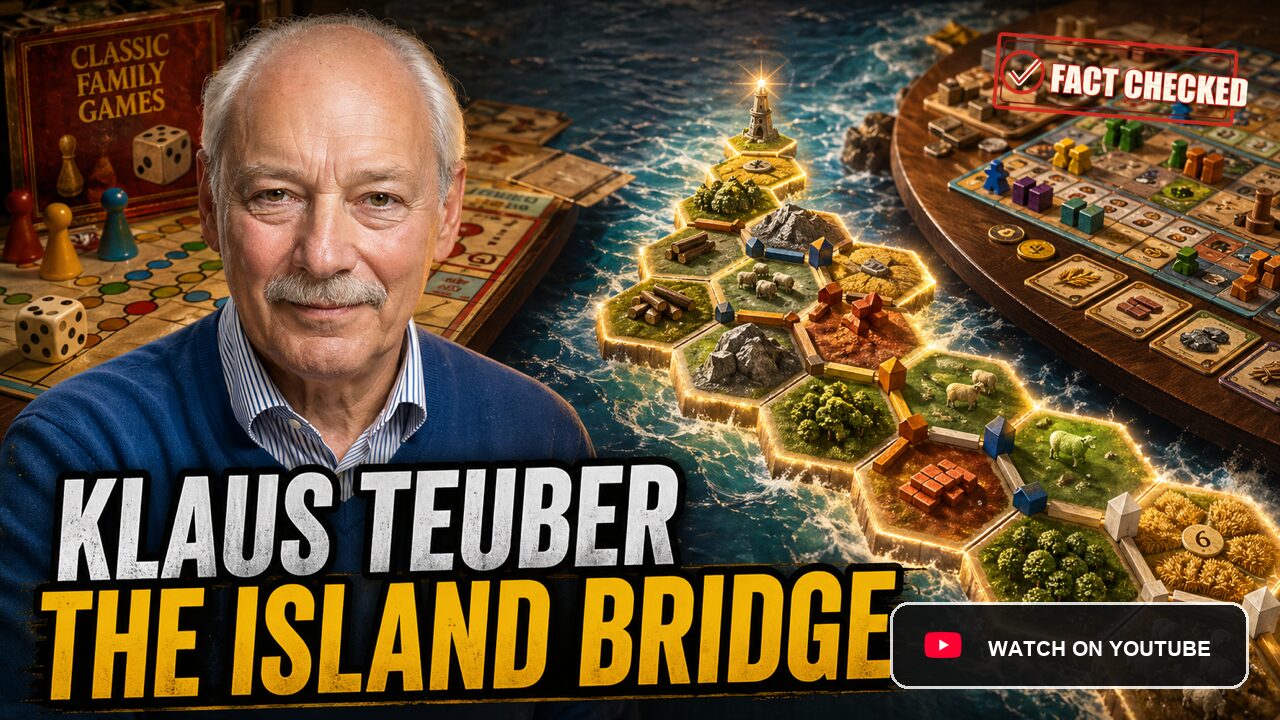
That is the short version of Catan.
Before Catan, hobby board gaming lived in separated rooms. Germany had a sophisticated family-game culture, full of clever systems, short play times, and elegant interaction. America had mass-market staples, wargames, role-playing games, and a smaller hobby scene that often treated family games and strategy games as different species.
Then a dental technician from Germany designed a game about roads, sheep, brick, wood, wheat, ore, and talking your friends into bad trades.
The island changed everything.
Catan did not invent hexes. It did not invent trading. It did not invent resource management. It did not invent family strategy games. Its genius was synthesis: a modular island, probability-mapped production, constructive building, and social negotiation all tied together so cleanly that a new audience could walk in.
The bridge worked because the game was deep enough for hobbyists and friendly enough for families.
That is harder than it sounds.
Before The Hexagons
Teuber was already an extraordinary designer before Catan.
Barbarossa, published in 1988, asked players to sculpt riddles out of clay. The objects needed to be recognizable eventually, but not so obvious that everyone guessed immediately. It was creative, strange, social, and unlike the typical image of a strategy game.
It won the Spiel des Jahres.
Adel Verpflichtet followed in 1990. It was a bluffing and collecting game about aristocrats, thieves, detectives, and timing. Players chose actions secretly and tried to outguess each other in a social dance of greed and suspicion.
It won the Spiel des Jahres too.
Drunter & Druber arrived in 1991, a tile-laying game where players built over a town while secretly trying to protect certain buildings. Voting, misdirection, and shared destruction turned the board into a table argument.
Another Spiel des Jahres.
Three different games. Three different mechanical spaces. Three major awards in four years.
That matters because it proves Catan was not a fluke. Teuber already understood how to make people interact. Barbarossa made creativity public. Adel Verpflichtet made bluffing theatrical. Drunter & Druber made the table negotiate what to destroy.
The social engine was there before the island.
Catan As Synthesis
Catan is often described through its components: hexes, resources, settlements, roads, cities, development cards, robber, dice.
That list misses the real design.
The real design is dependency.
You cannot produce everything efficiently. You need wood and brick for roads, wheat and ore for cities, sheep for development cards, and the right numbers in the right places. The dice decide who produces, but the board decides what production means. A six on brick is not the same as a six on sheep. A settlement on poor numbers is not dead, but it changes what kind of table politics you need.
The game makes you need other people.
That is the core.
Trading is not a side activity. It is the social heart of the design. You look across the table and ask for what you lack. You offer what someone else needs. You decide whether helping them helps you more. You lie a little. You plead a little. You overcharge. You promise future cooperation you may or may not mean.
The island is geography.
The table is economy.
The people are the engine.
That is why Catan became more than a clever German game. It turned the room itself into part of the system.
No Elimination, No Escape
Another quiet strength of Catan is that it keeps everyone in the game.
Older mass-market games often allowed or encouraged elimination, long downtime, or runaway misery. A player could be broke, trapped, or functionally dead long before the game ended. Catan does something different. You may fall behind, but you usually still produce. You still trade. You still block. You still matter.
Every dice roll can involve multiple players.
That was crucial. Catan did not ask new players to wait fifteen minutes for their next meaningful moment. It made them watch every roll because every roll might give them something or give their opponent too much.
The robber added another social layer. It is a rule about scarcity, but also a rule about blame. Move the robber, and you are not just making a tactical choice. You are choosing whom to inconvenience. You are making a statement about who is ahead, who deserves pressure, and who should not be trusted.
That is social infrastructure.
Teuber’s mechanics keep pointing players back at each other.
The Gateway
The word "gateway" gets overused now, but Catan earned it.
It was not the easiest game in the world. It was not the deepest. It was not the most balanced. It was not the most thematic. What it did better than almost anything before it was sit between worlds.
A person who grew up with Monopoly could understand trading and building.
A strategy gamer could see the probability map and long-term positioning.
A family could finish a game without anyone being eliminated.
A hobbyist could teach it without apologizing for a giant rulebook.
That middle space became historically important. Catan proved that a modern strategy game could travel far beyond the established German market. It helped introduce a global audience to a different idea of what board games could be: interactive, constructive, strategic, social, and replayable without requiring war-game density.
Ticket to Ride, Carcassonne, Pandemic, Wingspan, Azul, and hundreds of later games did not copy Catan directly. They did not need to. They crossed through the market opening Catan helped create.
That is the bridge.
Not one mechanism.
A path.
The Franchise Choice
After Catan, Teuber faced a problem most designers never get.
What do you do when one game changes your life?
He chose to deepen the island. Seafarers expanded the map. Cities & Knights added commodities, progress cards, city improvements, and the barbarian threat. Starfarers took the Catan idea into space. Later expansions and variants kept stretching the system into new shapes.
Cities & Knights deserves special mention because it proved Catan could carry more strategic weight than the base game suggested. The expansion asks players to think about defense, improvement tracks, commodities, and the timing of barbarian attacks. It is still Catan, but the center of gravity shifts.
That is real design work.
The trade-off is that Teuber’s later career became tied to one world. The restless designer who had made Barbarossa, Adel Verpflichtet, and Drunter & Druber in rapid succession became the careful steward of Catan. There were other designs, but none reshaped the conversation the way the island did.
That is not a failure.
It is the cost of building something enormous.
The Family Company
Catan eventually became more than a game.
It became a family company, a brand, an international publishing structure, and a shared cultural reference point. Teuber’s son Benjamin became part of the design and development legacy. The game moved across languages, editions, expansions, digital versions, spin-offs, and licensed experiments.
The scale matters because it proves the design did what bridge designs are supposed to do.
It carried weight.
Catan did not only have a good launch. It endured. Players kept teaching it. Families kept buying it. Hobbyists kept arguing about it. Designers kept responding to the problems it made visible.
Some later players criticize it for dice variance, trading politics, kingmaking, and early placement imbalance. Those criticisms are not imaginary. The game is not perfect.
But perfect is not the same as historic.
Catan’s importance is not that every mechanism is flawless. Its importance is that the whole system created a new point of contact between people who did not previously share the same table.
That achievement is larger than elegance.
The Social Game
Teuber’s hidden pattern is social infrastructure.
His games are not only about the board state. They are about what the board state makes people do to each other.
Barbarossa makes players interpret each other’s creativity. Adel Verpflichtet makes them read greed and bluff. Drunter & Druber makes them vote, conceal, and destroy with a smile. Catan makes them negotiate, plead, accuse, bargain, and build a little economy out of trust and self-interest.
This is why Catan survived outside the hobby.
It gives people something to talk about.
Not just after the game. During the game. Constantly. The sheep joke, the bad trade, the robber grudge, the road race, the settlement spot no one should have left open. The game creates stories because the players create friction.
Teuber understood that board games are not only mechanisms.
They are excuses for human contact.
What He Actually Built
Klaus Teuber built the bridge that carried modern German-style board gaming into the wider world.
He did not invent every piece of Catan. He did not invent strategy games, trading, hexes, resources, or family play. He built the configuration that made those pieces legible to millions of people.
That is the contribution.
Catan showed that a constructive, non-elimination, negotiation-driven strategy game could become a global phenomenon. It gave publishers proof that modern board games could sell outside their old borders. It gave players a way to ask for something better than roll-and-move nostalgia without jumping straight into hobby complexity.
And before that, Teuber had already made three award-winning games in three different modes.
The island did not come from nowhere.
It came from a designer who had been building social machines all along.
Where To Find Him
Start with Catan because history demands it. Play the base game to understand the bridge. Add Cities & Knights if you want to see the system carry heavier strategic load. Look back to Barbarossa, Adel Verpflichtet, and Drunter & Druber if you want the pre-Catan proof that Teuber was always more than one island.
The lasting image is still the table.
Someone has brick. Someone needs sheep. Someone is pretending not to be ahead. Someone moves the robber and starts a small argument that will be remembered longer than the score.
The hexes matter.
The people matter more.
Klaus Teuber built the island so the table could become the game.
Fact Check Notes
Publication notes
This site is AI-assisted and human-reviewed. We use artificial intelligence to help gather research, organize source material, and draft profile content. Human editors then read, revise, and check each profile before it goes live. Most profiles are built through deep AI research and two separate rounds of fact-checking.
Leave a Reply
You must be logged in to post a comment.