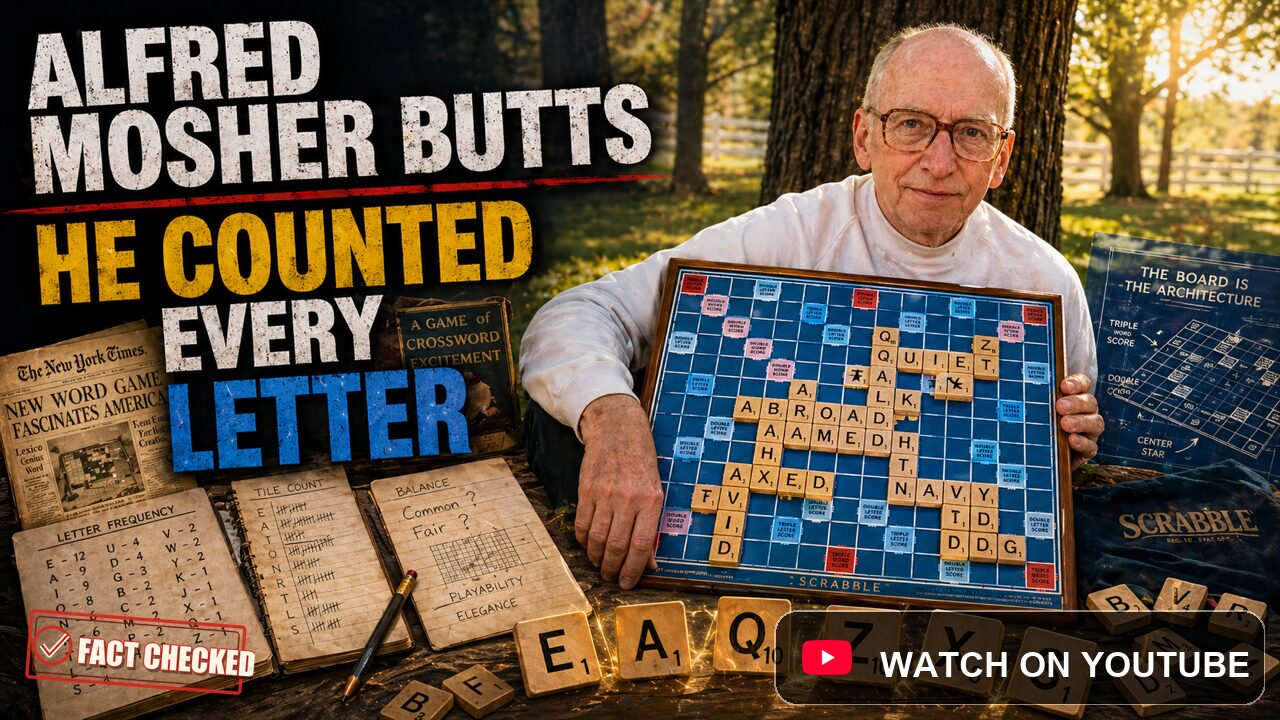
Alfred Mosher Butts built Scrabble by doing something almost nobody in game design was doing in the early 1930s.
He counted.
Not players. Not sales. Not turns. Letters.
During the Great Depression, when architecture work collapsed for huge parts of the country, Butts found himself with time and an architect’s habit of measuring the structure before he trusted the drawing. He took newspapers and started counting how often each letter appeared in English usage. How many Es. How many As. How often a Q showed up compared with an R.
He was not guessing at word-game balance.
He was measuring the raw material.
That is the hidden genius of Scrabble.
The game feels like vocabulary. It looks like a crossword. It plays like territory. But underneath all of that is a frequency table built by an unemployed architect with patience, discipline, and a pencil.
Common letters became common tiles. Rare letters became scarce and valuable. The S, despite being useful, stayed limited because plurals would make the game too easy. The premium squares made placement matter as much as language.
Butts did not just make a word game.
He engineered one.
Poughkeepsie And The Empty Office
Butts was born April 13, 1899, in Poughkeepsie, New York.
He trained as an architect and built a normal professional life before the Depression tore the bottom out of it. Architecture depends on people having money to build. In the early 1930s, that money vanished for a lot of clients. Like countless other professionals, Butts lost work and found himself staring at a question that did not care about his résumé.
What do you do with your mind when your profession goes silent?
He looked at games the way an architect might look at a city block.
What categories existed? What forms were missing? Word games existed, but the mainstream versions of the time did not combine vocabulary, spatial play, and scoring into one durable board system. The crossword craze had already shown that people liked arranging words into intersecting grids. Anagram games had already shown that letter tiles could be satisfying objects.
But the two ideas had not yet fused into the shape the world now knows.
So Butts started building.
The Letters Before The Board
The first version was called Lexiko.
It had letter tiles and word formation, but no board. That made it important as a prototype and incomplete as a game. Without a board, words did not occupy space. They did not intersect. They did not create territory, blocking, risk, or long-term positional choices.
Still, Lexiko contained the core empirical insight.
Butts counted letter frequencies from newspapers to build the tile distribution and scoring. The exact list of papers varies across retellings, but the central act is well established: he analyzed real English usage and used it to decide how many of each tile should exist and how much each should be worth.
Most games were balanced by instinct, tradition, and repeated play. Butts approached the problem like a technical designer. If the game was made of letters, the letters had measurable properties. Their frequency in written English could tell him how many tiles should exist and how punishing it should be when you finally got one.
That is why Scrabble still feels fair.
The Q is hard because English makes it hard. The E is easy because English gives it away. The X tempts you because the value is real, but the placement problem is real too. The tile bag is not random chaos. It is language converted into probability.
That is Butts’s great unseen contribution.
He made English itself part of the game engine.
Criss-Crosswords
By the late 1930s, Butts had added the board.
He called the new game Criss-Crosswords. It used a square grid, crossword-style intersecting placement, and premium spaces that rewarded letters and words differently depending on where they landed.
That changed everything.
The board gave the game a second brain.
Now a good word was not automatically a good play. A short word in the right place might outscore a longer one. A clever placement could open a premium square to danger. A player could block, hook, extend, and build. Vocabulary mattered, but so did board vision.
Scrabble is not just a spelling contest. It is a construction game. Each word changes the structure available to every future player. The grid starts empty, then becomes a shared building that nobody fully controls. One player lays a beam. Another hangs a word from it. Someone else discovers that the opening you created has become a threat.
The game is elegant because every word is both language and architecture.
Butts tried to sell it.
The companies said no.
In the early years, major manufacturers passed. Butts kept making sets, refining the system, and trying again. The invention had the quiet problem that many clean designs have. It did not look like much until you played it.
Scrabble And The Second Set Of Hands
James Brunot, an entrepreneur who saw what the game could be, acquired rights, refined the commercial presentation, and helped bring it to market. The name changed. The packaging changed. The manufacturing became real.
The core engine did not change.
That distinction matters.
Butts built the engine. Brunot helped make the product.
The first years were slow. Then the game broke through, helped by department-store orders and word of mouth. Commercial partners scaled production, and Scrabble moved from obscure invention to household object.
The Game That Did Not Need Fixing
The astonishing thing about Scrabble is how little it has needed to change.
The 15-by-15 grid remains. The seven-tile rack remains. The balance between word knowledge, probability, board position, risk, blocking, and scoring remains. Tournament rules have evolved, dictionaries have changed, and international versions have adapted to different languages, but the central engine still works.
Many games become famous because they arrive at the right cultural moment. Fewer survive deep competitive study. Scrabble has survived both the family table and the tournament hall. Casual players can make words and enjoy the social ritual. Competitive players can track tiles, calculate risk, manage openings, and treat the game as a serious contest of probability and position.
The same design supports both.
That is architecture.
Butts’s design has been copied, adapted, digitized, parodied, and transformed.
The cultural template is obvious: letter tiles, word construction, scoring pressure, and the pleasure of discovering that a word fits.
Scrabble did not merely succeed.
It became a grammar for later word games.
What He Actually Built
Alfred Mosher Butts did not invent wordplay.
He did not invent crossword puzzles, anagrams, letter tiles, or competitive vocabulary. He did not build a long catalog of games, and his later attempts did not become a second design legacy. He was not a professional game designer in the modern sense.
What he built was one of the cleanest games of the twentieth century.
He fused empirical letter frequency, tile drawing, crossword placement, positional scoring, and everyday vocabulary into a game almost anyone can understand and almost nobody can exhaust. He made data feel like play.
That is the honest measure.
Butts’s career as a game designer is narrow.
His impact is not.
One game was enough because the one game held.
The Letters Are Still There
Alfred Mosher Butts died on April 4, 1993. He was ninety-three.
The game has sold in the hundreds of millions across the world, with widely reported figures above 165 million sets worldwide. Exact totals shift depending on the year and the source, but the scale is not in doubt.
But the most impressive part is still the quietest.
The letters still work.
The distribution Butts built from newspaper counting remains the heart of the English-language game. The board still turns vocabulary into architecture. The rack still turns probability into hope. The S is still dangerous. The Q still makes people nervous.
Butts counted every letter because he thought the answer was in the structure.
He was right.
Fact Check Notes
Publication notes
This site is AI-assisted and human-reviewed. We use artificial intelligence to help gather research, organize source material, and draft profile content. Human editors then read, revise, and check each profile before it goes live. Most profiles are built through deep AI research and two separate rounds of fact-checking.
Leave a Reply
You must be logged in to post a comment.