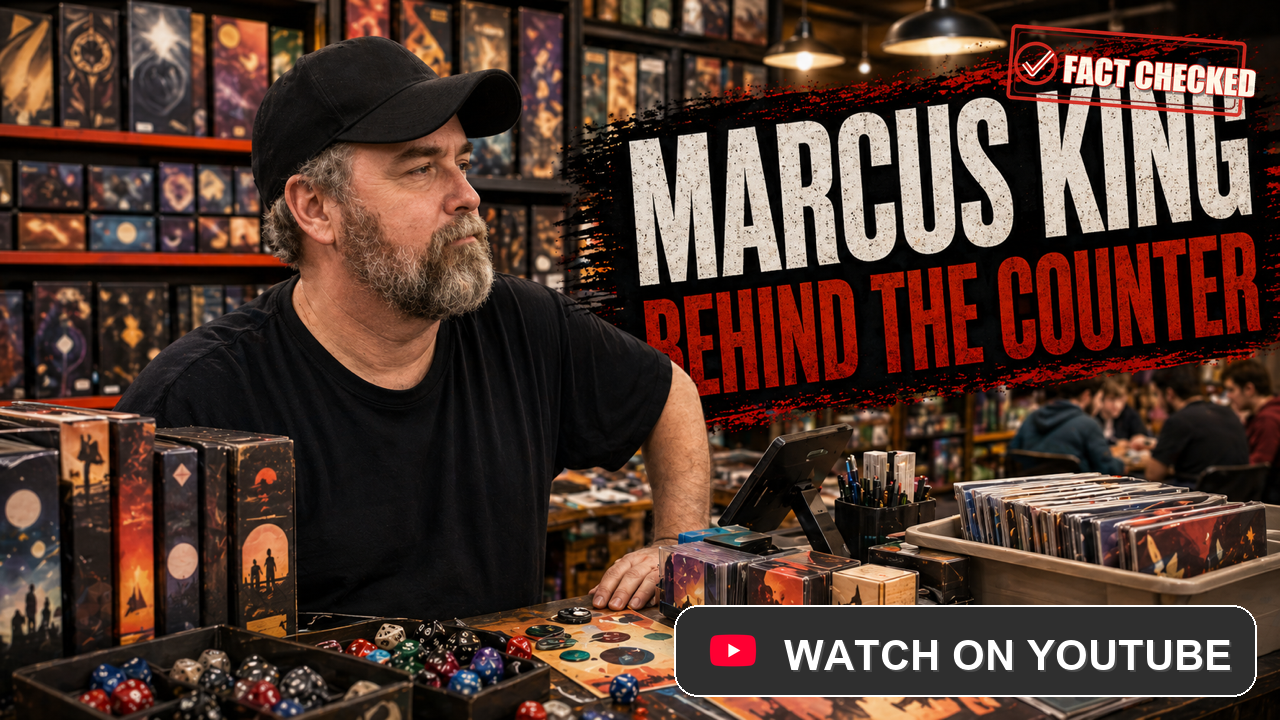
He made the place where the games could live.
That matters more than the industry usually admits.
Designers create rules. Publishers print books. Manufacturers make boxes. Distributors move product. But somewhere near the end of that chain, a local store has to turn all of it into rent, payroll, inventory, events, community, and one more reason for a player to walk through the door next week.
That was King’s world.
He was a retailer. A columnist. A GAMA leader. A convention auction operator. A blunt teacher of the trade. He belonged to the part of tabletop history that is easiest to overlook because it leaves fewer famous covers behind.
But games do not reach people by magic.
Stores do some of that work.
King spent a life teaching how.
The First Counter
King’s public story begins before the hobby retail world looked anything like it does now.
He was born in 1961, served twelve years in the U.S. Army, and opened his first game store in Anchorage, Alaska, during his military years. That early start matters. This was before Magic: The Gathering transformed hobby stores. Before online retail rewired customer behavior. Before organized play became a standard business tool. Before many game stores had any real model for what they were supposed to be.
The Michigan store path came later. In 1994, King was not yet running Titan Games. He owned an oil change shop. His first Michigan game store was Gamers Guild in 1997. Then came BC Hobby in 1999. Titan Games entered the story in 2001, when it was purchased.
That became the store name most closely tied to his early public reputation. By the early 2000s, Titan was not only a local store. King’s RPG.net author bio described a large retail footprint, a deep online catalogue, heavy convention attendance, and responsibility around the Origins game auction. He was already working multiple versions of the same problem:
How do you turn games into a working business?
Not a dream.
A business.
That distinction is the core of Marcus King.
The Store As Machine
King understood that a game store is not one thing.
It is retail floor, community center, warehouse, event site, classroom, hangout, marketplace, and customer-service trap, all at the same time. It has regulars who keep it alive and regulars who can poison it. It has new releases and dead stock. It has organized play, subscriptions, used games, comics cycles, convention sales, kids who need a safe place, adults who need boundaries, and inventory that quietly eats cash if the owner does not understand it.
King wrote about that machine in public.
His Behind the Counter column began on RPG.net in 2003 and eventually ran for dozens of installments. Later, ICv2 carried his writing from 2010 to 2017, drawing on more than thirty years of retail experience. The topics read like a game-store survival course: opening a store, business basics, inventory control, customer relationships, outreach, Friday Night Magic, comic subscriptions, diversification, Pokémon Go, dead inventory, service boundaries, and the daily discipline of staying alive.
That is not glamorous writing.
It is useful writing.
Useful matters.
The School That Did Not Exist
One of King’s clearest insights was that the hobby had almost no real school for retail.
People opened stores because they loved games. That love helped them start. It did not teach them how to manage cash flow, negotiate customer expectations, track turns, build events, price used goods, handle theft, control bad behavior, or decide when sentiment was killing the business.
King wrote as if he was trying to fill that gap.
He was not writing theory for its own sake. He was writing from behind the counter. The counter is where ideals meet invoices. It is where the person who loves games discovers that love alone does not pay the distributor.
That is why other retailers remembered him as a teacher.
His advice was not always soft. It was not always comfortable. It was meant to keep stores alive.
And when a store survives, players have a place to gather.
That is industry work.
The Dead Inventory Instinct
King had a particular reputation for the hard retail stuff.
He understood liquidation, used games, rare stock, convention sales, and the strange afterlife of products that other stores could not move. Industry accounts remember Titan Games and King as a place to sell large quantities of dead inventory, especially role-playing games. Remembrances describe huge convention booths, liquidation buys, aggressive promotions, flea-market hunting, online resale, and the constant search for margin in overlooked places.
That sounds rough because it is rough.
Hobby retail is often romanticized from the customer side. Shelves, tables, dice, comics, familiar faces. From the owner side, it is a knife fight with rent due.
King knew both views.
The soft part was community.
The hard part was math.
His gift was not pretending those were separate. A store that cannot make margin cannot remain a safe place. A store that ignores community becomes a warehouse with a cash register. King treated the store as a living system where sourcing, events, inventory, customer behavior, and local trust all had to work together.
The Boundary Man
King could be blunt.
That comes through in the columns and in the way peers remembered him. He was not interested in the slogan that the customer is always right. He believed stores needed boundaries. If someone tried to exploit the store, undermine sales, poison the community, or behave badly, the store owner had to protect the business and the people inside it.
That is not cruelty.
That is stewardship.
A good game store has to be open enough to welcome strangers and firm enough to protect regulars. It has to make space for kids, new players, awkward people, collectors, competitive players, families, and old-timers without letting any one person ruin the room.
King’s obituary and peer remembrances also point to the other side: support for charities, school fundraisers, safe spaces for different kinds of people, and a soft spot for kids. That combination is important.
Hard edges around the business.
Soft regard for the people the business served.
That was the structure.
The Gama Voice
King’s influence did not stay inside one store.
He served in the Game Manufacturers Association, including the Retail Division and vice-presidential service. He spoke at GAMA events. Other retailers remembered him as someone worth hearing, someone whose seminars justified the trip, someone whose advice translated into better practice.
This is where his importance gets bigger than Titan Games, Mad Ox, or any single location.
He became part of the trade’s memory.
Retail knowledge is fragile. It often lives in one owner’s head until the store closes. King helped move that knowledge into columns, seminars, convention conversations, and public trade discussion. He made the unwritten parts of the store business more visible.
That kind of work rarely gets a trophy.
It changes behavior anyway.
The Kentucky Years
King eventually sold his Michigan stores and moved to London, Kentucky.
There, public sources place him first with Troll and Toad and later under his own banners again, including Mad Ox Games & Comics. In 2019, he announced his retirement, transferred inventory and subscriptions to Main Street Games & Comics, and said he would remain part time to help teach the new owner the ropes.
That sentence is very Marcus King.
Even retirement became training.
His obituary says he spent his later years helping his daughter Devlin run Main Street Games & Comics. The store work continued, but now with the added shape of legacy: teaching the next person how the machine runs.
What He Actually Built
Marcus King did not design a famous game.
He did not publish a landmark rulebook. He did not create a miniatures line or a distribution empire. His contribution sits in a different category.
He built stores.
He built store knowledge.
He built public language for the practical work of surviving behind the counter.
That makes him part of tabletop history because the tabletop industry is not only made by creators. It is made by the people who keep the shelves stocked, the events running, the lights on, the problem customers contained, the kids welcome, the margins alive, and the next owner trained.
King’s legacy is not one product.
It is transfer.
Methods moved from him to other retailers. Advice became columns. Columns became training material. Seminars became operational memory. A store owner’s hard-won lessons became part of the field.
That is infrastructure.
Where To Find Him
Marcus King died on March 22, 2022.
What remains are the stores he ran, the retailers he taught, the columns he wrote, the GAMA rooms where people heard him speak, and the memory of a man who understood that loving games was not enough to save a store.
You had to know the business.
You had to protect the room.
You had to adapt.
You had to make the numbers work without forgetting why the place mattered.
That is what King taught.
Games need designers. They need publishers. They need distributors and manufacturers.
They also need a counter.
Marcus King spent his life behind one, then told everyone else how to keep theirs standing.
Fact Check Notes
Publication notes
This site is AI-assisted and human-reviewed. We use artificial intelligence to help gather research, organize source material, and draft profile content. Human editors then read, revise, and check each profile before it goes live. Most profiles are built through deep AI research and two separate rounds of fact-checking.
Leave a Reply
You must be logged in to post a comment.