There is a moment every Dungeon Master knows.
Someone at the table looks up from their character sheet and asks, quietly, like they are asking for permission to want something:
Can I play the monster?
Or they point at a starship deck plan and ask a different version of the same question:
Can we actually run this without it turning into an argument?
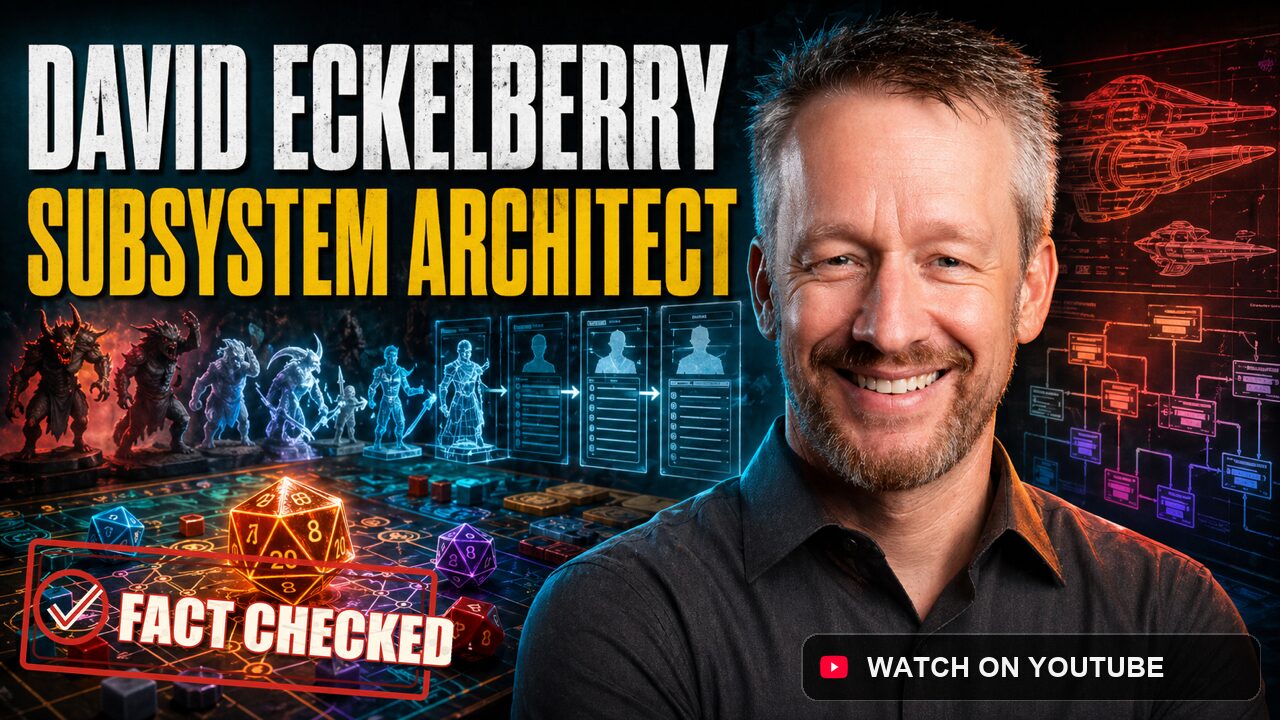
David Eckelberryâs tabletop career lives in those moments. Not in the headline rules. In the load-bearing math that keeps a table from slipping sideways when players push the game into strange shapes.
A ship fight that still feels like the same game as a firefight.
A centaur, ogre, or mind flayer that can begin at first level without the rest of the party feeling like props.
A rules engine asked to carry something it was not built for, and still hold long enough to play.
That craft rarely gets a spotlight. It gets a sigh of relief. It gets a session that keeps moving.
The Era That Wanted One Engine
Eckelberryâs tabletop work sits in the late 1990s and early 2000s, when big roleplaying lines were shifting toward unified rules language and repeatable design tools.
The older style of expansion could be flexible and charming, but it often leaned on the refereeâs instinct to patch gaps in the moment. That sounds romantic until you are the person behind the screen, trying to keep a campaign alive while the game keeps adding exceptions.
The new style wanted fewer exceptions.
It wanted shared categories. It wanted systems you could teach once and then reuse. It wanted a rules chassis that could take a new creature, a new vehicle, a new template, and have it interact with everything else without the DM inventing a private ruling that would break three sessions later.
Eckelberryâs signature fits that moment. He was not the public face of a setting line. He was valuable in the parts of publishing where systems either scale or they fail in front of everyone.
STAR*DRIVE AND THE PROBLEM OF SCALE
Alternity was TSRâs late science-fiction roleplaying game, published in the companyâs final years before Wizards of the Coast became the new home for Dungeons & Dragons and related work.
Within Alternity, Star*Drive was the big space opera campaign setting: alien species, political blocs, frontier regions, and enough open space to run long campaigns without running out of oxygen.
Star*Drive is credited to David Eckelberry and Richard Baker. That pairing matters because a space opera setting has a double obligation.
You need a world you can picture.
You also need procedures you can run.
The moment you put ships on the table, scale stops being flavor. Scale becomes math. A gunfight is a handful of rolls and a few tense decisions. A ship fight asks for range, sensors, hull strength, crew actions, weapon arcs, damage states, and the uncomfortable truth that a single hit might end the scene if the numbers are wrong.
Eckelberryâs approach, across the Star*Drive era support material associated with Alternity, is consistent: do not treat the hard parts as special cases. Build subsystems that still connect to the gameâs main language.
That is what âsubsystem architectâ means in practice. It means making the weird parts legible.
Starships Are Not Just Big Characters
Science fiction games often fail in the same place.
They give you a setting that feels huge, then hand you ship rules that feel bolted on. Either the ship system is so abstract it stops being satisfying, or it is so detailed that it turns into a second game that nobody can remember.
One of the reasons Eckelberryâs name shows up around Star*Drive support is that he kept returning to the scale problem. Starships is remembered by fans as a book that tried to make ship encounters playable at the table without throwing away the core Alternity language. It treated ships as systems with distinct parts and actions, not just a vehicle stat block.
This is a recurring pattern in his credits list: setting tools, alien and creature support, reference compendiums, and modular documentation that helps a referee run something complicated without improvising every number from scratch.
The Monster-As-Player Question
If Star*Drive is a story about scale, Savage Species is a story about identity.
In Dungeons & Dragons, monsters have always pulled on players. A minotaur is not just an enemy. A minotaur is a self. Sooner or later, somebody at the table wants that identity and wants it now, not at level twelve.
Before 3E, the answers were often social answers.
Maybe, if the Dungeon Master allows it.
Sometimes, if the campaign starts at a higher level.
Sometimes, if you accept being less durable than the book version.
And sometimes, the answer is no.
Third Edition made the rules chassis more unified and more quantified, which made the monster question feel solvable in a new way. Savage Species, credited to David Eckelberry, Rich Redman, and Jennifer Clarke Wilkes, is one of the clearest attempts to turn that feeling into a working toolkit.
The book is not just a list of playable creatures. It is a method. It lays out how to think about Effective Character Level, racial Hit Dice, built-in abilities, size, movement, natural armor, special attacks, and the way a creatureâs advantages distort party balance in ways that are hard to notice until a fight goes wrong.
The most durable idea associated with that toolkit is progression.
Instead of telling a player, âYou cannot be that creature until later,â you break the creature into level-like steps. A character can begin as a younger or less developed version of the monster, then grow into the full shape over time.
It is intuitive because it treats âbeing a monsterâ the way D&D already treats âbeing anything.â You become it through advancement.
The Limits Were Part Of The Point
Savage Species is also remembered because it exposes a real design tension in 3E-era D&D.
Some kinds of power are easy to price. Flight. Strength bonuses. Natural armor. Resistances.
Other kinds of power are harder to price because they interact with survival.
In 3E terms, level cost does not automatically come with the hit points you would normally have if you had spent those levels on class advancement. That can produce characters who feel powerful in concept and then feel brittle in play, because the adventure assumes a sturdier body.
If you have ever watched a playerâs excitement drain away after the third time their âcool monster characterâ drops in one round, you understand what that cost means emotionally, not just mechanically.
This is not a reason to dismiss the work. It is a reason to see what it was trying to do.
Eckelberryâs subsystem style is not âperfect answer forever.â It is âbuild a framework that a table can use, then be honest about where the framework bends.â
A flawless tool becomes invisible. A useful tool that reveals real constraints becomes something later designers study, revise, and argue with.
Masters Of The Wild And The Smaller Toolkit
Not every subsystem is as dramatic as âlet players be monsters.â
Sometimes the subsystem is a class corner of the game that needs more knobs without becoming a separate game.
Masters of the Wild, credited to David Eckelberry and Mike Selinker, is a 3E guidebook focused on barbarians, druids, and rangers. It is an early example of what class support books would become: more options, more texture, more ways for a character to feel distinct, and enough system language that the Dungeon Master can adjudicate it without inventing new rulings every session.
You can see the same temperament at work.
Keep it compatible. Make it legible. Give the table tools instead of speeches.
What He Actually Built
David Eckelberry did not design Dungeons & Dragons 3E by himself. He did not invent the d20 System. He did not single-handedly create the dream of âmonsters as player characters.â
What he built, and co-built, were adapters. Frameworks. Toolkits for the places where a unified rules chassis tries to stretch.
His work sits in the zone where games stop being slogans and start being procedures.
When a player wants to pilot a ship, the table needs rules that do not collapse into improvisation fatigue.
When a player wants to be the monster, someone has to price that fantasy without turning the rest of the party into spectators.
And when a class corner of the rules needs more depth, the options have to stay readable and compatible with the core engine.
That is subsystem architecture. It is not the invention of the engine. It is the craft of building the fittings that keep the engine useful.
The Digital Continuation
After tabletop publishing, Eckelberryâs credits and public profiles place him in digital game development, particularly in systems-focused roles. Public credit listings include work connected to Dungeons & Dragons Online, and later public profiles place him in leadership roles at studios in the live-service and mobile space.
The throughline makes sense.
Digital games reward designers who can think in progression, balance, scaling, and interaction between systems that were built by different teams at different times. The problems look different on the surface, but the core question is familiar.
Can this be made to fit the system?
Where To Find Him
As of 2026, public profiles and credit listings still associate David Eckelberry with digital game work and leadership. The most reliable trail is through credit databases and professional profile pages rather than tabletop publisher credits, because the later career is in software.
If you know him from tabletop, the best place to start is still the work.
Savage Species, for the monster framework and its limits.
Star*Drive, for the scale problem and the setting support that made it playable.
Masters of the Wild, for the early 3E class-toolkit approach.
Eckelberryâs signature is not the headline.
It is the workbench behind the headline.
Fact Check Notes
Publication notes
This site is AI-assisted and human-reviewed. We use artificial intelligence to help gather research, organize source material, and draft profile content. Human editors then read, revise, and check each profile before it goes live. Most profiles are built through deep AI research and two separate rounds of fact-checking.
Leave a Reply
You must be logged in to post a comment.