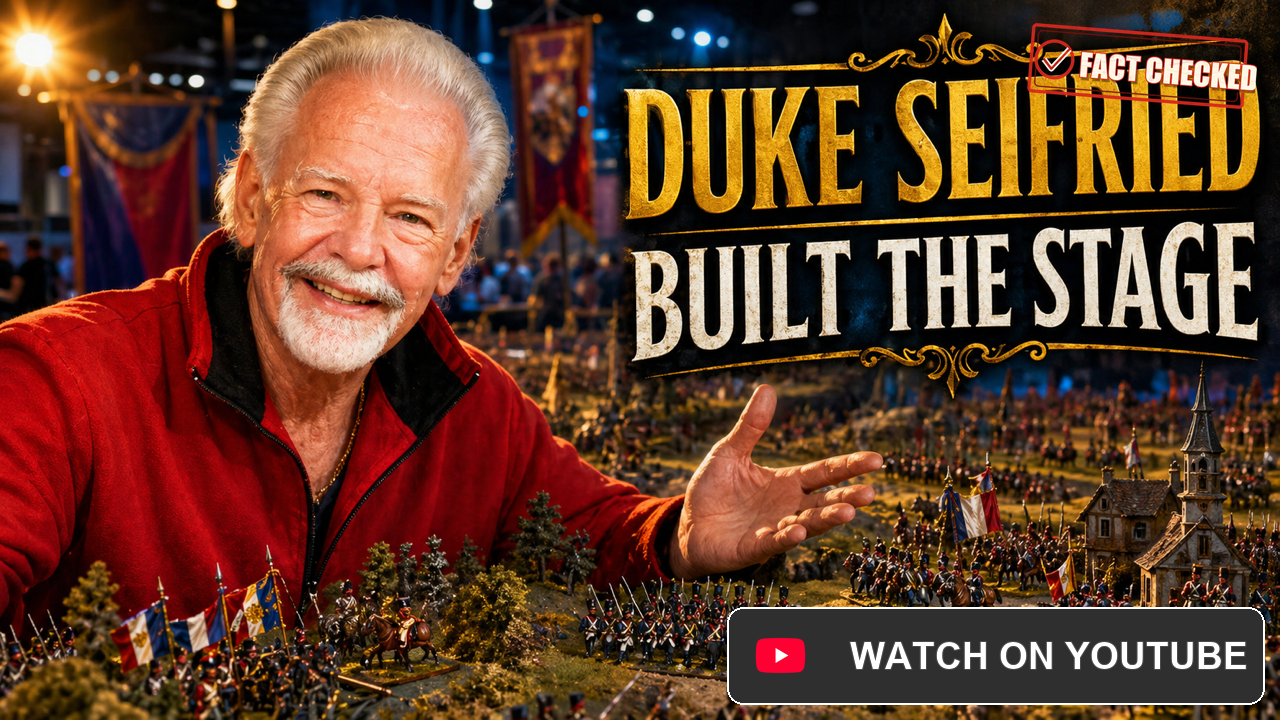
Before we talk about the games Duke Seifried designed, we have to talk about the stage.
That is where the real story is.
Bruce "Duke" Seifried was one of the great builders of American miniature gaming. He sculpted figures, sold figures, packaged figures, licensed figures, painted figures, and arranged figures into displays so large that they could stop a convention hall in mid-stride.
He helped make miniatures look professional on a store shelf.
He helped make fantasy and historical wargaming feel like parts of the same hobby.
He helped give the field one of its useful public names: adventure gaming.
He helped build the commercial and theatrical world in which other people’s games could live.
But that is not the same thing as writing the games.
Duke Seifried is one of the most important tabletop figures whose design bibliography is surprisingly small. That is not a contradiction. It is the shape of his career. He mattered enormously because he understood that play begins before the first rule is read. It begins when someone sees the table.
The Dayton Tables
Seifried came out of the early American miniature wargaming scene, especially the Dayton War Game Gang of the late 1950s and early 1960s.
Those were not quiet little games tucked onto a coffee table. They were giant Napoleonic battles played with thousands of figures on sand tables large enough to feel like terrain instead of a board. The habit of spectacle was there from the beginning.
The young Seifried did write rules. His key solo design was Melee, a Napoleonic miniature wargame from around 1960. This was not the later fantasy combat game with the same title. It was a product of early American historical miniatures culture, built for the kind of massed tabletop fighting the Dayton group loved.
Melee matters because it is the one confirmed place where Seifried stands as a primary rules author.
It is also hard to discuss in detail.
The full rules were preserved in Duke Seifried and the Development of American Miniature Wargaming, edited by John Curry and Jim Getz for the History of Wargaming Project. That same project describes Melee as one of the complete rule sets included in the book and as a major influence on American wargaming.
But the game has not become a public design conversation in the way Diplomacy, Tactics, Chainmail, Dungeons & Dragons, or Squad Leader have. There is no widely circulated mechanical breakdown. There is no common vocabulary of "the Seifried system" that later designers casually invoke. The rules exist, and they mattered within a circle, but they are not easy to evaluate from the outside.
That uncertainty matters.
The public record supports Seifried as a pioneer and showman. It gives much thinner evidence for Seifried as a major rules architect.
The Credits And The Caveats
Several game credits orbit Seifried’s name, but most of them come with qualifiers.
Napoleonique, first published in the 1970s and later revised, was written by Jim Getz with assistance from Duke Seifried. That is an important connection, especially because Getz and Seifried were part of the same larger miniature wargaming world. But the credit itself places Getz as the writer.
Frappé! has been described as coming from an idea by Seifried, with the development work credited elsewhere. That is a concept contribution, not the same as a finished rules design.
Panzertroops, tied to Heritage’s World War II miniature gaming material, was a collaboration with Stan Glanzer. That gives Seifried a real co-design credit, but the split of labor is not easy to reconstruct.
Then there is the larger confusion created by Heritage Models.
Seifried was a force inside Heritage. Heritage published and sold games. Therefore, later memory often pulls those products toward him. But publisher, manufacturer, executive, and designer are different jobs. Knights and Magick, Star Trek: Adventure Gaming in the Final Frontier, John Carter, Warlord of Mars, Swordbearer, and the Dwarfstar microgames all belong to other designers in the rules-writing sense.
Seifried helped make a company that could put those objects into the world.
He did not write all the plays performed on that stage.
The Packaging Of Wonder
The reason this distinction can feel unfair is that Seifried’s non-design innovations were not small.
He helped make the blister pack a standard form for miniatures retail. That sounds mundane until you think about what it changed. A figure in a bag or mail-order list is one kind of product. A small group of figures displayed in a clear package on a hobby shop pegboard is another. The customer can see the troops. The store can stock them. The hobby becomes visible.
He pushed licensed miniatures into the field early, bringing fantasy and media properties into tabletop figure lines before that became routine.
He helped popularize varied poses within packs, acrylic paints for miniature use, boxed hobby starter products, and trade-show displays with professional punch.
He also gave the field a phrase that helped join historical wargaming, fantasy miniatures, and roleplaying under one tent: adventure gaming.
That phrase mattered because the 1970s hobby was splitting and merging at the same time. Historical miniatures players, fantasy players, and roleplayers did not always see themselves as part of one culture. Seifried did. He liked the blend. He liked the spark between what some players treated as separate worlds.
The phrase made room.
It did not create a combat mechanic. It created a public doorway.
The Tsr Doorway
Seifried’s time at TSR belongs to the same pattern.
He joined after Dungeons & Dragons already existed. He was not one of its originators, despite later blurbs and loose memory sometimes pulling him toward that myth. His TSR role was business, manufacturing, miniatures, and distribution.
That work still mattered.
Getting games into broader retail channels changed who could find them. A game on a bookstore shelf lives differently from a game known only through small hobby networks. Seifried understood packaging, sales, and presentation because those had always been part of his gift.
The mistake is not praising him for that.
The mistake is calling that work game design.
The Extravaganzas
If Seifried has a design signature, it lives most clearly in his convention displays.
His Extravaganzas were giant interactive dioramas: historical and fantasy battles rendered with huge numbers of miniatures, dramatic terrain, and a showman’s instinct for the gasp. Minas Tirith. Helm’s Deep. The Alamo. Khartoum. Normandy. Custer. Pirate scenes. Massive sand tables. Crowds of players and spectators.
These were not private art objects. They were invitations.
The rules for these events were deliberately simple. The goal was to get people playing fast, not to make them complete a study course before touching the table. A person could walk up, receive a quick briefing, and enter the scene.
That is Seifried’s genius in miniature.
He knew spectacle could lower the barrier to entry. The table did the first half of the teaching. The figures told you what mattered. The terrain showed you where the danger was. The eye pulled the hand forward.
For many designers, visual presentation is decoration added after the game has been solved.
For Seifried, the visual presentation was the recruitment engine.
He was not asking, "How do I model every historical detail?"
He was asking, "How do I make someone stop walking, lean over the table, and want to play?"
That question has its own craft.
The Award In His Name
The legacy confirms the shape of the man.
Seifried was inducted into the Origins Hall of Fame in 2005 as a publisher and pioneer in the miniatures industry. The Historical Miniatures Gaming Society continues to list the Duke Seifried Game Master of the Year Award as part of its awards program. Tabletop Gaming’s 2018 report on his death highlighted his role in pioneering miniatures, coining adventure gaming, bridging historical and fantasy play, and creating dioramas and displays.
Notice the language.
Publisher. Pioneer. Game master. Showman. Sculptor. Advocate.
Those are not lesser words.
They are simply different words.
The award in his name is not for the most elegant rules engine. It is for game mastering, presentation, and the ability to host a memorable miniature event. That is exactly right. Seifried’s deepest contribution was not the hidden math of a system. It was the public act of making tabletop play irresistible.
The Honest Shape
The honest profile has to hold two truths at once.
First: Duke Seifried’s direct rules-design record is modest. Melee is the key solo credit. Napoleonique is an assistance credit. Frapp√©! is a concept credit. Panzertroops is a co-design. The best evidence for rules influence exists in specialist wargaming history, not in broad public discussion.
Second: Duke Seifried’s hobby impact was enormous.
He helped transform miniatures from lead objects into packaged, licensed, displayed, paint-supported, convention-ready pieces of adventure. He understood that tabletop gaming was tactile before it was verbal. Before a player studies a rulebook, they see figures, boxes, terrain, colors, and other people having fun.
Seifried worked in that first moment.
He built the invitation.
That is why any profile of him that treats the small rules bibliography as the whole story misses the man. But any profile that turns his industrial and theatrical achievements into system-design achievements also bends the record.
The middle is more interesting anyway.
He was the rare hobby figure whose most important design object was not a rulebook.
It was the table.
What Remains
Duke Seifried died on September 29, 2018, at age 83.
What remains is not one famous game that everyone can still pull off a shelf. What remains is a set of habits the hobby absorbed so deeply they can feel invisible.
Miniatures hanging in clear retail packaging.
Licensed figures treated as serious gaming objects.
Fantasy and history sharing convention space.
Adventure gaming as a name broad enough to hold more than one tribe.
Huge display games that make strangers stop and stare.
An award that still carries his name because the hobby remembers what he actually did best.
The plays were written by other people.
Duke Seifried built the stage, turned on the lights, filled the hall, and made sure the audience knew where to look.
Fact Check Notes
Publication notes
This site is AI-assisted and human-reviewed. We use artificial intelligence to help gather research, organize source material, and draft profile content. Human editors then read, revise, and check each profile before it goes live. Most profiles are built through deep AI research and two separate rounds of fact-checking.