You pick up a book that promises you a world you already know. The names are right. The art looks familiar. The pitch hits all the expected notes. Then you play, and the table never quite gets there. It feels like the property has been reduced to references.
That gap is not usually about a missing rule. It is about a missing feeling.
Star Trek without the quiet pressure of responsibility. Dune without politics and suspicion. Tolkien without moral weight. You get the nouns, but the verbs that make the stories live never show up.
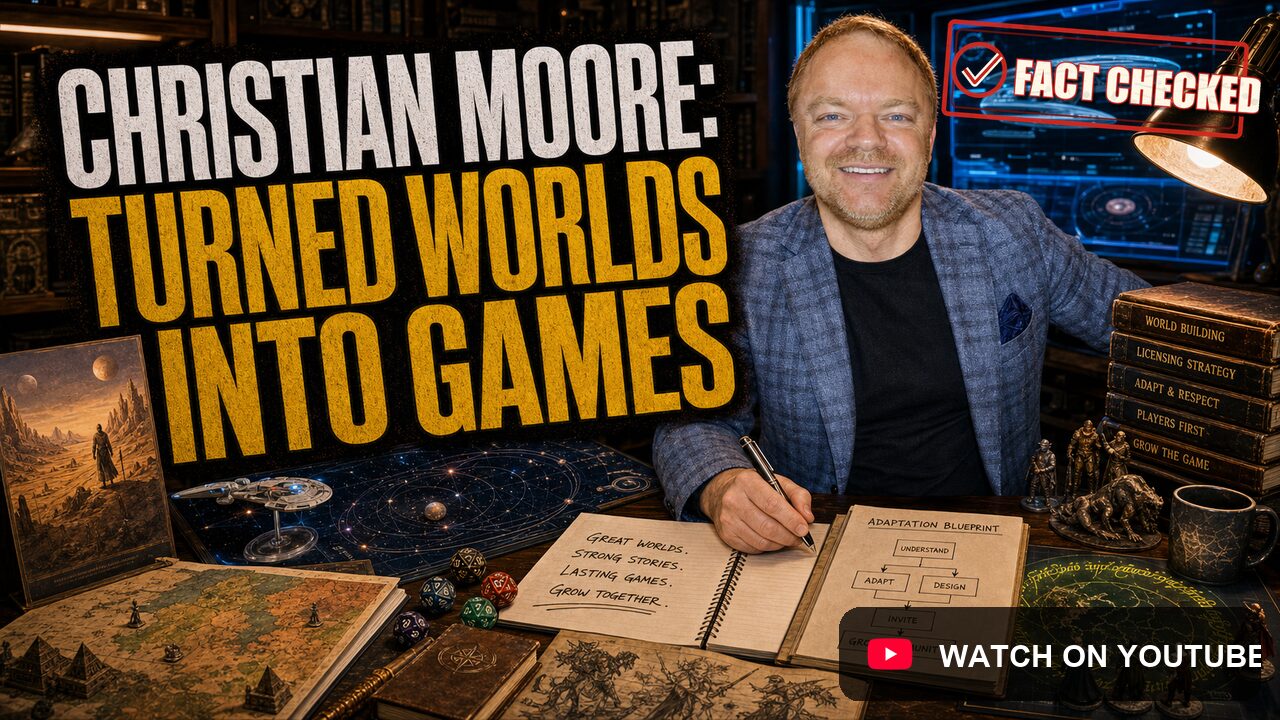
Christian Moore’s career has been shaped by that exact problem. Across different companies and eras, he kept returning to the work of translation: turning beloved worlds into playable experiences without shrinking them.
ARIA
Last Unicorn Games took shape in the 1990s with Christian Moore, Owen Seyler, Greg Ormand, and Bernie Cahill among its founding forces. One of the studio’s early flagships was Aria: Canticle of the Monomyth.
Aria did not aim for quick fantasy comfort food. It treated myth, culture, and history as game material, and it pushed the table to think in larger scales than a single party of adventurers. It asked what a people becomes over time, and how institutions and traditions bend under pressure.
That ambition made it memorable, and it also made it demanding. Aria required patience and shared intent. For some groups, that is exactly the point. For others, it is too steep a climb.
Either way, it revealed Moore’s instincts early. He was less interested in surface detail than in the machinery under a world, the parts that make a setting feel like a place instead of a backdrop.
Star Trek, Built For Tone
Last Unicorn’s best known breakthrough was Star Trek roleplaying in the late 1990s.
That era of Trek had a clear temperature. People expected competence. They expected moral dilemmas that do not have clean answers. They expected science, diplomacy, and a chain of command that actually matters. If you turn that into generic action with familiar names, fans will feel the betrayal immediately.
Tabletop design cannot lean on actors, camera language, or music. You have to build the experience out of choices, consequences, and what the rules quietly reward.
Last Unicorn approached Star Trek as a tone problem, not a branding problem. The line used the ICON System and expanded into multiple eras and sourcebooks, with an obvious but difficult goal: help ordinary players run sessions that feel like Star Trek episodes. Investigation has a place. Scientific thinking has a place. Ethical pressure has a place. So does the steady friction of duty.
When an adaptation lands, fans do not just recognize the setting.
They relax into it.
Dune, And How Fast A License Can Vanish
Last Unicorn also pursued Dune: Chronicles of the Imperium, a roleplaying take on Frank Herbert’s universe.
Dune does not forgive shallow adaptation. Its drama is built out of motive, inheritance, institutions, ecology, and the dangerous ways power disguises itself. A Dune table needs room for negotiation and maneuvering. It needs status and suspicion to be playable, not just decoration.
The book is remembered now partly because it became scarce. Around the period when Wizards of the Coast acquired Last Unicorn, Dune saw a limited release and then disappeared from ordinary availability, leaving behind the kind of collector legend that grows when something ends too early.
That scarcity is not just trivia. It is a reminder of how fragile licensed tabletop work can be. Even when a team understands a world, business reality can cut the line off before it finds its audience.
From Design To The System That Makes Design Possible
Moore’s path did not stay inside one studio.
Over time he worked in the wider Wizards and Decipher orbit, on or around multiple licensed properties and game lines. Like many people who last in tabletop, his work also moved toward the unromantic side of the hobby, the machinery that decides whether games survive.
Licensing and approvals. Distribution. Retail health. Production schedules. Digital storefronts. Marketing.
Fans sometimes treat those forces as separate from “the real work,” as if the game exists in a vacuum once the rules are written.
It does not.
Publishing is part of play. It determines what gets printed, what lines continue, and whether the people building worlds can keep their jobs long enough to finish what they started.
That context makes Moore’s more recent public role feel like continuation rather than departure.
In 2025, Paizo announced Moore as its Chief Growth Officer, with responsibilities spanning sales, e-commerce, marketing, and licensing. “Growth” is a word tabletop fans have learned to distrust, sometimes for good reason. Growth can mean a healthier business and more people at the table. It can also mean turning a community into a funnel and a world into a product.
The interesting question is whether you can scale without stripping away the reasons people trusted the thing in the first place.
What He Actually Built
Christian Moore did not build these games alone.
Licensed roleplaying is team work, shaped by writers, editors, developers, artists, and licensors. The lone genius version of this story gets the facts wrong, and it misses what matters.
Moore’s contribution is better described as a pattern.
He kept returning to translation. Aria treated culture and long time-scale change as play material. Star Trek treated tone as a requirement. Dune demanded politics and institutions, not just adventure. In each case, the aim was to protect the feeling that made the world beloved, then make that feeling something a group can produce together around a table.
In modern tabletop publishing, the same instinct shows up as a business question that is also a creative one.
How do you scale a world without killing the reason people entered it?
Where To Find Him
Moore’s early legacy is easiest to find through Last Unicorn’s catalog.
Aria: Canticle of the Monomyth remains a demanding design from the 1990s, remembered by people who wanted roleplaying to feel like building history instead of only running encounters. Last Unicorn’s Star Trek books are still spoken about with affection by fans who wanted tabletop Trek to feel like episodes, not generic space action.
If you want the collector artifact, Dune: Chronicles of the Imperium is the one people still hunt.
His current public work is through Paizo, where the job is less about a single mechanic and more about the long health of the worlds players already live in: Pathfinder, Starfinder, and whatever comes next.
Christian Moore’s story is not just a résumé.
It is a repeated promise to fans: if you love a world, the game should not ask you to leave it behind in order to play.
Fact Check Notes
Publication notes
This site is AI-assisted and human-reviewed. We use artificial intelligence to help gather research, organize source material, and draft profile content. Human editors then read, revise, and check each profile before it goes live. Most profiles are built through deep AI research and two separate rounds of fact-checking.
Leave a Reply
You must be logged in to post a comment.