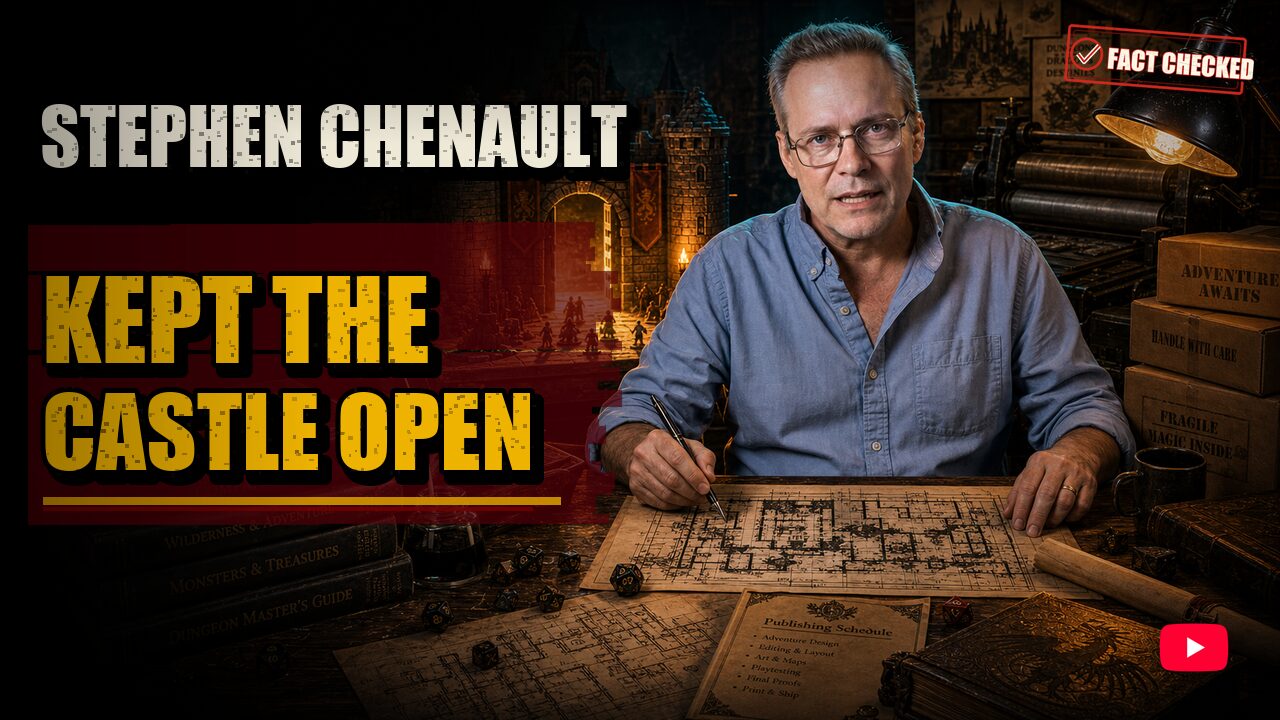
Some people change a game by writing the rule everyone remembers.
Stephen Chenault changed one corner of tabletop gaming by keeping the doors open.
That sounds less dramatic until you look at the years he had to keep them open through. The d20 boom. The d20 crash. The long shadow of third edition. The rise of PDF publishing. The Old School Renaissance. The death of Gary Gygax. The slow rebuild of old licenses. The 2023 OGL crisis. Crowdfunding. Virtual tabletops. Supply chains. Print costs. A tabletop business that never stops finding new ways to make small publishers prove they are serious.
Through all of that, Troll Lord Games stayed at the table.
Stephen Chenault is the co-founder and long-running public face of that company. With Davis Chenault and Mac Golden, he helped launch Troll Lord Games in Little Rock, Arkansas, in 1999. With the wider Troll Lord crew, he helped carry Castles & Crusades from a lean old-school fantasy engine into one of the longest-running independent fantasy RPG lines in the hobby.
His contribution is not only design.
It is stewardship.
The Company Under The Bridge
Troll Lord Games began with a private fantasy world and a publisher’s problem.
The Chenault brothers wanted to get their campaign material into print. Mac Golden had his own publishing idea with a gaming magazine called The Seeker. The pieces fit together well enough that the three friends formed a company.
The name came before internet slang swallowed the word troll. It belonged to the older fantasy meaning: bridge, myth, danger, and grin.
That early version of Troll Lord Games did not yet know what it would become. The first products were not a complete RPG line. They were setting material and adventures: After Winter’s Dark, The Mortality of Green, Vakhund: Into the Unknown. The company showed up at Gen Con in 2000 with books, ambition, and the kind of confidence that small publishers need before reality teaches them invoice math.
Then the market moved.
Dungeons & Dragons third edition arrived. The d20 System opened the gates for third-party publishing. Troll Lord Games moved into that current and found an audience.
But the important thing about Stephen Chenault’s career is not that he rode the d20 wave.
It is that he did not let the company drown when the wave broke.
The Game That Moved Faster
Castles & Crusades came out of a specific frustration.
By the early 2000s, many fantasy players liked the unified d20 mechanic but were tired of the weight surrounding it. Feats, skill allocations, tactical modifiers, prestige paths, and layered exception rules could make a session feel like a negotiation with the character sheet.
Troll Lord Games wanted something quicker.
The answer became Castles & Crusades, first seen in the 2004 white box and then in the Players Handbook. The central mechanic, the SIEGE Engine, is usually credited to Davis Chenault and Mac Golden as its primary architects, but Stephen Chenault’s role as publisher, champion, writer, and company driver mattered. He helped make sure the game existed, reached players, kept getting supported, and became more than a clever mechanic in a binder.
The SIEGE Engine asks the table to start with attributes. Some are Prime. Some are not. Prime checks begin from a lower base number. Non-Prime checks begin from a higher one. Add difficulty, roll a d20, add the right bonuses, and move.
The genius is not that the math is complicated.
The genius is that it is not.
The Castle Keeper can resolve almost anything with the same logic. The player can try something that is not printed as a skill. The table does not have to stop for a rule hunt every time someone gets creative.
That gave Castles & Crusades its place in the old-school revival.
It was not a retro-clone in the later, stricter sense. It did not merely photocopy an older rules chassis. It built a modern bridge back to an older rhythm of play: fast rulings, dangerous exploration, strong archetypes, and trust in the referee.
Stephen Chenault did not invent that tradition.
He helped keep it commercially alive at a moment when a lot of players were looking for it again.
Gary’S Publisher
The Stephen Chenault story cannot be separated from Gary Gygax.
The Chenaults met Gygax at Gen Con in 2000 and gave him early Troll Lord Games material. The relationship that followed became one of the most important pieces of Troll Lord Games history.
From 2001 until Gygax’s death in 2008, Troll Lord Games published major Gygax material, including books in the Gygaxian Fantasy Worlds line and work connected to Castle Zagyg. For a small independent company, that was not just a good publishing deal. It was a trust assignment from one of the founders of the hobby.
Stephen Chenault had to manage that trust.
That meant publishing the work, protecting the relationship, dealing with expectations, and later carrying the disappointment when Castle Zagyg stopped after Gygax’s death and the license situation changed.
Years later, Troll Lord Games returned to that legacy through renewed Gygax estate work, including public campaigns and new efforts around Gary Gygax’s Castle and related material. The exact shape of those projects belongs to the current company updates, not rumor. But the pattern is clear enough.
Stephen Chenault became one of the people responsible for keeping a door open between the hobby’s founding era and its current one.
That is not nostalgia as decoration.
It is archival work with printing invoices attached.
Sovereignty As A Business Model
Chenault’s strongest design instinct may not be on the character sheet.
It may be in the company structure.
Troll Lord Games has spent years trying to reduce the number of outside systems that can break its work. That shows up in direct sales, crowdfunding, domestic production, in-house printing capacity, PDF distribution, convention presence, and public community channels. It also showed up during the 2023 OGL crisis.
When Wizards of the Coast’s license fight shook the tabletop industry, Troll Lord Games chose a hard path: move Castles & Crusades away from OGL dependence and rebuild the line through Reforged editions. That meant text cleanup, legal caution, reorganization, and the risk of touching a game with two decades of shelf life.
The safer short-term move would have been waiting for the storm to pass.
Troll Lord Games did not wait.
That is the same instinct behind the company’s physical production choices. Small RPG publishers are vulnerable to freight costs, printer delays, paper prices, warehouse problems, and sudden market shifts. Building more print control close to home is not romantic. It is practical. It is also a statement about independence.
This is where Stephen Chenault’s work starts to look like game design again.
A company is a system. It has resources, bottlenecks, weak spots, and turn order. If you depend too much on one outside rulebook, one outside license, one outside printer, or one outside platform, then someone else can change your game.
Chenault’s answer has been to move more of the game back inside the walls.
The Troll Voice
Part of Troll Lord Games’ staying power is tone.
The company has never felt like a polished corporate mask. Its public voice is casual, direct, funny, sometimes messy, and usually personal. Stephen Chenault’s State of the Trolls updates and public appearances have tended to sound like a person talking across a table, not a brand department sanding every edge smooth.
That matters in tabletop.
Players do not only buy rulebooks. They buy trust. They buy a feeling that someone will answer when the book is late, when the campaign changes, when a PDF has a problem, when a Kickstarter gets complicated, or when an old line needs to be explained.
Troll Lord Games has built a community partly because the company still feels reachable.
That same value shows up in the company’s support for military personnel and veterans. Troll Lord Games’ veteran discount and deployment-support policies are not just marketing copy. They reflect a company culture that treats the game table as part of a larger human world.
That does not make every choice perfect. No small publisher gets through twenty-five years without uneven books, late schedules, rough edges, or projects that grow too large for their first plan.
But the voice held.
People knew who they were buying from.
What He Actually Built
Stephen Chenault did not single-handedly create the Old School Renaissance. He did not design Castles & Crusades alone. He did not personally author every Troll Lord Games book, solve every licensing problem, or preserve Gary Gygax’s legacy by himself.
What he built was the house that made those things possible.
He helped turn a home campaign and a few early products into a durable independent publishing company. He helped bring Castles & Crusades to market and keep it in continuous support. He helped give Gary Gygax a late-career publishing home. He helped steer Troll Lord Games through the d20 collapse, the OGL crisis, and the changing economics of RPG printing.
Most designers get remembered for a rule.
Stephen Chenault may be remembered for a threshold.
The castle stayed open because someone kept handling the unglamorous parts: printing, shipping, licensing, layout, campaigns, schedules, conventions, updates, and the thousand ordinary decisions that let extraordinary games keep reaching tables.
That is not a smaller legacy.
It is the part that lets the rest survive.
Where To Find Him
Stephen Chenault remains publicly active through Troll Lord Games. The official Troll Lord Games site, Troll Dens updates, BackerKit campaigns, Kickstarter campaigns, and company convention appearances are the safest current paths into his work.
For the game itself, start with Castles & Crusades Reforged and the current Troll Lord Games store. For the larger company story, follow the official Troll Lord Games updates around Aihrde, the Gygax projects, Amazing Adventures, Barsoom, and the continuing Reforged line.
The cleanest summary is still simple.
Stephen Chenault helped build a company around old-school adventure.
Then he kept it alive long enough for the old school to become new again.
Fact Check Notes
Publication notes
This site is AI-assisted and human-reviewed. We use artificial intelligence to help gather research, organize source material, and draft profile content. Human editors then read, revise, and check each profile before it goes live. Most profiles are built through deep AI research and two separate rounds of fact-checking.
Leave a Reply
You must be logged in to post a comment.