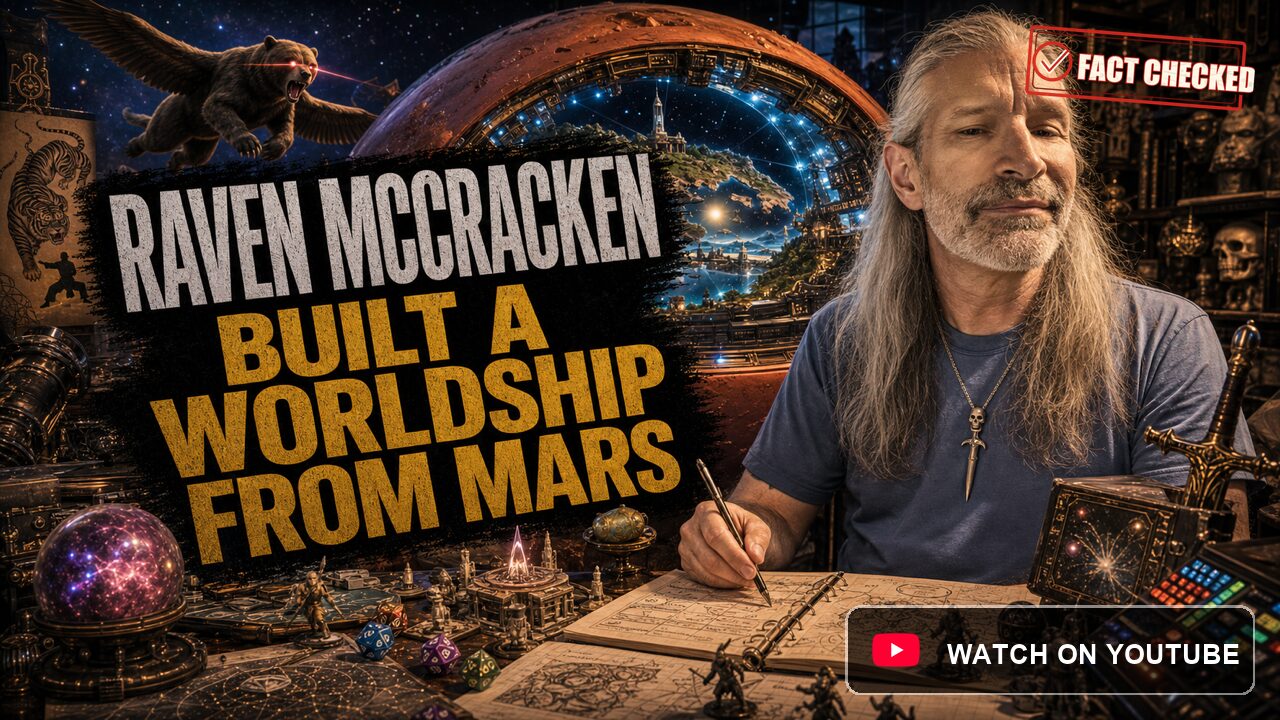
Raven c.s. McCracken made a hollowed-out Mars full of laser-eyed bears, martial-arts gnomes, mutant vampires, alchemical winged warriors, psionic cyborgs, gods, guilds, starships, hand-to-hand combat rules, and enough tables to make the book feel less like a game manual than a private mythology that escaped into print.
That was The World of Synnibarr.
First published in 1991, then revised in 1993, Synnibarr became one of the strangest artifacts in tabletop roleplaying history. People called it brilliant. People called it unplayable. People called it one of the worst games ever published. The label stuck because the game was easy to mock: huge numbers, strange terminology, wild character options, dense rules, and a setting that refused to choose between fantasy, science fiction, superheroes, martial arts, horror, and space opera.
But mockery is the simplest reading. Synnibarr is more interesting than that, because embarrassment and imagination are tangled together in the same book.
It is what happens when one creator decides the answer to every design question should be yes, then keeps building after everyone else would have stopped.
The Hollowed Planet
Synnibarr does not begin in a tavern.
It begins 50,000 years in the future, after Earth has been destroyed and Mars has been transformed into a massive worldship. The planet is hollowed out. Civilizations live inside it. Technology, magic, divine intervention, alien biology, guild politics, and cosmic travel all sit on top of each other because McCracken did not see genre as a set of walls.
For many designers, genre gives a game focus. In Synnibarr, genre is fuel.
The premise lets a character walk from fantasy ruins into high technology, then into divine cosmology, then into a monster encounter that sounds like it was designed by a teenager with no internal censor and too much paper. That is not an insult. Synnibarr’s most famous creatures survived because they are so specific. The giant mutant fire clam. The flying grizzly. The thermal drake. The sorts of things a cleaner, more professional book might have cut during development.
McCracken kept them.
That decision is the emotional key. A cleaner game would have looked more professional. It also would have been less itself.
That choice tells you almost everything about him as a designer. He was not trying to produce a balanced genre product for a defined shelf category. He was trying to preserve the full pressure of his imagination, even when that pressure made the book hard to use.
The Player As Cosmic Weapon
The same instinct shaped character creation.
Synnibarr did not ask players whether they wanted to be a fighter, a wizard, or a rogue. It asked whether they wanted to be a Mage Tiger, a Bio-Syntha Cyborg, a winged alchemist, a mutant vampire, an Amazon with biochemical control, or a non-classed adventurer stitched together from skills, cybernetics, mutations, psionics, and combat tricks.
This was player freedom in its most explosive form. Not narrative freedom in the modern sense. Not freedom from rules. Synnibarr gave players freedom through rules, options, points, charts, and stacked abilities.
That mattered in the early 1990s. The tabletop field still had many games that believed more detail meant more reality. If a character could lift enormous weight, the rules should tell you how much. If a martial artist could pin a weapon, throw an enemy, or strike several times in a second, the rules should try to model it. McCracken pushed that thinking until it became enormous.
His martial arts background shows through the system. Combat in Synnibarr wanted second-by-second control. It cared about physical action, strikes, throws, pins, momentum, and the exact feeling of a body doing something in space. The intent was not laziness. It was the opposite problem. McCracken wanted the game to account for too much.
That is where the fun and the trouble meet.
The Beautiful Problem
The early Synnibarr rules used percentile dice, deep derived statistics, large resource pools, merit points, and long lists of powers. It was possible to build characters with spectacular force almost immediately. It was also possible to get lost before play began.
The magic system and power lists could scale in ways that made the numbers lurch upward fast. Combat could swing from slapstick failure to sudden overkill. Character creation gave players so many levers that the game practically invited optimization. In the hands of a group that loved that style, the result could feel like opening every toy box in the house at once. In the hands of a group expecting clean modern usability, it could feel like being buried.
That is why Synnibarr’s reputation split so sharply.
Critics saw a rulebook that needed stronger editing, clearer organization, and tighter development. They were not wrong. The book became famous for density, strange phrasing, and systems that seemed to fight their own usability. Retrospective reviews often treat it as a cautionary tale about what happens when ambition outruns structure.
The defenders saw something else. They saw a game with no embarrassment about wanting to be huge. They saw monsters, classes, gods, planets, and powers that no cautious committee would have approved. Even people who would never run the rules as written have admitted that Synnibarr can be mined for ideas. It is a quarry of odd invention, and the quarry still has sparks in the stone.
That is the odd fairness the game deserves. It is not secretly elegant. It is not secretly simple. It is not secretly misunderstood because everyone else lacked imagination. It is a difficult, overstuffed, often baffling book.
It is also alive.
The Creator In The Rulebook
One of the most famous Synnibarr stories is that McCracken put his own contact information into the early material and invited players to reach out if the game was not being run correctly.
Whether told as comedy, criticism, or legend, the story fits the design. Synnibarr feels like a world whose creator wanted the physics to matter. A rule was not only a suggestion. It was a piece of how the universe worked.
That attitude runs against a lot of tabletop culture. Game masters change rules. Groups improvise. Tables ignore what slows them down. The modern hobby often treats the printed book as a starting point rather than a final authority.
McCracken’s early posture appears to have been much stricter. The rules described his universe, and the universe had weight. If the Fate, Synnibarr’s term for the referee, bent those rules too freely, something was being lost.
That can feel controlling. It can also feel sincere. The same stubbornness that made the game hard to edit is the stubbornness that let it exist at all.
The Long Return
Most strange 1990s RPGs vanish.
Synnibarr did not.
McCracken kept working on it for decades. Through Line of Sight Games and later publishing efforts, he pushed into board games, fiction, and other media, but Synnibarr remained the gravity well. The internet made the game easier to ridicule, then easier to rediscover. Its reputation as an infamous RPG became part of its identity.
The attempt to revive it through crowdfunding showed both sides of that identity. A large early campaign was too ambitious for the size of the audience. A smaller, more focused campaign found support. The modern Synnibarr project eventually produced new material, including the Ultimate Adventurers Guide and later Book of Fate material tied to the modern version of the system.
The important part is not that the revival became a mainstream hit. It did not. The important part is that McCracken kept revising. He did not leave Synnibarr frozen as a 1990s joke. He kept trying to make it work closer to the way he imagined it should.
That persistence changes the story.
The Honest Read
Raven c.s. McCracken is not a designer whose legacy rests on mechanical elegance.
His work did not give the hobby a clean procedure that everyone copied. It did not define a mainstream school of play. It did not become the model for how large RPGs should be organized. Synnibarr became famous as an example of what can happen when scope, terminology, math, and editing are allowed to expand without enough outside pressure.
But tabletop history needs room for the people who pushed too far.
McCracken represents a kind of independent design that is harder to imagine now: one person building a whole cosmos with minimal restraint, publishing it, defending it, absorbing years of jokes, then returning to keep working on it anyway. That kind of career does not produce tidy lessons. It produces an object.
Synnibarr is that object.
It is excessive. It is strange. It is funny when it means to be serious and serious when it sounds impossible. It contains the flaws of a game that needed more development and the force of a creator who could not stop building.
The best way to understand it is not as the worst game ever made. That phrase is too lazy for something this specific.
Synnibarr is one of the purest examples of maximalist tabletop authorship ever printed. Every weakness comes from the same source as every strength: McCracken wanted the game to hold everything.
Where To Find Him
McCracken remains publicly tied to Synnibarr and the long-running work around its modern editions. His current footprint is scattered across product pages, crowdfunding history, publisher listings, and the continuing online memory of The World of Synnibarr.
For new readers, the easiest way into the story is not to start by asking whether the old jokes were fair. Start with the premise. Mars hollowed into a worldship. Characters built like cosmic weapons. A rulebook that tried to put every genre on the same table and then dared the math to survive.
Most games choose a lane.
Raven c.s. McCracken built a road through all of them and filled it with flying grizzlies.
Fact Check Notes
Publication notes
This site is AI-assisted and human-reviewed. We use artificial intelligence to help gather research, organize source material, and draft profile content. Human editors then read, revise, and check each profile before it goes live. Most profiles are built through deep AI research and two separate rounds of fact-checking.
Leave a Reply
You must be logged in to post a comment.