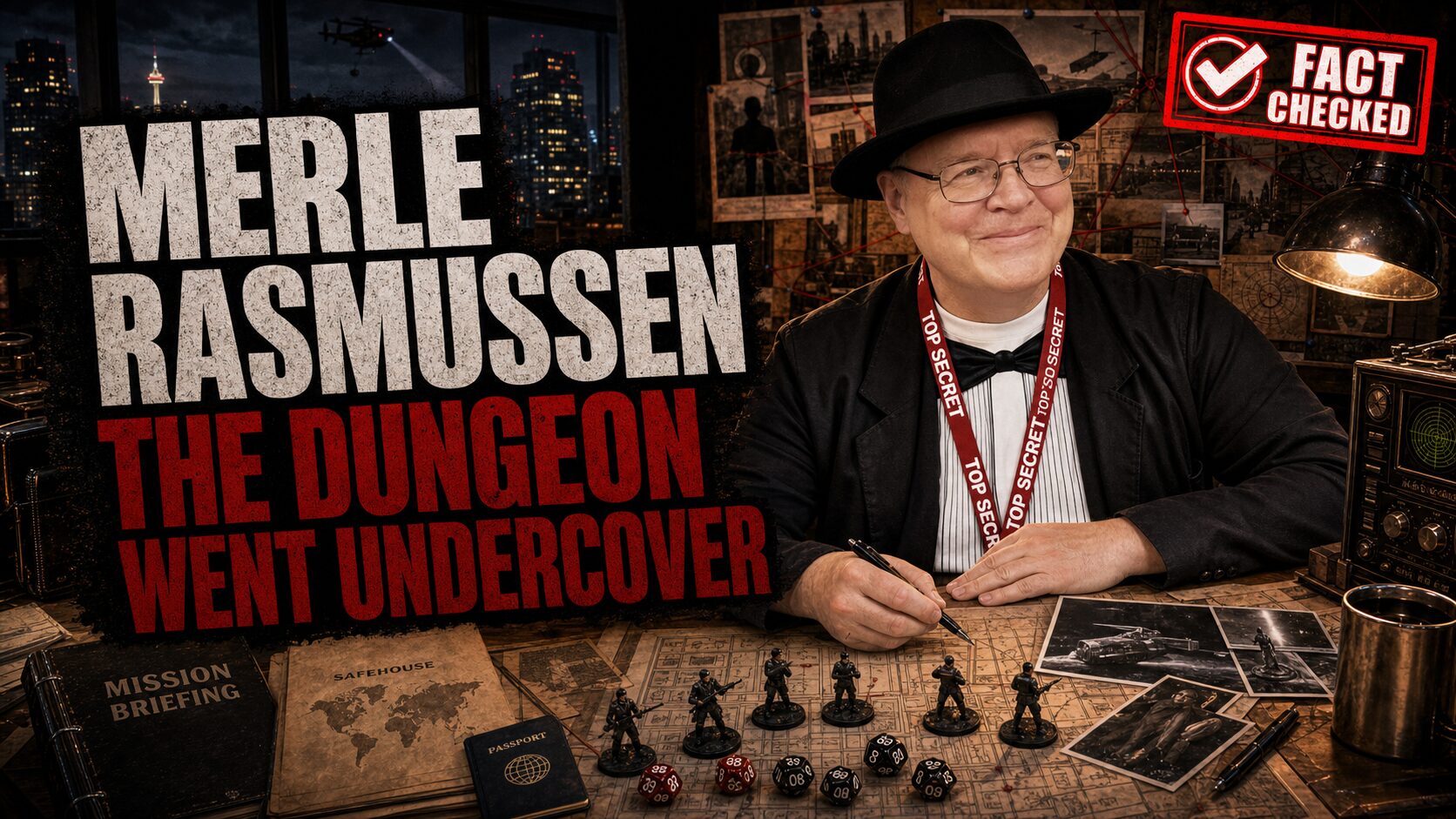
Merle M. Rasmussen gave TSR a passport.
Before Top Secret, TSR role-playing mostly lived in fantasy, science-fantasy, dungeons, ruins, monsters, mutants, and invented worlds. Players knew how to kick down doors, map corridors, fight creatures, find treasure, and argue with wizards.
Rasmussen asked them to do something else.
Blend in.
Lie convincingly.
Follow the target.
Plant the device.
Open the safe.
Escape without starting a war.
That was not a small genre shift. It changed the player’s imagination. A dungeon asks, "What is in the next room?" Espionage asks, "Who is watching me, and what do they think I am doing?"
That question became Top Secret.
The Iowa State Agent
Rasmussen began developing his espionage simulation in the mid-1970s while he was at Iowa State University. The timing matters.
Dungeons & Dragons had proved that role-playing could work. But the young hobby had not yet spread cleanly into every genre. Designers were still discovering what a role-playing game could be when it left fantasy behind.
Spy fiction was waiting.
James Bond was there. The Man from U.N.C.L.E. was there. Cold War tension was there. Gadgets, secret files, double agents, hidden bases, assassinations, coded messages, and enemy organizations were already part of the culture.
What had not been fully solved was how to put that energy at the table.
Rasmussen wrote to TSR. Mike Carr responded. The project moved into review and development. By 1980, TSR published Top Secret: An Espionage Role Playing Game.
It was one of TSR’s earliest major moves outside fantasy adventure, and it is widely cited as the first published espionage role-playing game.
That alone gives Rasmussen a place in the history.
But the better question is what Top Secret asked players to do.
The Dungeon Went Undercover
Top Secret did not simply replace swords with pistols.
That would have been easy.
It changed the posture of play. The gamemaster became the Administrator. Characters became agents. Missions replaced dungeon crawls. Equipment lists became tradecraft. Organizations mattered. Modern locations mattered. Getting caught could matter as much as getting shot.
The game used percentile mechanics and d10s. It gave players a way to think about physical ability, knowledge, charm, courage, movement, combat, and the tools of espionage in a modern frame. But the real shift was behavioral.
A fantasy adventurer can walk into a ruin wearing armor and carrying a sword.
A spy has to get through customs.
That difference changes everything.
Players now had to think about cover identities, surveillance, contacts, alarms, documents, vehicles, timing, and consequences in a world that looked more like their own. The monster was no longer always in the room. Sometimes it was in the file cabinet, the border checkpoint, the hotel lobby, or the person smiling too calmly across the table.
Top Secret made role-playing contemporary.
Not universal. Not perfect. Not realistic in every way.
Contemporary.
The danger wore a suit.
The Fbi Story
One of the famous Top Secret stories sounds like it belongs in the game.
During playtesting, a note about a fictional assassination plot, written on TSR stationery, reportedly brought the FBI to TSR’s offices. It was a prop, a piece of spy-game fiction that wandered too close to the real world.
That story is funny because it is absurd.
It is also revealing.
Fantasy props rarely summon federal attention.
Espionage play sits closer to reality. A castle map looks like a game. A monster stat block looks like a game. A fake assassination note on company stationery can look like something else.
That was part of the electricity of Top Secret. It brought role-playing into a genre where the line between pretend paperwork and real paperwork could feel uncomfortably thin.
The game was still entertainment.
But the costume changed.
The Administrator’S World
Top Secret had a strong early following because it offered a different fantasy of competence.
Not power fantasy in the dungeon sense.
Professional fantasy.
Players could become agents with specialties. They could operate inside agencies, bureaus, missions, briefings, and operations. The fantasy was not simply being stronger than the enemy. It was being prepared, trained, cleared, briefed, and dangerous in a world of secrets.
That is why the word Administrator matters.
It makes the game feel like a file system. There are operations. There are reports. There are clearances. There are agencies. There are people who know more than you. There are instructions you may not fully trust.
Rasmussen kept supporting that world through Top Secret material. The Top Secret Companion expanded the game in 1985. G4 File: Guns, Gadgets & Getaway Gear followed in the Top Secret/S.I. era. Dragon Magazine carried Top Secret articles and material that helped the line feel like more than a single box.
Again, the game was not only "spy D&D."
It had its own vocabulary.
The Limits Of The First Mission
Top Secret was still an early RPG.
It could be crunchy. It could show the seams of its era. Some adventures still borrowed the old structure of "go to dangerous place, defeat hostile force, complete objective," just dressed in modern clothes. Later espionage RPGs would find sleeker ways to handle cinematic pacing, investigation, conspiracy, and tradecraft.
That is the honest boundary.
Rasmussen did not solve every espionage design problem in 1980.
What he did was open the door.
Once the door was open, the hobby could walk through it. James Bond 007 would make espionage more cinematic. Top Secret/S.I. would reshape the line under Douglas Niles. Conspiracy games, techno-thrillers, special-operations games, and modern action RPGs would keep exploring territory that Top Secret helped mark.
Every later spy game did not descend directly from Rasmussen.
But Top Secret proved the genre belonged at the table.
That proof mattered.
The Return Of Top Secret
Rasmussen did not leave the file closed forever.
Decades later, he returned with Top Secret: New World Order, working with Jayson Elliot, James Carpio, Allen Hammack, Chad Parish, A.J. Davenport, and others connected to the revival. The new version updated the premise for a world of modern threats, shadow organizations, high technology, surveillance, and shifting alliances.
That return matters because it shows the original idea still had pressure in it.
Espionage did not stay frozen in 1980. The Cold War changed. Technology changed. The public imagination changed. The spy fantasy moved from dead drops and embassy parties into drones, networks, data, contractors, private actors, and global uncertainty.
Rasmussen’s return to Top Secret was not only nostalgia.
It was a recognition that the genre still had work to do.
After this profile went live, Rasmussen himself added the most fitting possible update: the page had pictured Allen Hammack instead of Rasmussen. Rasmussen joked that Hammack, "The Silencer," had been protecting his true identity since February 1980. It was a funny correction, but also a useful one. Hammack was part of the Top Secret story, but Merle M. Rasmussen is the designer whose face belongs on this page.
Rasmussen also shared a current mission briefing of his own. He said he is designing TOP SECRET 2150: Spies in Space(R) with Joseph Bloch of BRW Games. That matters because it shows the Top Secret idea is still not locked in the past. The original game moved role-playing into modern espionage. This new project, by Rasmussen’s own account, points the file toward science fiction and spacefaring spy work.
He has also remained active around the old-school gaming world. Gary Con’s 2025 guest page notes recent and ongoing projects including Rendezvous Oasis for Top Secret: New World Order, Rasmussen’s Planetarium through Frog God Games, Stagecoach King through Kenzer & Company, and other writing projects.
That is a good late-career shape.
The designer who took TSR out of the dungeon kept building worlds.
What He Actually Built
Merle M. Rasmussen did not invent spy fiction.
He did not design every later version of Top Secret. He did not create every modern or espionage RPG that followed. Top Secret was not the final word on tradecraft, investigation, conspiracy, or cinematic spy action.
What he built was the first major bridge.
He showed that role-playing could move into the modern world and still feel like role-playing. He gave TSR a non-fantasy genre with its own procedures, tone, vocabulary, and player behaviors. He asked players to stop thinking like tomb robbers for a while and start thinking like agents.
That shift is bigger than one boxed set.
Top Secret changed the shape of possibility.
The dungeon did not disappear.
It put on a suit, picked up a dossier, and crossed the border under a false name.
Where To Find Him
Merle M. Rasmussen is still publicly connected to Top Secret’s legacy.
Top Secret: New World Order is available through Solarian, Gary Con’s 2025 profile mentions ongoing writing and game work, and Rasmussen has now publicly said he is designing TOP SECRET 2150: Spies in Space(R) with Joseph Bloch of BRW Games. His older TSR material remains part of early RPG history, especially for players interested in the moment when role-playing moved beyond fantasy into modern espionage.
Start with the original Top Secret if you want the first mission.
Look at Top Secret: New World Order if you want to see Rasmussen return to the file decades later.
Then look at the wider hobby and notice how normal modern-world RPGs feel now.
That was not always true.
Somebody had to open the briefing folder first.
Merle M. Rasmussen did.
Fact Check Notes
Publication notes
This site is AI-assisted and human-reviewed. We use artificial intelligence to help gather research, organize source material, and draft profile content. Human editors then read, revise, and check each profile before it goes live. Most profiles are built through deep AI research and two separate rounds of fact-checking.
Leave a Reply
You must be logged in to post a comment.