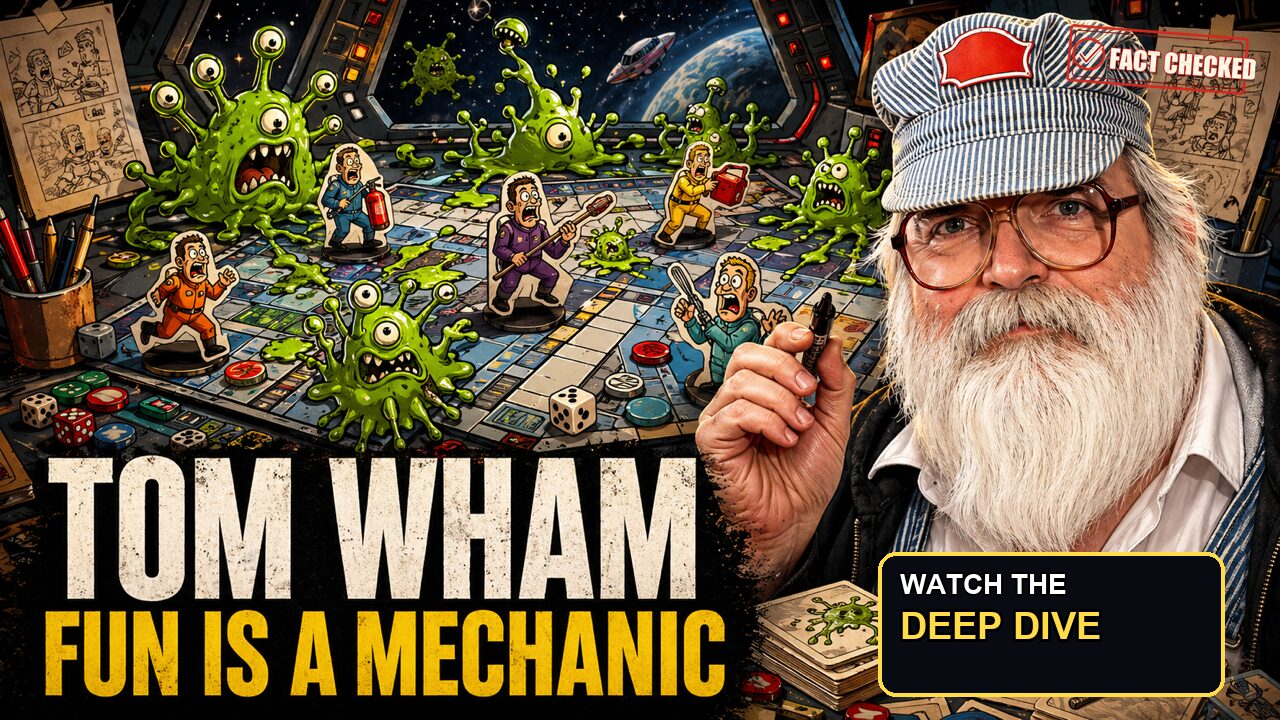
That was the point.
By the late 1970s, tabletop gaming had a seriousness problem. Avalon Hill had trained one wing of the hobby to respect hexes, odds tables, and historical rigor. Dungeons & Dragons had trained another wing to respect charts, character sheets, monster statistics, and rules arguments that could turn one hallway into a court case.
Wham came from the same world. He worked at TSR. He contributed art to the original Monster Manual. He designed games with counters, combat, maps, and rules.
But the emotional temperature was different.
A Tom Wham game did not ask you to admire the simulation. It asked you to laugh, panic, poke the machine, and see what happened. The art was not frosting. The joke was not a break from the design. The cartoon was the interface.
That was his gift: he understood that tone changes how people play.
Tsr Employee Number Thirteen
Wham’s official Tom Wham Games biography says he had been designing games since childhood, after getting a Monopoly set and immediately modifying the rules. That is a good origin story because it sounds exactly like him: take the thing everyone knows, scribble on it, and see if it gets livelier.
His first published design credit came before TSR. In 1972, while working in shipping, layout, and whatever else needed doing at Guidon Games, he co-authored Ironclad, a set of Civil War naval miniature rules. Gary Con’s profile describes that as his first design credit, published in 1973.
Then came the Lake Geneva doorway.
In May 1977, Wham arrived at TSR as the company’s thirteenth employee. He ran the Dungeon Hobby Shop for a summer, then moved into the art department. He worked with Dave Sutherland and Dave Trampier on the original Monster Manual and contributed several illustrations, including the early published depiction of the Beholder.
That part of the story is not a board-game design credit. It still matters. Wham was helping shape the visual grammar of fantasy gaming at the exact moment the hobby was learning what its monsters looked like.
He was also standing near the printing presses.
The Centerfold Game
Wham made a deal with Tim Kask, editor of The Dragon, to put a complete game into the magazine.
That sounds small now. It was not small.
A board game normally came in a box. It had a board, counters, rules, packaging, a retail price, and a shelf. Wham’s Dragon games traveled lighter. Pull out the center pages. Cut out the pieces. Read the rules. Play.
Snit Smashing appeared in Dragon #10 in 1977. Snit’s Revenge followed in Dragon #11. The Awful Green Things from Outer Space arrived in Dragon #28 in 1979. Search for the Emperor’s Treasure, File 13, King of the Tabletop, and Elefant Hunt followed in later issues.
These were not previews. They were games.
The format did two things at once. It gave Wham a place to publish strange work that might have looked risky as boxed product, and it gave readers a direct relationship with game design. You could buy a magazine and end up with a full board game on your table that night. The scissors were part of the ritual.
Several of those designs later grew into boxed or commercial editions. The magazine insert was a proving ground, but it was also a statement: a game did not need to be large to be complete.
The Weapon You Do Not Understand
The Awful Green Things from Outer Space is Wham’s cleanest miracle.
The setup is perfect cartoon science fiction. The crew of the Znutar has discovered hostile green things aboard ship. The things grow, split, swarm, and threaten to overrun the vessel. The crew has weapons. Fire extinguishers. Rocket fuel. Pool sticks. Stun pistols. Cans of food. Whatever is lying around the spaceship.
The trick is that nobody knows what the weapons do.
When a weapon is used for the first time, its effect is randomly determined for that session. It might kill. It might stun. It might shrink the target. It might make the green thing grow. It might do nothing useful at all. Once the effect is known, that weapon works the same way for the rest of the game.
The Science Fiction Encyclopedia’s entry captures the center of it: the crew’s weapons have unknown effects until tried, and early play becomes a desperate experiment while the things multiply.
That is a beautiful design idea.
The game does not just randomize outcomes. It randomizes knowledge. You cannot begin with a perfect plan because you do not yet know what your tools are. Testing becomes strategy. Sacrifice becomes information. The first half of the game feels like people in a bad movie grabbing whatever is nearby and yelling, "Try this!"
That could have been frustrating in a serious tactical game. In Wham’s hands, it is funny because the whole presentation tells you how to receive disaster. If the fire extinguisher makes the monster bigger, the game has not betrayed you. It has delivered the scene it promised.
That is tone as design.
Kings, Things, And Maps That Draw Themselves
Wham’s fantasy strategy work moved the same playful instinct onto a wider map.
King of the Tabletop appeared in Dragon #77 in 1983. It later became Kings & Things, expanded and commercially published through West End Games and other publishers, with Rob Kuntz involved in the larger edition. The game let players build a kingdom from tiles and chits, filling a fantasy world with hidden armies, odd creatures, heroes, and hazards.
It is not Catan before Catan. That comparison is too neat and too flat. Wham’s map is rowdier. It is full of surprise forces, monsters, comic fantasy, and war. But it does share a big modern instinct: the board is not simply given to the players. It is revealed, built, and made strange through play.
You are not exploring a polished fantasy atlas. You are opening boxes inside boxes.
That difference matters. Wham’s world-building is not mainly about efficiency. It is about discovery. The fun lives in turning over the next tile, meeting the next absurd thing, and having your plan shoved sideways by whatever the game coughs up.
The Art Does The Work
Wham’s games are hard to separate from his drawings.
The green things are funny because they look like Wham drew them. The Snits work because they look like anxious little creatures from a newspaper strip that wandered into a biology lesson. The fantasy counters in his kingdom games have the looseness of doodles, but they also make the rules easier to enter. You know how seriously to take the game because the art tells you.
That can sound like a soft contribution. It is not.
Graphic tone controls player behavior. A grim war map encourages caution, calculation, and complaint when the dice go wrong. A Tom Wham board gives players permission to experiment. It lowers the social cost of losing. It makes bad luck feel like a story instead of an error.
This is why his games can survive swingy outcomes that would hurt a colder design. The randomness is high. Balance can wobble. Some sessions tilt hard toward one side. The Awful Green Things can become a slaughter if the crew discovers the wrong weapons too late.
But the joke is load-bearing. Players forgive chaos when the game has taught them to enjoy the crash.
The Side Career That Would Not Stop
Wham was not always a full-time professional game designer in the modern sense.
At TSR, much of his work was art, layout, editing, development, and production. After TSR, his own site says he eventually worked for many years as the computer guy at the Lake Geneva Public Library. Gary Con’s profile says he retired from that library IT role in 2003.
The games kept coming anyway.
There was Iron Dragon, a fantasy railroad game from Mayfair. There was The Great Khan Game with Richard Hamblen. There was Mertwig’s Maze. There was Feudality from Z-Man Games in 2011. There were collaborations with James M. Ward, self-published projects, handmade prototypes, and later Tom Wham Games, the company he formed with Dave Conant after 2017 to bring more of those shelf games into print.
The recent work matters because it shows the habit never left. Tom Wham Games currently sells games, art, apparel, and related merchandise. Its Moose Quest page describes a new Kickstarter version published in July 2025. Its events page lists 2025 appearances and the continuing Whamathon tradition, adjusted for age but still centered on sitting down to play a pile of Tom Wham games.
That is not a nostalgia act. It is continuity.
What He Actually Built
Tom Wham did not invent humor in tabletop games. He did not create every light strategy game that came after him. His mechanics did not become a widely copied school in the way some designers’ systems did. The unknown-weapon idea in The Awful Green Things remains more admired than imitated.
What he built was permission.
Permission for a game to be a cartoon and still be a real game. Permission for a magazine insert to count. Permission for randomness to create comedy instead of merely variance. Permission for art to carry rules, not just decorate them. Permission for a designer’s personal tone to be visible on every counter.
That is why Wham’s work holds a specific place in the hobby. The games are not perfect machines. They are lively machines. They rattle, grin, surprise you, and sometimes bite the person who thought they had solved them.
The design lesson is not that fun replaces craft. Wham had craft. The lesson is that fun can be the craft.
Where To Find Him
Tom Wham is still publicly active through Tom Wham Games, the company he and Dave Conant built to publish and sell his games, art, and related work. The site lists current products, including Moose Quest, and points fans toward convention appearances and Whamathon events.
Gary Con’s current profile describes him plainly: he continues to design games today.
That feels right. Some designers leave behind systems. Wham leaves behind situations: a spaceship overrun by green things, a cartoon body invaded by Snits, a fantasy kingdom made from chits, a table full of people discovering that the thing they thought was a weapon may have just made the monster worse.
Then everyone laughs.
That laugh is part of the rules.
Fact Check Notes
Publication notes
This site is AI-assisted and human-reviewed. We use artificial intelligence to help gather research, organize source material, and draft profile content. Human editors then read, revise, and check each profile before it goes live. Most profiles are built through deep AI research and two separate rounds of fact-checking.
Leave a Reply
You must be logged in to post a comment.