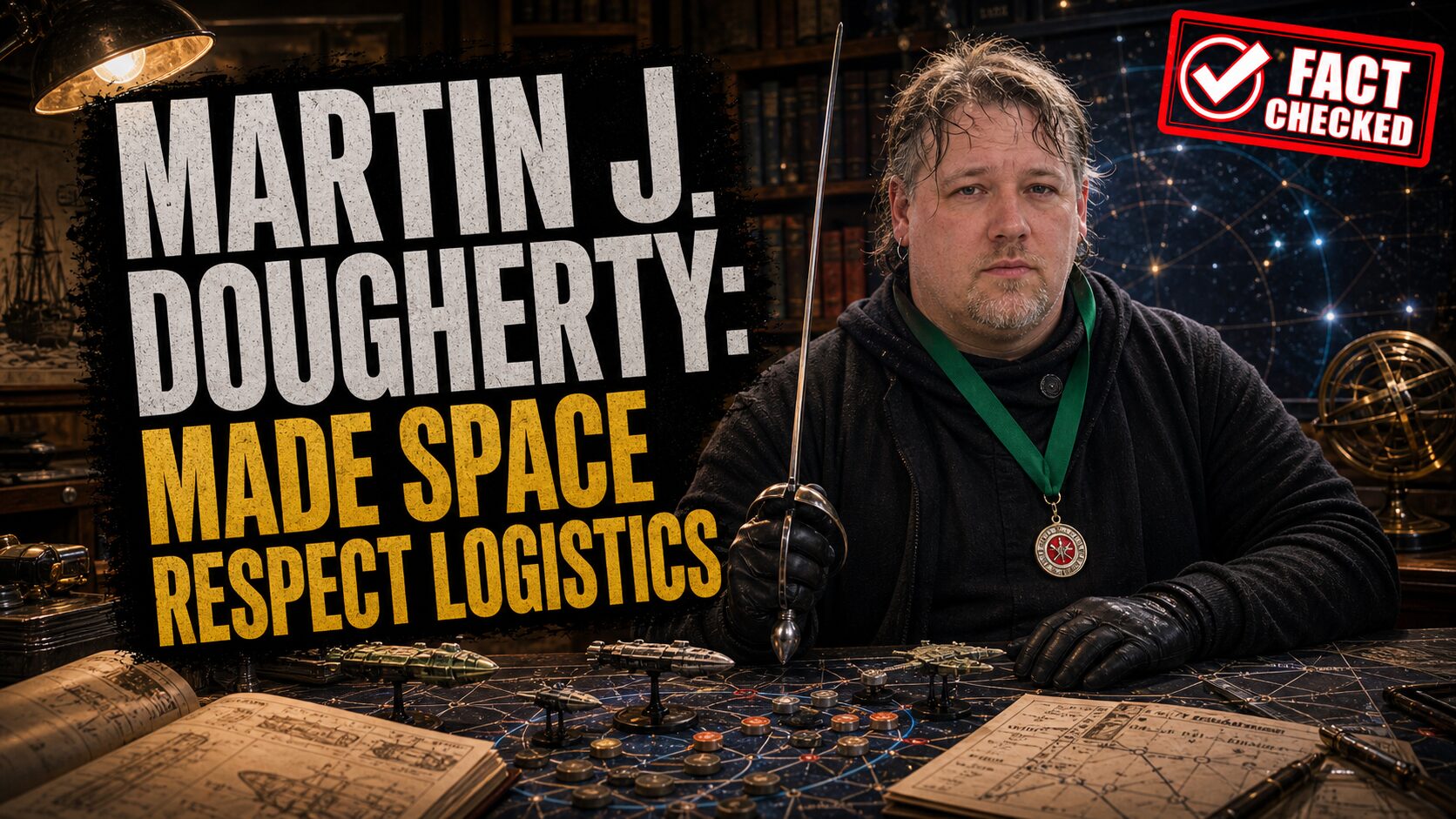
That sounds like a small distinction until you sit down with Traveller. A lot of space adventure treats warships, mercenaries, empires, and unexplored sectors as dramatic scenery. Dougherty treats them as systems. A ship has range. A regiment has supply problems. A border war has production limits. A single world cannot dominate a region unless the economics, geography, and politics explain why.
That is the quiet spine running through his tabletop work. Dougherty did not create Traveller, and he did not invent military science fiction roleplaying. What he has done, across decades of writing and design, is make imagined space feel operational. His version of adventure is not about invulnerable heroes cutting through a fair fight. It is about ordinary capable people trying to survive inside worlds that push back.
That instinct did not come from one place. It came from tabletop games, military history, defense analysis, fencing, self-defense instruction, and a long working life spent thinking about what actually happens when plans meet pressure.
From Fanzines To Fault Lines
Dougherty came out of the older hobby culture where writers often learned by doing. Before the cleaner version of the roleplaying industry existed, there were fanzines, postal games magazines, startup publications, and small publishers with more enthusiasm than money. He wrote for that world early, then moved through computer game documentation and quality assurance work where the job was not to admire a system. The job was to break it.
That matters.
Error-trapping a computer game teaches a designer to look for the place where a rule collapses. It asks a very practical question: what happens when someone does the thing the designer did not expect? Dougherty carried that habit into tabletop writing. His settings rarely feel like painted backdrops because he keeps asking what happens underneath the obvious adventure.
If a sector has trade routes, who protects them? If a fleet moves across the map, where does it refuel? If a mercenary unit takes casualties, who pays for recovery, transport, ammunition, and legal cover? If a supposedly minor world has outsized power, what is the hidden reason?
Those are not decorative questions. In Dougherty’s work, they are adventure engines.
The Traveller Problem
Traveller is one of tabletop roleplaying’s great sandboxes. It has always promised freedom: get a ship, find a crew, take a job, cross the border, make money, get in trouble. The danger of a sandbox that large is that it can turn into a pile of local facts. One world is interesting. One subsector is interesting. One naval base, one patron, one alien ruin, one map hex.
Dougherty’s strength is seeing the bigger machine.
He has often described a top-down approach to Traveller setting work. Instead of starting only with a local planet and building outward, he starts with the large structure: sectors, borders, economics, military reach, political friction, industrial capacity. Then he moves inward. The local adventure still matters, but now it sits inside a believable pressure system.
That approach has shaped much of his modern Traveller work for Mongoose Publishing. His name is tied to major pieces of the current line, including sector material, equipment and naval support, mercenary frameworks, exploration campaigns, and the modern handling of The Fifth Frontier War. The exact credits vary from book to book, and Traveller is too large to reduce to one writer, but Dougherty has become one of the major architectural voices of the Mongoose era.
His work on Mercenary shows the pattern clearly. The fantasy version of mercenary adventure is simple: take a contract, bring big weapons, win the fight. Dougherty is more interested in the machinery around the fight. Who hires you? What can you legally carry? What happens when you need medevac? What does it cost to move troops through interstellar space? What does a professional fighting force look like when it is not protected by heroic immunity?
That may sound less glamorous. In play, it often makes the story better. Limits create choices. Scarcity creates plans. Logistics make victories feel earned.
War That Does Not Care About Balance
Many tabletop games are built around fair encounters. The players meet an enemy that is tuned to their level, their gear, and their expected chances. Dougherty’s military design instincts push in a different direction.
Real conflicts are not fair. They are lopsided, confused, expensive, political, and often decided before the first shot by supply, morale, intelligence, geography, or production. Dougherty’s defense writing and military history work feed directly into that outlook. He has written widely about battles, weapons, strategy, ancient warfare, modern hardware, and the difference between a spectacular machine and a useful one.
That difference is central to his design voice. A weapon can be impressive and still be a strategic failure. A fleet can be powerful and still arrive too late. A faction can have better soldiers and still lose because it cannot sustain the war. A player group can win by refusing the fight everyone expected them to take.
That is why his Traveller campaigns tend to feel less like balanced board states and more like living military problems. The Fifth Frontier War is the clearest example. The classic Traveller conflict between the Third Imperium and the Zhodani Consulate is not just a backdrop for shooting. In Dougherty’s handling, the war becomes a sector-wide pressure system, with intelligence, force projection, politics, and local choices all pulling against one another.
The exciting part is not that players stand near history. It is that they can push on it.
The Long Voyage
Dougherty is not only a writer of war. One of his most striking Traveller projects is Deepnight Revelation, a huge long-form campaign built around a dangerous expedition far beyond familiar space.
The premise is cinematic: a starship and crew undertaking a voyage into the unknown, with isolation, resource strain, strange discoveries, and moral decisions accumulating over years of fictional time. But again, the real drama comes from systems under stress. Exploration is not just wonder. It is maintenance, morale, medicine, command judgment, scientific uncertainty, and the slow psychological cost of distance.
That is a very Dougherty move. He does not drain the romance from space travel. He makes the romance more expensive.
Deepnight Revelation works because the vastness is not just a painted starfield. It is a practical problem. A ship alone in deep space becomes a community, a workplace, a military asset, a laboratory, and a fragile home. When something goes wrong, the question is not only whether the heroes are brave. The question is whether the whole expedition can absorb the consequence.
That kind of campaign gives players freedom without pretending the universe is weightless.
History, Horror, And Hard Choices
Dougherty’s tabletop work also reaches beyond Traveller. His contributions to Cubicle 7’s World War Cthulhu line show another side of the same discipline. The pitch could easily have gone wrong: historical war plus Lovecraftian horror is a dangerous mix if the real history becomes costume.
The better version treats the war seriously. Dougherty’s military background helps there. The horror does not need to come only from monsters. It can come from intelligence work, occupied cities, compromised missions, bad information, civilian danger, and the moral pressure of operating inside a catastrophe. The Mythos makes the darkness stranger, but the human war is already frightening.
He has also written for Paranoia, where the same structural mind turns toward bureaucracy, absurdity, and failure. That range is useful. It shows that his design voice is not just "make everything grim." It is "make the premise behave." Traveller behaves like a frontier and a military economy. World War Cthulhu behaves like intelligence work under impossible stress. Paranoia behaves like a machine built to punish competence.
Different tones. Same respect for the system.
The Fencing Master’S View Of Design
Dougherty’s martial arts and historical fencing work are not side trivia. They explain a lot about his games.
He has spent decades teaching and assessing physical combatives, fencing, and self-defense. In that world, theory fails fast. A technique that looks elegant in a calm room may fall apart under fear, fatigue, confusion, or speed. Good instruction has to survive pressure. It has to favor repeatable fundamentals over fragile cleverness.
That maps almost perfectly onto his tabletop preferences.
He tends to favor competent generalists over fantasy superheroes. He is drawn to people who have enough training to act, but not enough power to ignore the situation. The best solution is rarely the most ornate one. It is the solution that still works when the plan goes sideways.
That is why his adventures do not need to railroad players into one correct answer. If the environment is built honestly, players can solve problems from strange angles. They can negotiate, hide, bluff, salvage, reroute, improvise, retreat, or make a bad deal and live with it. The referee does not need to force drama. The situation already has teeth.
What He Actually Built
Dougherty did not make Traveller popular by himself. He did not create its original rules, its Third Imperium, or its oldest maps. He is also not the only important writer in the Mongoose era.
What he built was structural trust.
That is a different kind of contribution. It is the feeling that a setting has load-bearing walls. It is the confidence that a war has reasons, a ship has limits, a sector has politics, and a local job connects to something larger than tonight’s encounter.
His influence is less about one famous mechanic than about a design posture. Start with the world as a functioning system. Let economics and logistics matter. Let violence be dangerous. Let ordinary people remain ordinary enough that courage still costs something. Give players room to act, then make the world respond.
For a game like Traveller, that is not a minor virtue. It is the whole promise of the table.
Where To Find Him
As of May 7, 2026, Martin J. Dougherty remains publicly visible through his author listings, Traveller credits, and historical fencing work. Goodreads lists a large catalog under his name and links readers to his author website. RPGGeek tracks many of his tabletop roleplaying credits, especially across Traveller and related science fiction roleplaying work. The British Federation for Historical Swordplay lists him in its leadership and assessment material, which fits the martial side of his public career.
For game readers, the most active trail is Mongoose Publishing’s Traveller line, including his recent and ongoing work around The Fifth Frontier War and other major Traveller releases. For history readers, his military history, weapons, mythology, and combat books remain widely available through mainstream book channels.
Dougherty’s best work keeps returning to the same hard truth: adventure is more interesting when the universe has weight. Ships need fuel. Armies need supply. Fighters need fundamentals. Heroes need limits.
Space gets better when it has to obey logistics.
Fact Check Notes
Publication notes
This site is AI-assisted and human-reviewed. We use artificial intelligence to help gather research, organize source material, and draft profile content. Human editors then read, revise, and check each profile before it goes live. Most profiles are built through deep AI research and two separate rounds of fact-checking.
Leave a Reply
You must be logged in to post a comment.