Early American game history is easy to miss because it does not look like an industry yet.
No sleek brands. No national ad machine. Just a parlor, a table, and whatever a family is willing to bring into the room at night.
In the early 1840s, many American home games came with a justification attached. They could entertain, but they were expected to behave. A lot of them were framed as moral amusements or educational novelties, the kind of thing that let an adult say, This is not only fun. This is improving.
Anne Wales Abbott stepped into that world with a small card game that did not need the sermon to earn its place on the table.
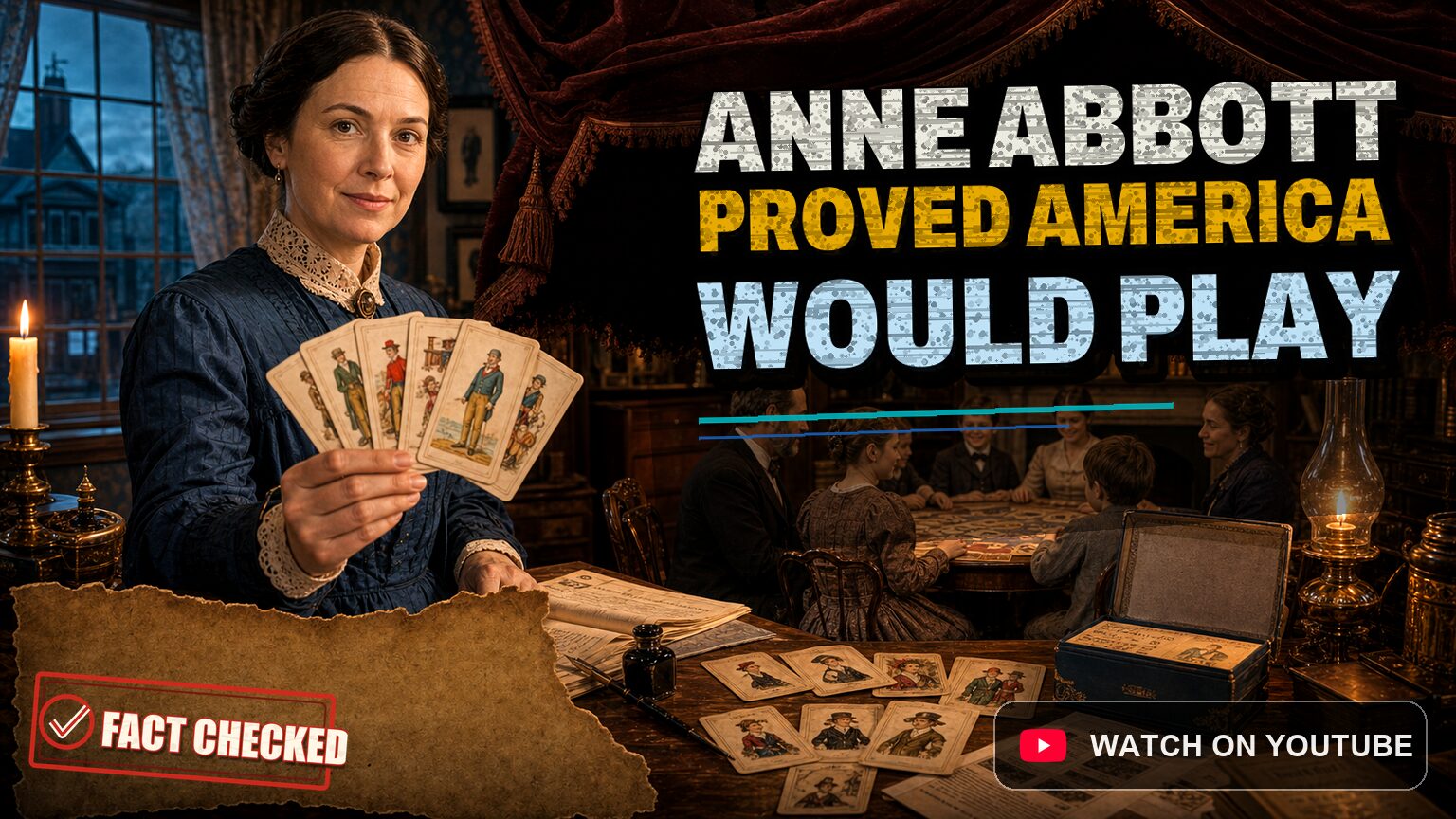
The Improved and Illustrated Game of Dr. Busby was published by W. & S. B. Ives of Salem, Massachusetts. It was a compact set of illustrated cards built around attention, memory, and the social tension of asking the right person the right question.
You can feel the design immediately. A player asks another player for a specific card. If the other player has it, they hand it over. If not, the turn moves on, and everyone has learned something. The room becomes the game state. The game rewards the person who listens and watches.
And it sold.
Abbott later claimed that Dr. Busby sold fifteen thousand copies in its first eighteen months. The safest way to treat that number is as her own later statement rather than a surviving audited ledger. Still, the point does not depend on the exact figure. The game became a real commercial success for its moment.
That success was a kind of proof. It suggested that American families would buy a game because it was fun, not only because it was improving.
Modern tabletop culture depends on that permission more than we like to admit.
A Writer In A Moral Age
Abbott was born in 1808 in Massachusetts and lived a very long life, dying in Cambridge on June 1, 1908. She came from the educated New England world of ministers, books, children’s literature, reform, and moral seriousness. Her father, Abiel Abbott, was a Congregational minister.
That background is part of the story. Dr. Busby does not read like a rebellion. It reads like someone who understood the moral world and still decided that play could stand on its own two feet.
Abbott’s broader career was in print culture. She wrote, edited, and worked as a critic. She edited a children’s magazine, The Child’s Friend, whose profits were connected to relief work for poor and neglected children. Games were not her only identity, and they were not even her longest one.
Which makes her place in game history feel cleaner, not smaller. Abbott was not trying to build a company empire. She made something concrete, watched it move through the world, and then went back to the work she knew.
In a history full of founders and brands, Abbott is something else: a moment of proof.
Dr. Busby And The New Kind Of Fun
Dr. Busby makes its argument without speeches.
It is not a game about becoming virtuous. It is not a game about being punished for vice. It does not let you play only after it has explained what you are supposed to learn. It trusts that paying attention, remembering, reading the room, and trying again already counts.
The cards are arranged into illustrated families of odd characters. The play lives in small human moves. Who noticed what. Who is pretending not to notice. Who asked for a card a minute ago, and what that implies about what they hold now.
Twenty cards is a small deck. That is part of the kindness of the design. It teaches quickly. It fits the rhythms of a home. It does not demand an entire evening. But it is also large enough that you cannot coast.
Every request changes what the table knows. Every denial is still information. The most important mechanic is not written on a card. It is the room’s shared memory, held together by observation and tiny acts of inference.
Abbott did not invent memory games. She did not invent the idea of collecting sets. European parlor traditions already contained family-card play, matching games, and variants of what later audiences would recognize as a Go Fish style structure.
The honest claim is simpler. Abbott helped package a familiar kind of play into a commercially successful American entertainment object at an early moment in the country’s game business.
That is not a flashy invention claim. It is a cultural and commercial one. It is the moment when a publisher can see demand, and a household can imagine paying for an evening that feels good.
That is how markets form. Not always with a brand-new mechanism. Sometimes a single product makes a quiet idea suddenly believable.
Two More Games, Then Back To Books
As far as surviving records show, Abbott’s published game work is concentrated in 1843 and 1844. Dr. Busby is the famous success. She is also associated with two other published titles from the same brief window: The Game of the Races and Master Rodbury and His Pupils.
We do not have the same clean, widely circulated surviving picture of those designs that we have for Dr. Busby, which makes it harder to talk about them with confidence. Still, the titles matter for one reason. They show Abbott was not an accident. She tried more than one format. She moved quickly.
Then she returned to the world where her career actually lived.
By the time the large American game companies became household names, Abbott was an older woman whose short design moment belonged to a different century. The American game business did not begin as a neat founder story. It began as a patchwork of printers, publishers, inventors, teachers, and writers, all testing what families would bring into their homes.
Abbott’s deck of cards is one of the proofs inside that patchwork.
What She Actually Built
Anne Abbott did not invent the human desire to play, and she did not invent memory games or family-card play.
She also did not single-handedly create the American game industry. It would be dishonest to describe later companies as if they were direct consequences of her small box of cards.
What she did build was smaller, and more believable.
She created, and saw published, an early American commercially successful parlor card game that treated entertainment as the primary justification. She helped demonstrate that American households would buy a game for pleasure, at a time when a lot of public-facing play still wore an educational mask.
If her later claim about fifteen thousand copies in eighteen months is even roughly true, it suggests demand that publishers could not ignore. If the exact number is uncertain, the shape of the story is still clear. The game landed. It moved. It was wanted.
Abbott’s contribution is best understood as a market proof and a cultural permission slip. The game said, in material form, you can put a small box on the table and let fun be enough.
A lot of tabletop history is built on that one quiet shift.
Where To Find Her
Abbott’s legacy is easiest to see through the surviving object.
The Henry Ford Museum of American Innovation holds a copy of The Improved and Illustrated Game of Dr. Busby. The artifact record and images of the surviving case and cards provide the most concrete way to understand the scale of the design and how it was presented to families in its own time.
If you want the short biographical frame, the standard encyclopedia summaries are a starting point, but the more interesting truth is in the physical game itself: the small deck, the illustrated families, and the kind of play it invites.
It is the simplest kind of proof.
Americans would play.
Fact Check Notes
Publication notes
This site is AI-assisted and human-reviewed. We use artificial intelligence to help gather research, organize source material, and draft profile content. Human editors then read, revise, and check each profile before it goes live. Most profiles are built through deep AI research and two separate rounds of fact-checking.
Leave a Reply
You must be logged in to post a comment.