Usually, it waits.
The game master points to it. Players ask where they are. Someone marks a door, a room, a stairwell, a corridor. The map becomes a helpful object, a guide to the real adventure happening somewhere else.
Amanda Lee Franck does not use maps that way.
In her best work, the map is already awake. It is not a reference sheet. It is a piece of pressure.
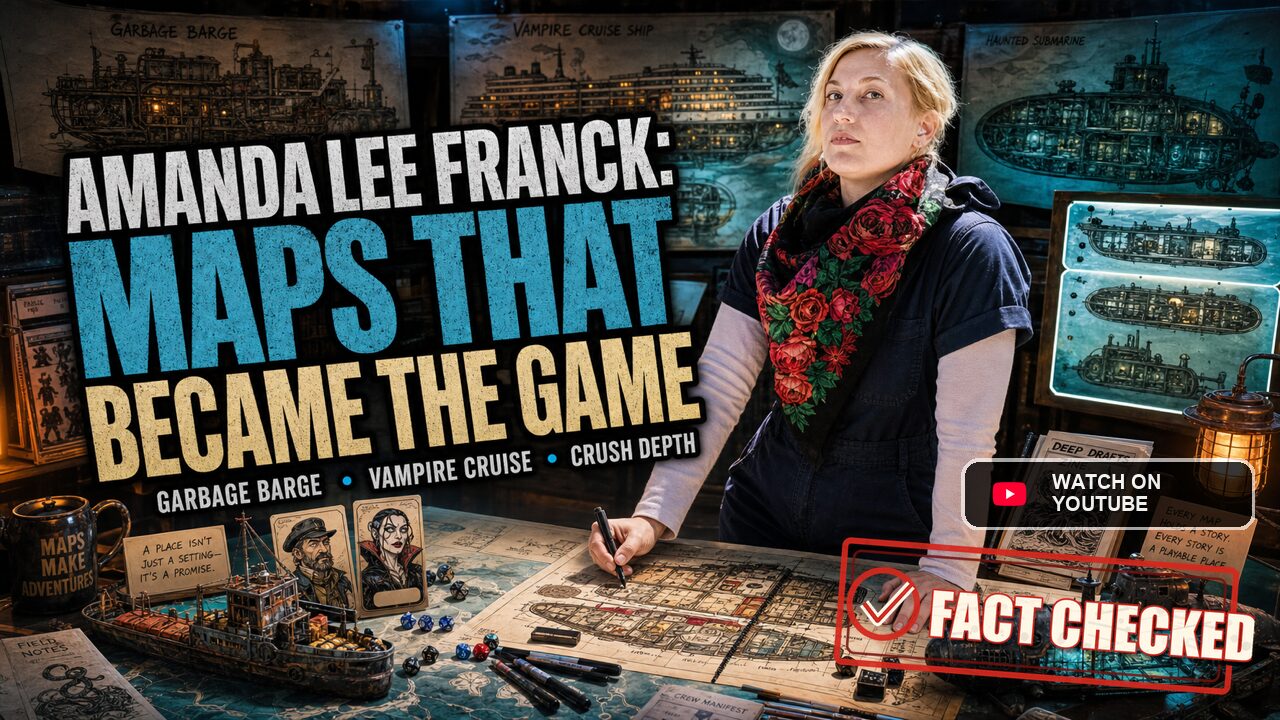
A garbage barge cutaway tells you what kind of job you have. A cruise ship itinerary tells you the horror will keep moving whether you understand it or not. A submarine map tells you the walls may not be as stable as they looked a minute ago.
That is the design signature.
Franck makes maps that become the game.
They do not just show where you are. They tell you what kind of night you are walking into.
Her tabletop career is still young, and that matters. This is not a story about a decades-long system catalog. It is the story of an illustrator and designer who entered independent RPGs with a clear instinct: draw the place so completely that the adventure starts living inside the drawing.
The Barge
The first vessel is full of trash.
You Got a Job on the Garbage Barge is the right place to begin because it explains nearly everything that followed.
Released in 2020 during the Zine Quest wave of small-format RPG projects, Garbage Barge is built around an absurdly strong image: a huge barge loaded with junk, jobs, creatures, odd residents, bad infrastructure, scavenged culture, and enough stink to become part of the setting’s physics.
It was Franck’s first RPG publication. By her own account, it was also the first RPG she had run.
That could have made the book cautious.
It does not.
Garbage Barge has the confidence of someone who was not trying to prove she understood the usual order of operations. Many RPG books begin with procedure, premise, rules, and then illustration. Franck moved from image outward. She drew a thing big enough to explore, then wrote the people, tasks, trouble, and strange little economies that could live on it.
The important move is not that the book has pictures.
RPGs have always had pictures.
The move is that the picture carries design load.
The cutaway, the crowded details, the heaps, the compartments, the implied routes and failures all do work that a paragraph would normally have to do. The drawing tells the game master how the place feels before the text starts explaining it.
You can almost smell the adventure before you know the rules.
That is where Franck’s voice begins.
VESSELS
Her major adventure work keeps returning to vessels.
A garbage barge.
A cruise ship.
A submarine.
That is not just a visual habit. It solves a real design problem.
In an adventure, players can always ask why they do not simply leave. Classic modules answer that question with locked doors, cursed mists, treasure, duty, wilderness, or social pressure.
Franck often answers it with water.
The vessel is the boundary. The vessel is the dungeon. The vessel is also the social space.
On a barge, you are stuck with the trash, the crew, and the job. On a cruise ship, you are trapped with passengers, schedules, private appetites, and whatever is moving below deck. On a submarine, the walls are not only walls. They are life support, pressure, machinery, and possible coffin.
That containment is elegant because it does not feel arbitrary. Nobody needs a magical dome to explain why the adventure stays focused. The setting explains it. Once the players step aboard, the world has edges.
Vampire Cruise sharpens that structure through social time.
The cruise ship is not only a location. It has an itinerary. Events happen. Meals are served. Passengers gather, miss things, gossip, dance, hide, and hunt. The schedule becomes a machine that runs with or without the player characters.
That gives the game motion without requiring a heavy plot rail.
Crush Depth Apparition pushes the vessel into horror.
The submarine is not simply where the haunting occurs. The submarine becomes part of the haunting. Systems fail. Pressure builds. Space can feel unstable. The adventure does not only ask who is trapped with you. It asks what happens when the place trapping you starts changing the terms.
That progression matters.
Franck’s early vessel was a riot of texture. Later vessels became tighter engines.
The First Line Of A Person
Franck’s NPC writing shows the same design economy as her maps.
Many RPG modules introduce non-player characters through appearance, motivation, personality traits, secrets, stat blocks, and long explanation. That can be useful. It can also ask the game master to perform translation every time someone starts talking.
Franck often cuts straight to performance.
One line in the character’s own voice.
The line tells you how the person speaks, what pressure they carry, what they might want, and what rhythm the game master can use at the table. The GM does not have to absorb a paragraph and convert it into speech.
The first line is already waiting.
This technique has roots. Zedeck Siew and Mun Kao’s A Thousand Thousand Islands is a clear influence on terse, illustrated NPC presentation. Franck’s version leans hard into line reading. The quote is not only description. It is an invitation to perform.
That lowers friction.
It also fits her larger design practice. A map gives the GM a place to move through. A voice line gives the GM a person to inhabit.
Both are compact.
Both are visual, even when one is made of words.
Both are immediately usable.
When Atmosphere Needs Handrails
Franck’s early work also shows the cost of trusting atmosphere too much.
Garbage Barge is vivid. That is not the problem. The problem is that vivid material still needs enough structure to help a game master turn it into motion.
A confident improviser can take a dense map, strange NPCs, a list of trash, and a pile of hooks and make a night of play. A less confident GM may admire the object and still wonder what to do next.
That tension sits at the center of Franck’s development.
Her instinct is generative. She builds places people want to look at. She fills them with characters who sound alive. She trusts the table to find the route.
But adventure design is not only making a place worth entering. It is also giving the person running the game enough handholds to keep everyone moving once they get there.
Crush Depth Apparition shows her working more directly on that side of the craft. The public material around the project points to a designer thinking harder about table support: escalation, failure, and a framework that can stand on its own instead of leaning entirely on someone else’s rules.
That is an important growth point.
The artist did not stop being an artist.
She started building more procedure under the image.
The Gallery Wall
Weird Hope Engines, a 2025 exhibition at Bonington Gallery in Nottingham, is a useful marker for understanding Franck’s place in the current independent RPG scene.
The show treated tabletop role-playing culture as gallery material: maps, rulebooks, and play itself as a visible practice. Franck was one of the featured artists, and the coverage around the exhibition framed this worldbuilding work as something you can look at, not just something you do at home.
For Franck, that context makes sense.
Her maps can hang on a wall without becoming empty decoration because they were never only illustrations in the first place. They already hold rooms, routes, schedules, implied voices, jobs, danger, pressure, and bad decisions waiting to happen.
Seen as gallery work, they do not lose their game function.
They reveal how much of the game function was visual all along.
That is the hidden strength of her design.
The adventure does not begin after the image.
The image is already doing adventure work.
What She Actually Built
Amanda Lee Franck works inside a visible independent RPG tradition. Illustrated maps came before her. Shipboard adventures came before her. Quote-driven NPCs, rules-light play, zine publishing, and system-agnostic modules all have their own histories.
Her contribution is a synthesis.
She takes cartographic art, closed-site adventure design, character voice, zine density, and atmospheric horror or comedy, then binds them together until the separation between illustration and writing starts to blur.
The map is not a picture of the adventure.
The map is one of the ways the adventure thinks.
That is why her work feels different.
The vessels matter because they create boundaries. The cutaways matter because they make those boundaries visible. The quotes matter because they turn NPCs into immediate performance. The light rules matter because they leave room for the place to carry pressure.
There are limits, and they are worth naming. Her influence is still forming. The public record does not yet show a broad school of designers building from a "Franck system." Much of the work is short-form, rules-light, and dependent on the GM’s comfort with improvisation. Even Crush Depth Apparition, her most procedural vessel, is built for a focused horror experience rather than long campaign architecture.
That honesty makes the achievement clearer, not smaller.
Franck is not finished building.
Where To Find Her
Amanda Lee Franck remains active as an artist and RPG creator. Her itch.io page describes her as making art and tabletop RPGs, and lists games including You Got a Job on the Garbage Barge, Vampire Cruise, Crush Depth Apparition, The Ghost Game, Local Heroes, and others.
Her Comradery page shows ongoing 2025 and 2026 activity: spot art, maps, short adventures, game work, and public posts. It also directs readers toward her broader illustration work for games such as The Between, Mausritter, and covers for Codex Magazine.
For the gallery side of the story, look at Weird Hope Engines through Bonington Gallery and Nottingham Trent University.
For the game side, start with the vessels.
The garbage barge.
The vampire cruise.
The haunted submarine.
That is where Franck’s work is easiest to see: a map, a place you cannot quite leave, and the feeling that the drawing has already started running the game.
Fact Check Notes
Publication notes
This site is AI-assisted and human-reviewed. We use artificial intelligence to help gather research, organize source material, and draft profile content. Human editors then read, revise, and check each profile before it goes live. Most profiles are built through deep AI research and two separate rounds of fact-checking.
Leave a Reply
You must be logged in to post a comment.