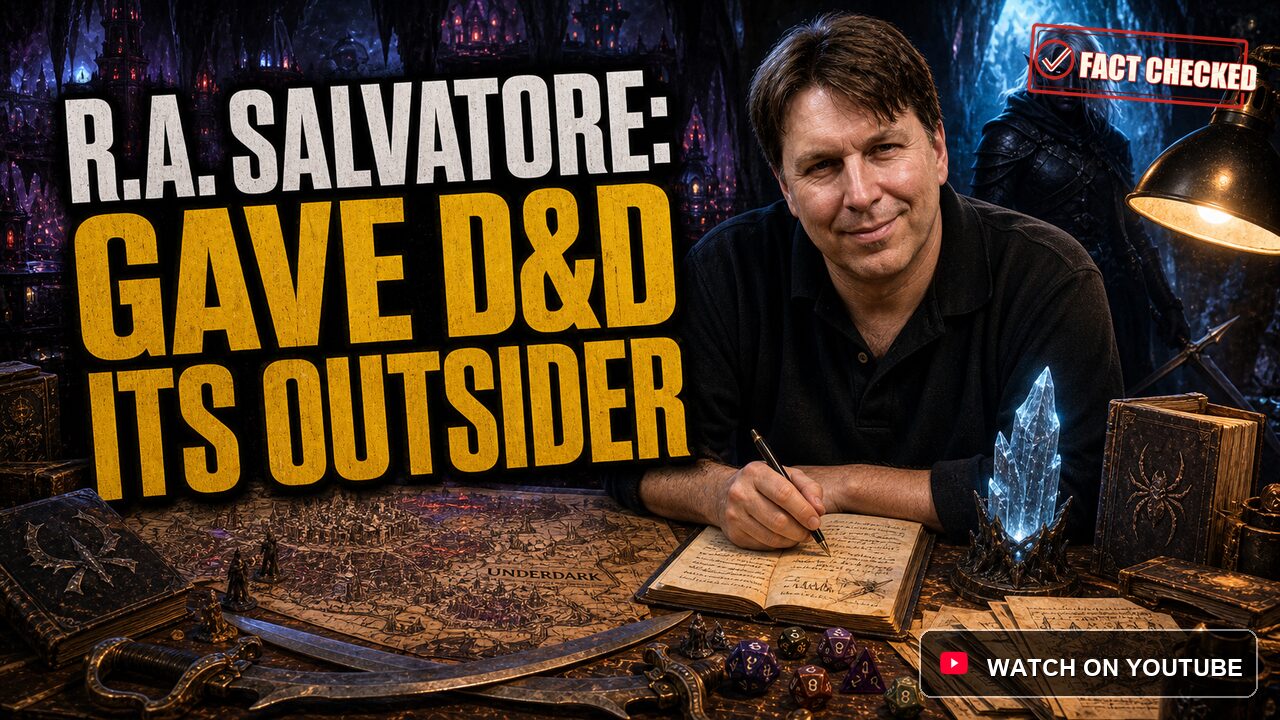
He began by writing one character.
A dark elf ranger. Two scimitars. A panther from another plane. A brutal home city below the earth. A conscience that did not match the world that raised him.
That character was Drizzt Do’Urden, and he changed the way a generation of players imagined D&D.
Not because every table became a Drizzt story.
Because Drizzt proved that a game world could turn one of its monsters into a moral center.
Before Salvatore, the drow were already part of Dungeons & Dragons. They had appeared in Gary Gygax’s modules and in early monster books as terrifying underground elves: cruel, dangerous, magically gifted, and tied to the worship of Lolth. They were excellent villains.
What they did not yet have was the full weight of a lived society.
Salvatore gave them one.
He gave them Menzoberranzan.
He gave them House politics, priestess rule, trained assassins, public cruelty, private fear, and a civic logic so poisonous that betrayal felt less like an exception than a survival skill. Then he placed one child inside that system and asked what it would cost him to leave.
That is where Salvatore’s tabletop legacy begins.
Not with a rulebook.
With a player question:
What if I do not have to be what the book says I am?
The Road To The Realms
Robert Anthony Salvatore was born in Leominster, Massachusetts, and stayed tied to New England even after his books carried him all over fantasy publishing.
Publisher and university bios tell the core story cleanly. He studied at Fitchburg State, changed direction after falling hard for Tolkien, and built a writing life around fantasy at a time when game fiction was still trying to prove what it could be.
Before TSR, Salvatore had written Echoes of the Fourth Magic. That manuscript did not become his first TSR book, but it opened the door. In interviews, he has described the strange turn that followed: TSR editor Mary Kirchoff saw something in his writing and brought him into the Forgotten Realms line.
The job became The Crystal Shard.
Drizzt was not originally the planned center of the book. Salvatore has told the story many times: he needed a companion character fast, and the drow ranger appeared under pressure. That almost accidental creation became the most durable character in D&D fiction.
That is one of the funny truths about fantasy publishing.
Some icons arrive with a business plan.
Some arrive because a writer has to solve a problem by the end of a phone call.
The Crystal Shard was published in 1988. Streams of Silver and The Halfling’s Gem followed, and the Icewind Dale books built an audience far beyond a simple product tie-in. Readers did not only want more Forgotten Realms.
They wanted to know where Drizzt came from.
That demand led to the Dark Elf books: Homeland, Exile, and Sojourn. Those novels turned a popular supporting character into one of fantasy’s defining outsiders.
The Underdark Got A Civilization
The most important thing Salvatore did with the drow was not making one of them good.
It was making the society around him coherent.
A weak version of Menzoberranzan would have been easy. Make everyone sneer, torture, worship a spider goddess, and wait for Drizzt to escape. That would have made him noble, but it would not have made the city memorable.
Salvatore did something stronger.
He treated evil as a system.
Menzoberranzan works because it has rules. Awful rules, but rules. Power moves through Houses. Religion is politics. Politics is survival. Matron mothers rule by fear, favor, and divine pressure. Murder can be a crime or a promotion, depending on whether the killer leaves evidence and survivors.
That matters for tabletop gaming because a playable setting needs more than mood.
It needs procedure.
If a Dungeon Master wants to use Menzoberranzan, they need to understand how people there behave when no hero is in the room. Who has power? Who wants it? What happens when a House fails? Why does someone obey? Why does someone betray? Where does fear become law?
Salvatore answered those questions in fiction, and D&D absorbed the answers.
The drow were no longer only monsters in a room.
They were a culture, a threat, a tragedy, and a campaign engine.
The Drizzt Effect
Drizzt also changed the fantasy of the ranger.
The original D&D ranger carried a lot of Aragorn in its bones: wilderness knowledge, tracking, hard travel, defense against danger at the borders of civilization. Drizzt brought a different image to the front of the table.
Speed. Two blades. Light armor. Moral exile. Animal companion. Brooding honor.
The rules did not simply become Drizzt, and it would be dishonest to pretend one novel mechanically dictated an entire class. Designers, editions, and player tastes all matter.
But culture has its own mechanics.
After Drizzt, players looked at the ranger differently. The dual-wielding outsider became a familiar table archetype. Some versions were sincere. Some were unbearable. Many tables met at least one dark, tragic, two-sword hero with a complicated past.
That is influence.
Not a line item in a rulebook.
A picture in the players’ heads.
Salvatore’s combat writing helped that picture stick. He writes fights with rhythm, weight, and readable movement. Blades do not simply flash because fantasy blades are supposed to flash. Feet shift. Balance changes. Pain matters. A duel has geography.
That style made Drizzt feel playable.
Readers could imagine the round-by-round action even when no dice were present. The novels translated tactical fantasy into emotional motion. For a hobby built around turning imagined movement into procedure, that was powerful fuel.
The Outsider Hero
Drizzt landed hard because he gave players a noble outsider at exactly the right time.
Many D&D players in the late 1980s and 1990s already knew what it felt like to have their hobby misunderstood. The satanic panic had made role-playing games sound dangerous to people who had never sat at a table. Geek culture had not yet been flattened into mass-market comfort. A lot of readers came to Drizzt with their own experience of being judged by the wrong story.
Drizzt was judged by what people believed drow were.
He kept choosing who he would be.
That is simple.
It is also why it worked.
The character is not only a sword fighter. He is a fantasy of self-definition. He is the person who says: the world can name me, but it cannot decide me.
D&D needed that.
The game had long used alignment, ancestry, monster entries, and broad moral categories as tools. Those tools were useful at the table, but they also carried a bluntness that later generations would question more openly. Drizzt did not solve that problem by himself. He did, however, give the game one of its most visible counterarguments from inside the fiction.
The Long Argument With The Game
Writing for D&D is not the same as writing in a private fantasy world.
The world changes because editions change. Gods die. Timelines jump. Magic systems break and heal. Corporate priorities become fictional weather. A novelist working inside that machine has to keep characters alive in more than one sense.
Salvatore has been unusually open about that pressure.
The Spellplague era and the Fourth Edition changes pushed the Forgotten Realms through a dramatic time jump and setting overhaul. Salvatore has said that the changes nearly broke him as a writer of the line. That is not hard to understand. The Companions of the Hall were not rules tokens. They were relationships that had accumulated meaning over years of novels.
When the game changes, the fiction has to carry the wound.
That tension is part of Salvatore’s legacy too. He became one of the writers most associated with the strange bargain of shared-world fiction: the author gives the world emotional continuity, while the game company keeps changing the ground under his feet.
He kept finding a path through it.
Sometimes that meant grief.
Sometimes it meant return.
Sometimes it meant arguing with the moral shape of the setting itself.
The Drow Change
The most recent major argument around Salvatore’s work came from the drow themselves.
For decades, D&D had leaned on the idea of evil peoples and inherited moral categories. Modern D&D has been trying to move away from that, especially where humanoid cultures are concerned. The drow became one of the most visible pressure points.
Salvatore’s Way of the Drow books helped reframe that history.
Starlight Enclave introduced the Aevendrow, a drow society outside Lolth’s cruel Underdark culture. Later lore also distinguished other drow peoples from the Lolth-sworn drow of Menzoberranzan. The point was direct: the drow were not all one thing, and no people should be written as biologically doomed to evil.
Not every fan liked that.
Some readers felt the change weakened Drizzt’s original isolation. Others pointed out that earlier good drow traditions, especially around Eilistraee, had already complicated the picture. Those critiques are part of the conversation.
But Salvatore’s position has been clear in interviews. If a trope lands as inherent racial evil, it has to change.
That is not a small statement from the man most associated with D&D’s most famous drow.
It means he is willing to revise the world that made him famous when the old structure no longer carries the moral weight he wants from it.
What He Actually Built
R. A. Salvatore is not primarily a tabletop rules designer.
That needs saying plainly.
He is a novelist whose work moved tabletop culture. He did not create the Forgotten Realms. Ed Greenwood did. He did not invent the drow. Gary Gygax and early D&D material put them into the game first. He did not single-handedly redesign the ranger class.
What he built was different.
He built the most famous interior life in Dungeons & Dragons.
He took a monster category and wrote a person inside it. He took a lightly sketched underground villain culture and turned it into one of the most recognizable societies in fantasy gaming. He gave Dungeon Masters a city full of usable conflict. He gave players a template for the honorable exile. He gave D&D fiction proof that a game novel could become a gateway into the hobby, not just merchandise beside it.
That is why he belongs in this series.
Not because he wrote rules.
Because he changed what the rules felt like they could mean.
Where To Find Him
Salvatore is still active.
His publisher biographies continue to list him as the author of more than sixty books, including many New York Times bestsellers, and his Drizzt work remains in print through current editions and collector formats. Fitchburg State University also preserves the R. A. Salvatore Collection, including manuscripts, correspondence, and working materials, turning part of his career into an archive for future study.
That feels right.
Drizzt began as a fast answer to a creative problem.
Now the character is part of the permanent grammar of D&D.
Every time a player asks whether an ancestry, a monster entry, a city, or a past has to decide who their character is, Salvatore’s shadow is somewhere nearby.
Not as a rule.
As a question with two scimitars in its hands.
Fact Check Notes
Publication notes
This site is AI-assisted and human-reviewed. We use artificial intelligence to help gather research, organize source material, and draft profile content. Human editors then read, revise, and check each profile before it goes live. Most profiles are built through deep AI research and two separate rounds of fact-checking.
Leave a Reply
You must be logged in to post a comment.