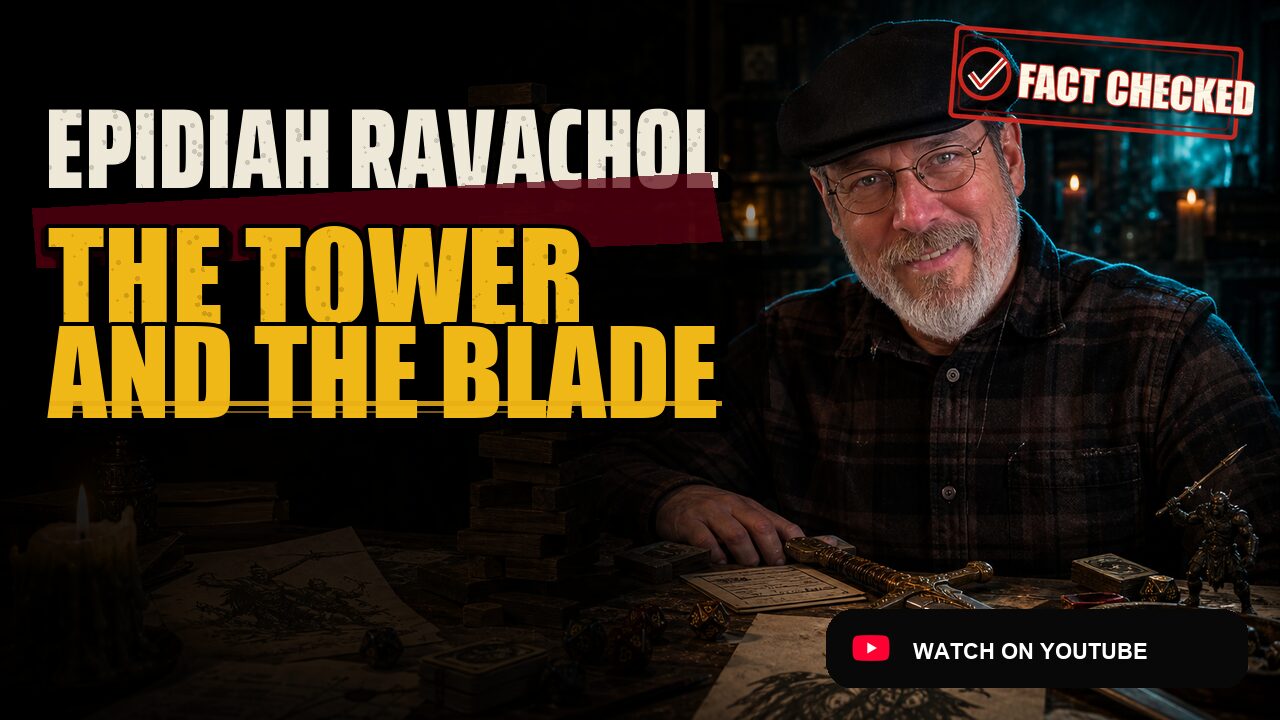
At an Epidiah Ravachol table, tension may be sitting in the middle of the room, stacked in wooden blocks, waiting for someone’s hand to shake.
That is the genius of Dread. The pitch is so clean it almost sounds like a party trick: replace the dice with a Jenga tower. When your character attempts something dangerous, you pull a block. If the tower stands, the character survives the moment. If the tower falls, the character is lost.
The first pull is easy. The next few are still manageable. Then the tower begins to lean. Blocks tighten. Gaps appear. The whole table starts watching the player’s fingers instead of the game master. People stop joking. Someone exhales too loudly and apologizes. The character may be running from something fictional, but the player is negotiating with gravity in public.
That is not a gimmick. That is design.
Ravachol, working with Nat Barmore, gave horror roleplaying one of its most elegant mechanical ideas: fear should not only be imagined. It should be touched.
The Tower
Dread understands something many horror games struggle to capture. Horror is not only the bad thing happening. It is the waiting. It is the knowledge that the next decision may cost more than the last one. It is the way confidence decays.
The tower makes that decay visible. Every successful pull makes the next pull harder. Every brave choice leaves the structure less stable for everyone else. The game does not need to announce escalation. The tower does it. The table can see the story becoming more dangerous because the object in front of them is becoming more dangerous.
That physical memory is the key. Dice forget. They roll, land, and reset. A tower remembers. It remembers the early easy choices, the reckless midgame choices, the lucky escapes, and the hand that almost knocked everything down but somehow did not. By the end of a session, the tower is a record of the group’s nerve.
Dread’s character creation matters just as much. Instead of beginning with stat blocks, players answer questions. Who do you love? What are you hiding? What do you regret? Why are you here? By the time the danger arrives, the character is not only a name on a sheet. The player has already confessed a few things on their behalf.
Then the tower asks for payment.
That is why the design still works. The mechanic is simple, but it is not shallow. It joins body, story, and consequence in one act. Pull the block. Hold your breath. Accept what happens.
The Blade
Swords Without Master shows another side of Ravachol’s imagination.
Where Dread makes fear physical, Swords Without Master makes tone mechanical. It is a game of sword and sorcery, strange deeds, hard choices, and wonder. Its dice are not primarily there to answer the usual question of whether a character succeeds. They help decide the mood of the next moment. Is the scene Jovial or Glum? Does the tale bend toward laughter, bitterness, awe, or sorrow?
That is a very different relationship with randomness. Many RPGs use dice to decide outcomes. Ravachol uses them to steer the emotional weather. The result feels closer to oral storytelling than tactical resolution. The players are not only asking what happens next. They are asking what kind of tale this is becoming.
That shift matters because sword and sorcery lives on texture. It needs flashing steel, bad bargains, strange horizons, and heroes who laugh too loudly because they know despair is waiting nearby. A conventional pass-fail roll can tell you whether the blade lands. Swords Without Master wants to know what the blade means when it lands.
The game first appeared inside Worlds Without Master, Ravachol’s fiction and gaming ezine. Years later, it was still alive enough to move toward a standalone release, with a 2026 crowdfunding and fix-up trail bringing the game into a new phase. That continued interest says something about the design. It was not only a clever insert in a magazine. It had a voice people wanted to return to.
Small Forms, Sharp Edges
Ravachol has a gift for making games that feel cut to a particular shape.
Vast & Starlit compresses a science-fiction RPG into a business-card-sized form. The achievement is not just that it is short. Many games are short because they are incomplete. Vast & Starlit is short because it knows exactly what it needs and refuses to carry anything else.
What Is a Roleplaying Game? is another act of compression, a tiny playable explanation of the medium. It teaches by becoming the thing it describes. That is a designer’s joke, but a serious one. The best educational games do not stand outside play and lecture. They invite someone in, hand them a role, and let the explanation happen through use.
Other Ravachol designs keep changing tools. Some use cards. Some use office comedy. Some use collaborative procedures. Some take horror apart from a new angle. The pattern is not that every game shares an engine. The pattern is that every game starts from a precise question.
What if fear lived in a tower?
What if dice told us the mood instead of the result?
What if a complete RPG could fit in a space usually reserved for a phone number?
What if explaining roleplaying could itself be roleplaying?
Those questions are the real catalog.
The Work Around The Games
Ravachol’s contribution is not limited to objects with his name on the cover.
Worlds Without Master served as a place where fiction and game design could sit beside each other without apology. The publication did not treat roleplaying as separate from adventure literature. It let prose, play procedures, illustrations, and experiments share a home. It also created room for other creators, which matters in a small-press field where platforms are often as important as products.
Dig 1,000 Holes Publishing gave Ravachol a direct route for strange work that might not need or want a conventional publisher’s shape. The name fits the body of work. It suggests persistence, craft, and a willingness to make odd openings in the ground just to see where they lead.
He has also been connected to workshops and collaborative design practices, including Playstorming and rapid design spaces where games are made as social acts rather than private monuments. That part of the story is easy to overlook because Dread’s tower is so memorable. But it belongs here. Ravachol’s work often treats design as something you do with other people in the room, not only something delivered to them later.
The Honest Boundary
Ravachol is not best understood as a system builder in the traditional sense.
Dread did not become a universal engine. It is too closely married to its own metaphor for that, and that is not a flaw. The tower works because horror needs rising dread. It can be adapted, as later designers showed in other emotional registers, but it does not become stronger by being stretched into every genre.
Swords Without Master is similarly specific. Its mood-driven randomness suits a certain kind of tale. Vast & Starlit is a brilliant compression exercise, not a sprawling campaign chassis. Again and again, Ravachol’s games choose precision over extensibility.
That choice limits their spread, but it sharpens their identity.
Some designers build toolkits meant to support many kinds of stories. Ravachol tends to build instruments tuned for one kind of pressure. A tower for fear. Dice for tone. A card-sized game for escape among the stars. A tiny lesson that becomes play while you read it.
The work does not say, use this engine forever.
It says, for this moment, this is the exact shape play should take.
What Remains
Dread remains one of the cleanest examples in tabletop design of a mechanic becoming a feeling. You can explain it to someone who has never opened an RPG book, and they understand it immediately. Then they try to pull a block and understand it better.
Swords Without Master remains a reminder that randomness does not have to be a judge. It can be a weather vane, a tonal demand, a push toward a more vivid tale.
Vast & Starlit remains a proof of compression. A game needs exactly as much structure as its premise requires, and sometimes that is far less than tradition would have us believe.
The workshops, the publishing, the small-form experiments, and the return of Swords Without Master all point toward the same hidden pattern. Ravachol is a designer of moments. Not moments in the thin sense of clever scenes, but moments where a rule, a gesture, and an emotion become the same thing.
The hand before the pull.
The dice turning the tale Glum.
The whole galaxy folded into a pocket-sized rule space.
The blade raised in wonder, not because the system told you whether it hit, but because the game asked what kind of story the strike belongs to.
That is the tower and the blade.
That is Epidiah Ravachol’s design gift: making the object on the table tell the truth before anyone has to say it aloud.
Fact Check Notes
Publication notes
This site is AI-assisted and human-reviewed. We use artificial intelligence to help gather research, organize source material, and draft profile content. Human editors then read, revise, and check each profile before it goes live. Most profiles are built through deep AI research and two separate rounds of fact-checking.
Leave a Reply
You must be logged in to post a comment.