In 2004, John Prescott made the kind of bet that only a small-press fantasy publisher can make.
He had no famous game design resume.
He had a fantasy world he wanted to bring into print.
And he had the nerve to call Larry Elmore.
That mattered because Elmore was not just another illustrator. He was one of the painters who had given the fantasy gaming aisle its memory. Dragonlance had his fingerprints. TSR’s classic era had his color and scale. If a tiny company out of Macomb, Mississippi, could put Elmore covers on its books, the line would not look like a hobby project. It would look like it belonged on the shelf.
Prescott founded White Silver Publishing around that wager. The company’s plan was bold and simple: publish new Dungeons & Dragons 3.5 material for the Sovereign Stone setting, then use that momentum to launch its own fantasy roleplaying game.
The original game was The Chronicles of Ramlar.
The result was beautiful, ambitious, overbuilt, uneven, and short-lived.
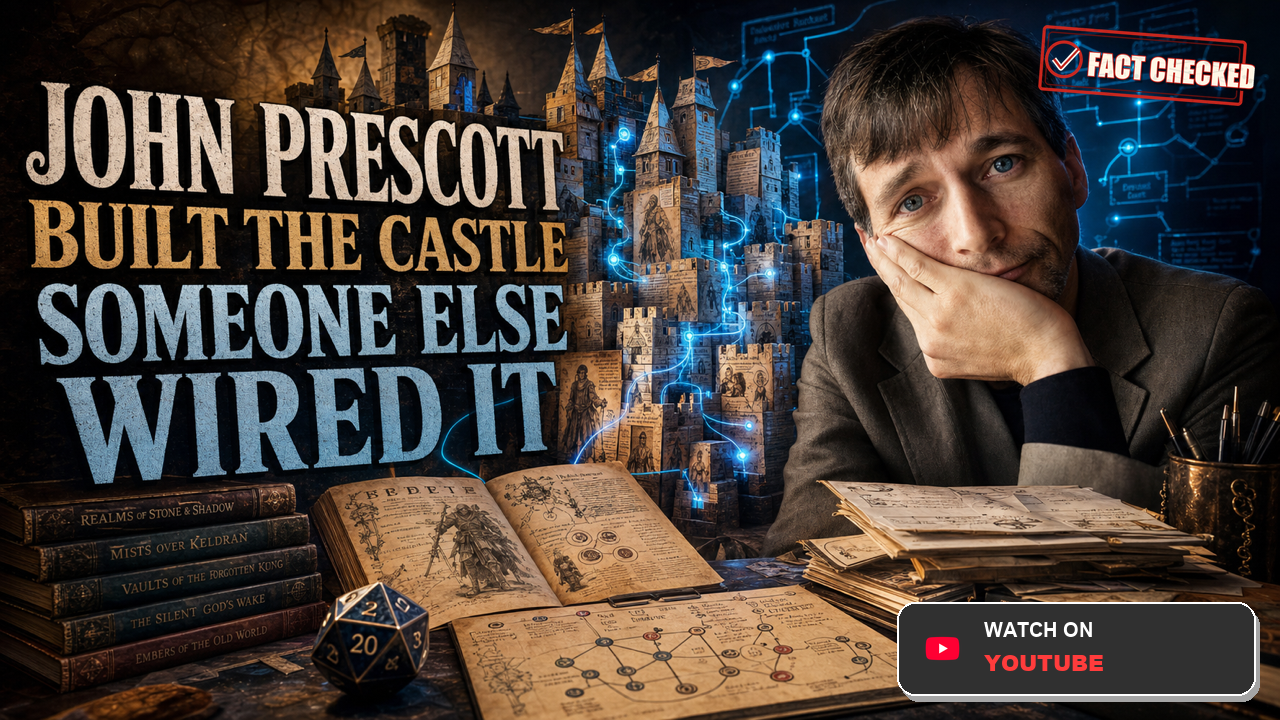
It was also a revealing case study in a kind of design labor that rankings often miss: not the person who builds the rules engine, but the person who imagines the world, hires the artists, gathers the team, and convinces everyone that the castle is worth wiring.
The Larry Elmore Bet
White Silver Publishing was not imaginary infrastructure.
It had officers. Prescott was president. Wayne Sykes served as CEO. Rajiv Patel served as CFO. The company published Sovereign Stone material, Ramlar books, adventures, and tie-in fiction. It went to conventions. It commissioned name artists. It tried to look like a real mid-tier RPG publisher because, for a brief window, it was trying to become one.
The art was the first promise.
Ramlar’s covers and interiors drew on artists whose names carried real tabletop weight: Larry Elmore, Mark Tedin, Ron Spencer, James Ryman, Ben Wootten, and others. Reviewers noticed immediately. Even critics who were skeptical of the rules tended to stop and acknowledge the production ambition. This was not a bare PDF with clip art and enthusiasm. It was a fantasy line dressed for the main shelf.
Prescott understood presentation.
That is not a small thing. RPGs are not only math. They are invitations. A book has to persuade a group to spend weeks, months, sometimes years inside an invented place. Prescott’s gift was making that place feel like it had already been waiting.
The Rules Guy
The Chronicles of Ramlar was not a one-man design.
The core book credits a large team, including Alana Abbott, Benji Blailock, Michael Johnston, Tony Lee, John Prescott, Rajiv Patil, Pyran Taylor, Shane Wilson, Shane Wood, and Wayne Sykes. That matters because Ramlar’s most interesting mechanical ideas did not clearly belong to Prescott.
Tony Lee was the rules professional in the room.
Lee had credits across Traveller, Deadlands, Marvel SAGA, professional wrestling RPG work, and Sovereign Stone. In later interviews and project discussion, he described himself as the game designer and rules guy for Ramlar. Prescott, by contrast, described himself as the world creator and openly pointed mechanical credit back toward Lee.
That does not erase Prescott.
It clarifies him.
Prescott was not the engineer who built the wiring. He was the person who imagined the castle, found the engineer, hired the painters, and tried to sell the whole impossible structure to the public.
What Prescott Actually Built
Prescott’s strongest claim is Eranon, the world of The Chronicles of Ramlar.
He built or directed the setting’s cosmology, races, cultures, geography, deities, history, and high-fantasy tone. The revised World Guide credits him directly for world creation, graphics, layout, and art direction. That combination says a lot. Prescott’s contribution was not only textual. It was visual and editorial. He was shaping what the world was, what it looked like, and how a reader encountered it.
Alana Joli Abbott’s tie-in fiction extended that world into novels, giving Ramlar a narrative life beyond the rules. Other writers and developers filled in regions, adventures, creatures, and support material. But the central setting vision was Prescott’s.
The world was traditional fantasy, not a radical break from the genre. It had familiar races, deities, regions, magic, monsters, and heroic framing. Its originality was not in rejecting fantasy convention. Its ambition was in density: enough names, places, gods, rumors, and campaign hooks to make Eranon feel like a place a group could occupy.
That was Prescott’s language.
Immersion. Visual authority. A shelf-ready world.
The Character Goals
The most admired idea in Ramlar was the Demeanor and Theme system.
On the character sheet, players had circles surrounded by dots. One track represented participation. The other tracks were written by the player as personal goals: become a dragon rider, cleanse a blighted land, earn a title, master a path, repair a wound in the character’s story.
Progress did not come only from defeating enemies or collecting treasure.
It came from pursuing the character’s stated intentions.
Reviewers responded strongly to this. They saw a fantasy RPG trying to turn player-authored goals into advancement infrastructure. The idea sat in the same broader early-2000s conversation as beliefs, aspects, flags, and character-driven reward systems, but Ramlar’s physical presentation made it unusually concrete. The goals were literally on the sheet, waiting to be filled in.
The honest boundary is attribution.
Prescott appears to have supplied the philosophical direction. Tony Lee appears to have built much of the mechanical implementation. That split is the whole Prescott problem in miniature: the thing people remember most as a design idea may have come from Prescott’s vision, but the working machinery was made by someone else.
The System That Fought Itself
Ramlar’s rules had real strengths.
The core resolution used percentile dice. The tens digit of a successful roll became a success value, so the best roll was not simply low. You wanted to roll high while still staying under the target. That gave the basic check a nice little tension.
The Momentum mechanic let extra success in combat convert into tactical advantage. The Armor and Body system tracked armor and injury across multiple hit locations. The game wanted combat to feel physical, detailed, and consequential.
Then the design started arguing with itself.
Several subsystems stepped away from the core resolution procedure. Combat leaned on its own tables. Rogue actions used separate handling. Magic had its own approach. The body-location system created bookkeeping. Armor damage required maintenance. Character creation asked players to manage a lot of numbers before play had even begun.
Reviewers saw the same pattern from different angles: a game with strong ideas, lavish art, and some clever machinery, but also a game that needed refinement and an experienced game master.
The revised edition tried to address some of this. It split the massive core into a Player’s Guide and World Guide, improved presentation, and introduced changes meant to reduce some accounting. But the deeper issue remained. Ramlar had too many systems acting as if they were the center.
The castle was full of rooms.
Not all of the lights were on the same circuit.
The Collapse
White Silver Publishing did not last.
By the late 2000s, the company was effectively gone or inactive. Public forum traces from the period show stress over unpaid freelancers and fulfillment issues. The d20 market had contracted. Dungeons & Dragons 4th Edition arrived in 2008 and made 3.5-compatible publishing feel suddenly older. Personal circumstances also seem to have weighed heavily on Prescott and the company.
Small RPG publishers often fail quietly.
White Silver failed in public enough to leave a paper trail.
That matters because it complicates the romantic version of the story. Prescott did not simply build a beautiful fantasy line that the market ignored. He ran a company, and companies have obligations. Artists, writers, customers, and backers remember whether they were paid, answered, and fulfilled.
The dream had real costs.
The Return That Did Not Return
Ramlar did not entirely disappear.
Prescott later surfaced around Whispering Tree Press, and a 2014 Pathfinder Edition Kickstarter tried to bring The Chronicles of Ramlar back. That campaign did not fund. Public updates from that period show Prescott and Tony Lee still presenting Ramlar together, still talking about Eranon, Momentum, Demeanor and Theme, and conversion plans.
The world still had believers.
It did not regain momentum.
A 2018 miniature-centered Kickstarter connected to Ramlar also shows Prescott still circling the property years after White Silver’s collapse. But no large-scale revival seems to have followed. The public game-design record grows quiet after that.
Prescott’s later public identity moved toward horror fiction. Author pages and audiobook listings connect him to Pray, The Revelation Chronicles, and Dark Continents Publishing. That shift makes sense. The strongest part of the Ramlar story was always the fiction-facing part: world, tone, imagery, presentation, and the urge to build a place large enough for other people to enter.
The Honest Boundary
John Prescott is not best understood as a great rules designer.
He is a world creator, publisher, art director, and team assembler whose most visible game depended on another designer’s mechanical craft.
That is not an insult.
It is the truth that makes the story interesting.
The tabletop field often talks as if design is only the finished rule system. But games reach the table through messier collaborations. Someone has to imagine the world. Someone has to commission the cover. Someone has to call Larry Elmore. Someone has to find Tony Lee. Someone has to believe that a Mississippi micro-press can stand beside larger companies for a season.
Prescott did that.
He also could not keep the machine running.
Both facts belong in the same portrait.
What Remains
What remains of John Prescott’s game career is not a thriving system or a widely copied mechanism.
It is a shelf of White Silver books, a fantasy world called Eranon, a handful of reviewer memories, a character sheet with personal goals arranged in circles, and the strange ache of a small company that almost looked bigger than it was.
The Demeanor and Theme system deserved more eyes.
The art direction did its job.
The world was built with care.
The rules were someone else’s wiring, and the wiring never quite carried the load.
That is why Prescott’s story stays with me. Not because he made a masterpiece, but because he represents a kind of tabletop ambition that is both noble and dangerous: the belief that if you gather enough artists, writers, rules people, and faith around an invented world, the world might become real.
For a little while, Ramlar did.
John Prescott built the castle.
Someone else wired it.
The lights came on, briefly.
Fact Check Notes
Publication notes
This site is AI-assisted and human-reviewed. We use artificial intelligence to help gather research, organize source material, and draft profile content. Human editors then read, revise, and check each profile before it goes live. Most profiles are built through deep AI research and two separate rounds of fact-checking.
Leave a Reply
You must be logged in to post a comment.