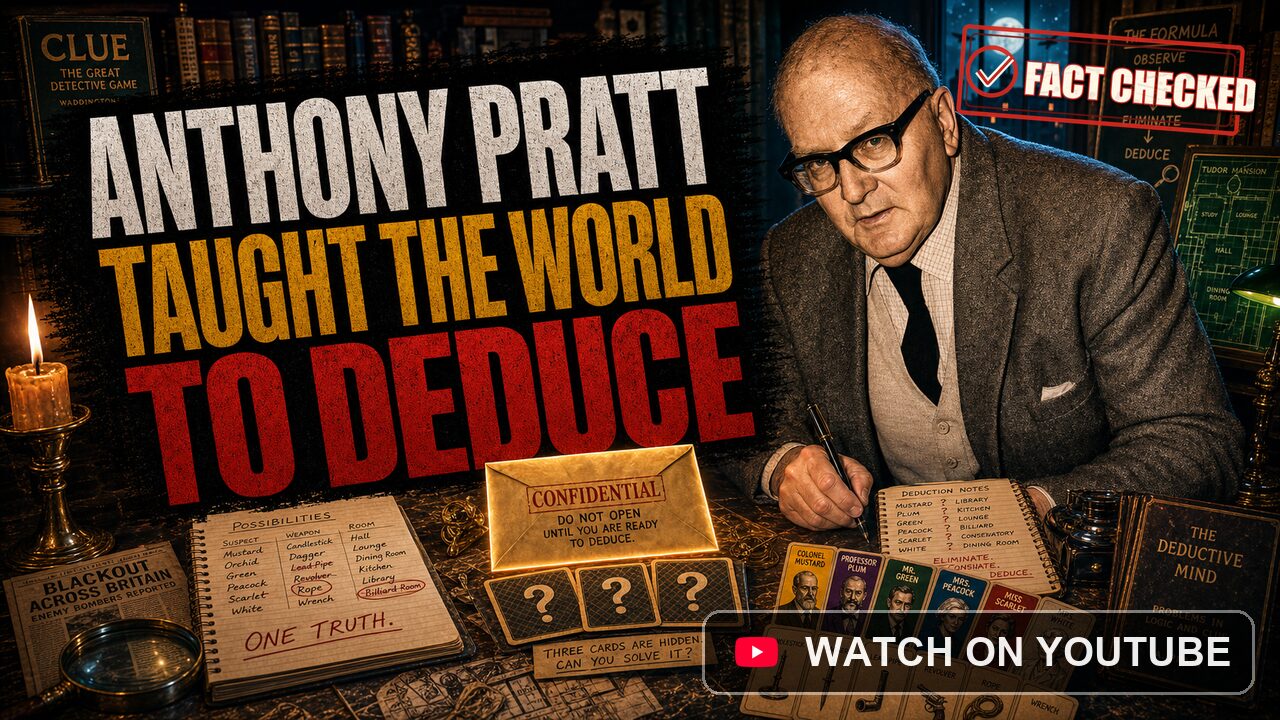
The Envelope
Anthony Pratt designed one game.
That game taught people, at kitchen tables, how to turn a messy mystery into a list you can cross off.
Cluedo, known as Clue in North America, is so familiar now that its central idea feels like part of the furniture. A murder. A mansion. A short list of suspects, weapons, and rooms. One card from each category hidden in an envelope. The rest dealt to the players. Ask questions. Watch what people can show you. Notice what they cannot. Cross out the impossible until the answer is the only shape left.
It feels obvious because Clue made it obvious.
Before Cluedo, murder mystery games existed as parlour entertainments, party games, and stories. Detective fiction had already trained readers to look for motives, alibis, objects, and rooms. Pratt and his wife Elva took that social form and gave it a repeatable engine. They made absence playable.
The answer is not on the board. The answer is not in your hand. The answer is the three cards nobody can show you.
That is the heart of it. A family game that teaches negative evidence without ever calling it that.
Pratt did not build a long career in game design. He did not publish a catalog. He did not found a school, tour conventions, revise editions, or explain his craft to later designers. He made one game in wartime Birmingham, sold the rights, lived quietly, and died before the board game industry fully remembered him.
But one game was enough.
Birmingham In The Blackout
Anthony Ernest Pratt was born in Birmingham in 1903. He was not trained as a game designer, because that profession barely existed in any modern sense. He was a musician, a pianist, a man who had played in hotels and knew the private entertainments of country-house guests.
That mattered.
In those spaces between the wars, murder mystery games were social events. Guests moved through rooms, took roles, guessed at motives, and turned the house itself into a stage. Pratt watched that form from the edge of the room. He had the musician’s position: present, observant, paid to provide atmosphere, close enough to notice how the entertainment worked.
Then World War II closed the old world down.
Pratt worked in a munitions factory. Birmingham endured air raids. Blackout nights made people stay inside. The hotel circuit and social rooms that had fed his imagination were no longer available in the same way. So Pratt brought the murder party home and compressed it onto cardboard.
He called the game Murder.
The setting was not just a mansion because mansions were fashionable in detective fiction. It was a way to keep a kind of social play alive when the world shrank. The country-house mystery became a board. The guests became suspects. The rooms became spaces you could enter. The guessing game became a system.
Pratt’s wife, Elva Catherine Pratt, was part of that invention. She helped design the board and artwork while Anthony shaped the game’s logic. The old story is sometimes told as if a lone man produced a finished classic in a flash of inspiration. The better version is domestic and collaborative: two people at a table, during a war, turning a parlour pastime into a box.
The Missing Card Machine
The genius of Cluedo is not that it has a murder.
The genius is the envelope.
The game begins by removing one suspect, one weapon, and one room from the full set of known possibilities. Those cards are hidden. Everything else is distributed to players. From that moment on, the whole game is a controlled argument about absence.
If someone shows you Miss Scarlett, then Miss Scarlett is not in the envelope. If nobody can show you the candlestick, that absence starts to glow. If a player fails to disprove a suggestion when you know they had a chance to, that silence becomes information. The game makes negative evidence concrete enough for a child to use.
It is elegant, but it is also forgiving. You do not have to be clever to enjoy it. You just have to keep track.
The theme does an enormous amount of work. A dry logic puzzle about hidden cards would not have traveled the same way. Cluedo wraps deduction in character, place, and object. It is not "card A, B, and C are hidden." It is Colonel Mustard, in the library, with the candlestick. That little sentence turns logic into theater.
The board helps too. You do not ask about any room from anywhere. You move through the mansion. That movement gives pacing to the deduction and lets players manipulate the fiction. Pulling a suspect into a room is not just a question. It is a stage direction.
The result is a game that feels social even when the engine is logical.
Patent, Delay, Publication
Pratt filed the British patent for his game during the war. The patent record for GB586817 lists the priority date as December 1, 1944, with publication in 1947. By then, the game had moved toward Waddingtons, the British publisher that would release it as Cluedo.
The delay was practical. Post-war Britain was still living with material shortages, and producing a board game was not immediate. The game finally appeared in 1949. Waddingtons published it in Britain as Cluedo, a blend of "clue" and "ludo." Parker Brothers published it in North America as Clue.
The published version was cleaner than Pratt’s original.
The suspect list was reduced. Some weapons changed. The production version had to become a family board game, not just a murder-party simulation. That is normal publication work. Games often become themselves through editing, manufacturing constraints, and publisher decisions.
What mattered is that the engine survived.
The hidden solution. The cards. The private reveal. The deduction sheet. The accusation. The envelope.
That was the structure Anthony and Elva Pratt had given the world.
The Bad Deal
Cluedo succeeded slowly enough that Pratt did not see the full shape of what he had made.
In 1953, he reportedly sold the overseas rights for a one-time payment of five thousand pounds. It was real money at the time, especially for a family trying to live in post-war Britain. It was also, in hindsight, a brutal bargain. Clue became a North American institution. The brand grew across editions, spinoffs, film, television, stage adaptations, digital versions, licensed reskins, and modern Hasbro products.
Pratt did not become wealthy from it.
That fact is easy to turn into a morality play, but it is better to keep it human. A company can own a brand and still forget the person who built the engine inside it. A game can be everywhere while its inventor remains a name most players never learn.
The game became famous while the designer stayed mostly invisible. For decades, the brand name traveled farther than the creator’s name. Later legacy reporting and Birmingham’s local commemorations helped put Anthony and Elva Pratt back into the story.
He died in 1994. He was ninety.
Elva had died four years earlier.
The game kept going.
The Genre That Followed
Cluedo did not remain just a brand. It became a design ancestor.
The direct shape of its mechanism, hide part of a known set and deduce the missing pieces, appears again and again in later tabletop design. Sometimes the inheritance is obvious. Sometimes it is structural rather than literal. Deduction games learned from Cluedo that hidden truth becomes playable when the possible answers are bounded, the questioning procedure is disciplined, and each failed proof matters.
Scotland Yard, Fury of Dracula, Mysterium, Awkward Guests, and many other games live in the larger territory Cluedo helped normalize: one side of the table knows something, or the game knows something, and the players build a map of certainty from partial evidence.
Not all of those games are simply Cluedo variants. Some are chase games. Some are ghostly communication games. Some are narrative puzzles. But the cultural doorway was opened by a game that made deduction feel social, theatrical, and learnable at the family table.
That is what Pratt’s one design did. It made a way of thinking popular.
It also showed that a board game could become a murder mystery generator. The same frame can produce a new story every night because the truth changes while the suspects and rooms remain stable. The envelope is a tiny randomizer with enormous theatrical power.
The Music Of Absence
Pratt was a pianist before he was a game inventor, and that matters more than it first appears.
Music teaches structure through presence and absence. The note matters. The rest matters too. A phrase can turn on what is withheld. A melody can be made sharper by silence around it.
Cluedo works the same way.
You do not win by seeing the answer. You win by hearing the silence around it. No one shows the rope. No one can disprove the study. A player hesitates. A card appears from the wrong hand. Your sheet fills not only with what is known, but with the shape of what remains unknown.
It is a game about negative space.
That may be why it has lasted. The mansion, suspects, and weapons are memorable, but the enduring pleasure is the click of absence turning into certainty. The moment when three blanks become one sentence.
Mrs. Peacock. The hall. The dagger.
The spell still works.
What He Actually Built
Pratt did not build a career as a game designer. He did not create a catalog, test himself across genres, or develop a long body of work. Cluedo was not untouched by publishers, and Elva Pratt’s contribution to the board and artwork deserves to stay in the story.
What Anthony Pratt built was a durable deduction engine.
He turned an informal murder mystery party into a structured elimination game. He made hidden information solvable through questions, movement, private reveals, and careful notes. He gave players a mystery that was fair because the answer was not arbitrary. It was sealed, bounded, and discoverable.
That is why Cluedo could survive generations of editions and visual redesigns. The wrapper can change. The characters can change. The mansion can be redrawn. The envelope still works.
That is also why Pratt’s small career and enormous influence can sit side by side without contradiction. He was not a master craftsman across decades. He was a musician and wartime worker who had one extraordinary structural insight and built it cleanly enough that the world kept playing.
One game. One envelope. A whole genre learning to ask better questions.
Where To Find Him
Anthony Pratt died on April 9, 1994. His legacy remains visible in Clue and Cluedo, still owned and marketed by Hasbro and still adapted into new editions, digital versions, escape-room formats, and pop-culture forms. The Strong National Museum of Play inducted Clue into the National Toy Hall of Fame in 2017. Birmingham has continued recovering Pratt and Elva’s place in the story, including a blue plaque at the Kings Heath house where the game was invented and a 2025 donation of Pratt family materials to Birmingham’s archive and museum collections.
The original local image file supplied for this package was missing, so the thumbnail uses a publicly available archival image of Pratt from HISTORY as the fallback likeness anchor.
The designer is gone.
The envelope is still sealed.
Every time someone opens it, Anthony Pratt is found again.
Fact Check Notes
Publication notes
This site is AI-assisted and human-reviewed. We use artificial intelligence to help gather research, organize source material, and draft profile content. Human editors then read, revise, and check each profile before it goes live. Most profiles are built through deep AI research and two separate rounds of fact-checking.
Leave a Reply
You must be logged in to post a comment.