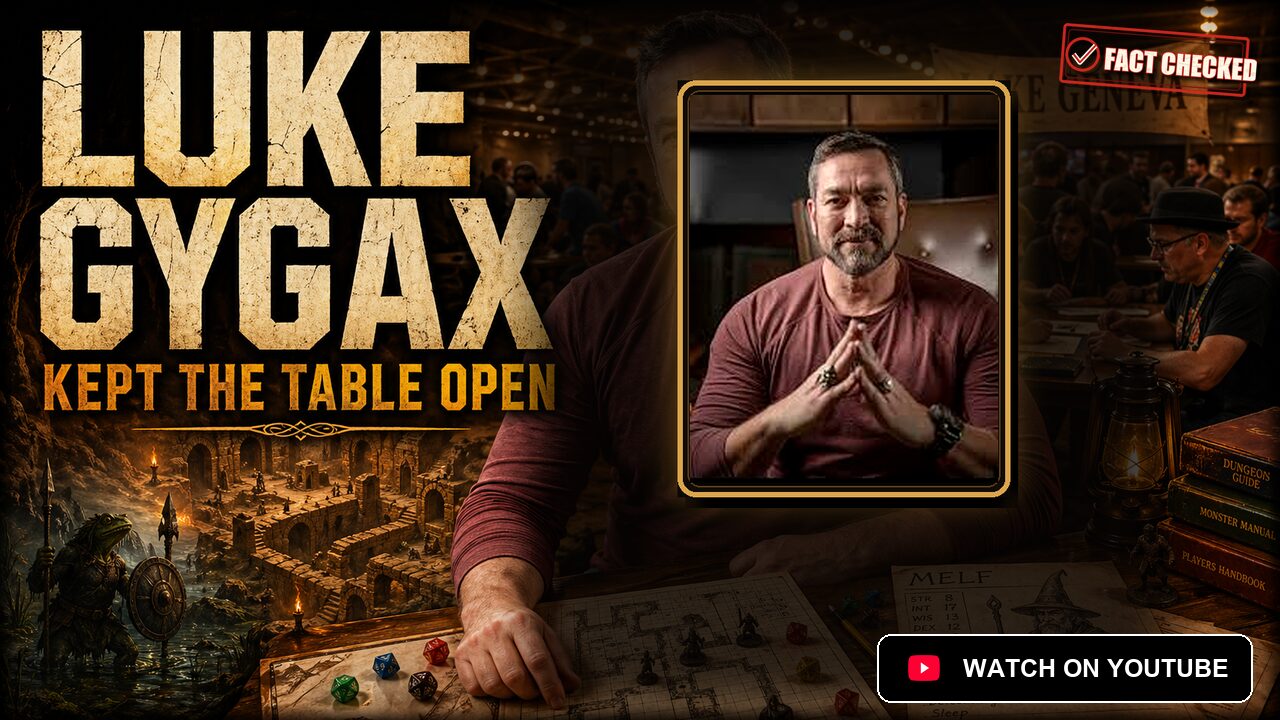
Not a company. Not a rulebook. Not a dungeon.
A table in Lake Geneva.
His father, Gary Gygax, helped turn wargaming into role-playing there. Luke grew up close enough to the early household games that the boundary between family play and game history barely existed. Before the hobby had a single canonical story, it was still a living room full of people trying things, arguing about them, laughing, and changing the rules until the night worked.
That is a strange inheritance.
Luke’s published design record is modest.
His legacy is not.
The distinction matters because Luke’s largest contribution to the hobby does not live in a clean list of credits. It lives in continuity. He has spent much of his adult life keeping the old table open.
The Boy At The Table
Luke grew up inside the origin story.
He was not an outside fan discovering the books later. He was there when the books were still downstream of play. That early presence left marks that became part of Dungeons & Dragons’ long memory.
The bullywug, the frog-like humanoid that first appeared in the Fiend Folio, is credited in multiple lore summaries to Luke and Gary Gygax. Melf, a Greyhawk character created by Luke, became attached to spells like Melf’s Acid Arrow and Melf’s Minute Meteors.
That is not the same thing as designing a system.
It is still remarkable.
Most players never get a character name printed in spell lists. Most designers would be thrilled to add one creature to the shelf of official D&D monsters. Luke did both because early D&D was built out of household play as much as it was built out of published text. Characters, jokes, monsters, and rules fed into one another. The ecology was messy. It was also how the game was born.
The Soldier And The Pause
Luke did not spend his whole life trying to become a full-time game designer.
He served for decades in the United States Army. Whatever else you think about the Gygax legacy, that part of his life matters because it gave him a second identity, a second discipline, and a long stretch of adulthood that was not built around publishing.
It also meant game work arrived in bursts.
Some designers leave a long solo system arc. Year after year, a visible staircase of books. Luke’s evidence looks different. It is more like a set of nodes. Collaborations. Convention work. Setting material that returns when life makes room for it.
One of the early published nodes often associated with him is work connected to Gamma World, credited alongside other designers. Later came The Lost City of Gaxmoor, co-authored with Ernie Gygax and David Moore.
Gaxmoor has the right old-school ingredients. Lost urban space. Factions. Dangerous exploration. A world that feels less like a plotted story than a place players can get into trouble.
It also shows a familiar tension.
Like a lot of early old-school material, it assumes an experienced referee who can repair, interpret, and animate the text. That can be thrilling at the table. It can also make the published artifact harder for a stranger to run cleanly.
Luke’s design case gets clearer when the environment gets sharper.
The World Of Okkorim
The World of Okkorim is Luke’s clearest original setting identity.
It is not Greyhawk with the labels changed. Okkorim draws more from deserts, ruins, scarcity, and Middle Eastern and North African textures than from the temperate medieval fantasy that shaped much of early D&D.
That difference is not cosmetic.
Luke’s Army career and travel experience gave him desert memory that most fantasy designers do not have. Heat that changes how you move. Distance that changes how you plan. Scarcity that makes a small mistake expensive.
Mechanically, Okkorim is not trying to invent a new resolution system. It is built to run in familiar engines.
That is not where Luke’s strongest move lives.
His strongest move is environmental. He brings personal geography into a traditional adventure frame, and the frame changes because the ground changes. The Oculus of Senrahbah trilogy and related Okkorim material show him trying to turn that world into a sustained adventure environment. The work is collaborative, but the setting voice is his.
If you want the clearest argument for Luke as a designer on the page, it lives there. Not in mechanical novelty, but in atmosphere you can actually run.
Gary Con
Gary Con is the center of Luke’s legacy.
After Gary Gygax died in 2008, friends and family gathered in Lake Geneva to remember him and play games. In 2009, Luke established the first official Gary Con.
That is a practical decision that carries an emotional weight.
Because once a hobby becomes global, history turns abstract. It becomes books on shelves, old interviews, arguments on the internet, people talking about the past as if the past is a sealed room.
A convention turns history back into bodies at tables.
Gary Con grew from memorial gathering into an annual pilgrimage, with guests from the earliest days of the hobby, long old-school tables, and a culture built around playing in person.
The official 2024 press kit lists more than two thousand in-person events and a sizable online schedule. That scale is not just nostalgia. It is logistics, hospitality, programming, and curation. A convention is a machine for creating encounters between people.
Gary Con’s machine is tuned toward memory and play.
This is not game design in the narrow sense.
It is culture design.
Luke has helped build a place where the old guard and the next generation can sit down together. That is different from writing a rulebook, but it may be more important to the survival of a play tradition than any single module.
The Third Act
Luke’s post-Army creative work has accelerated.
The Tomb of Gyzaengaxx, created with Alphinius Goo and Gooey Cube, raised $635,750 on Kickstarter from 2,964 backers. That is proof of appetite for a project that honors Gary while turning the homage into a playable adventure and campaign setting.
It is also a useful measure of where Luke stands as a designer.
The project is collaborative. It uses established systems and publisher infrastructure. It is powered partly by legacy.
It is still real work.
It is Luke operating at a larger commercial scale than earlier Okkorim projects, with a team capable of packaging, illustrating, and delivering the table experience in a more polished modern form.
He also shows up as a contributor in the broader RPG conversation, including work connected to the Kobold Guide to Roleplaying, which was part of the book that won a 2024 Silver ENNIE for Best RPG Related Product.
The trajectory is upward.
The portfolio is still developing.
What He Actually Built
Luke Gygax built continuity.
He carried childhood play into published D&D through Melf and the bullywug. He carried old-school habits into Gaxmoor, Okkorim, and later collaborative projects.
Most importantly, he carried the culture.
A lot of legacies die when history turns into a shrine. The people who were there get older. The stories get repeated until they harden. The play turns into a museum display.
Luke’s strongest contribution is stewardship that keeps the play alive.
The design limitations are still clear.
He has not published a major solo system. He has not created a mechanical framework that other designers adopted. Most of his credits are collaborative. His adventure work lives inside existing engines.
That is not a dismissal. It is the honest boundary around the published evidence.
And then you look at Gary Con again, and you realize what the evidence is really saying.
Luke is not trying to be Gary Gygax. Nobody can be.
His work is different. He keeps the door open. He keeps the tables full. He keeps the game moving from one generation to the next.
The game goes on because someone made sure there was still a place to play it.
Where To Find Him
Find Luke in Melf’s spells and the bullywug’s swamp.
Find him in The Lost City of Gaxmoor, the World of Okkorim, the Oculus of Senrahbah material, and The Tomb of Gyzaengaxx.
Find him at Gary Con, where the old table is not a museum piece but a living practice.
Gaxx Worx remains the home base for his Okkorim work and related projects. Gary Con remains the public ritual, the place where the family story becomes a room full of dice, old friends, new players, and referees still willing to let danger be dangerous.
That is the thesis.
Luke Gygax kept the table open.
Fact Check Notes
Publication notes
This site is AI-assisted and human-reviewed. We use artificial intelligence to help gather research, organize source material, and draft profile content. Human editors then read, revise, and check each profile before it goes live. Most profiles are built through deep AI research and two separate rounds of fact-checking.
Leave a Reply
You must be logged in to post a comment.