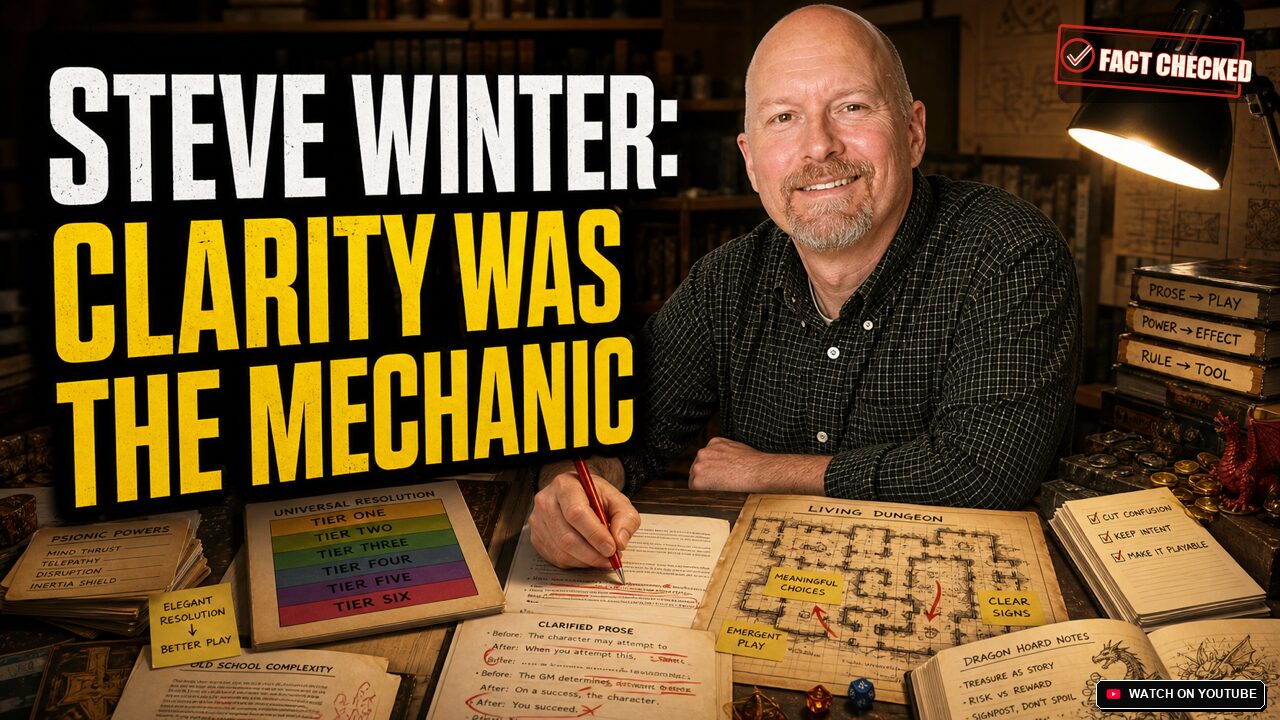
Steve Winter came to TSR with a skill the young role-playing industry badly needed.
He could make rules readable.
That sounds modest until you remember what early RPG books often asked of their readers. They were exciting, strange, dense, contradictory, magical, and sometimes nearly impenetrable. A rulebook could feel less like an instruction manual than a recovered artifact. Someone at the table had to decode it before anyone else could play.
Winter arrived at TSR in 1981 with journalism and editing experience. He understood deadlines, clean sentences, structure, and the difference between flavor and confusion. He became a Games Editor, then Manager of Game Editors, and spent years inside the machine that made Dungeons & Dragons products move from idea to printed object.
That kind of work rarely gets treated as game design.
It should.
A rule that cannot be understood does not function at the table. A rule that reads cleanly becomes action. Winter’s deepest contribution was not always invention. It was making invention usable.
The Desk At Tsr
TSR in the early 1980s was full of imagination, but not always full of editorial discipline.
Winter’s early work ran through the editorial side of major products: Star Frontiers, Gangbusters, World of Greyhawk material, Top Secret support, Oriental Adventures editing, and the steady churn of game books that needed to be coherent before they could be boxed, shipped, sold, and played.
Editors in games do more than fix punctuation.
They find contradictions. They ask what happens when rule A touches rule B. They notice that a table tells the player one thing and the paragraph under it tells the player another. They convert designer intention into player procedure. They make sure the person reading at midnight before tomorrow’s session can actually use the book.
Winter was good at that.
That is why his career keeps appearing at hinge points where the hobby needed translation: comic-book action into a universal table, psionics into AD&D procedure, old D&D assumptions into later reform, fifth edition’s launch adventures into publishable form, and a late-career megadungeon into readable danger.
The byline is only part of the story.
The Super Hero Rulebook
In 1984, Winter co-created the Marvel Super Heroes RPG with Jeff Grubb.
The attribution matters. Grubb is the key mechanical architect of the FASERIP system and its famous Universal Table. That table handled nearly everything through ranked abilities and color-coded results. White, Green, Yellow, and Red became degrees of outcome for punching, leaping, blasting, dodging, inventing, resisting, and doing the impossible in a superhero world.
Winter’s contribution was the rules text and presentation.
That was not cosmetic. It was part of why the game worked.
Marvel Super Heroes could have been a dry chart engine wearing a licensed costume. Instead, it read like an invitation to be inside a comic. The prose leaned into the energy of Marvel’s editorial voice. It made players feel that the book understood the genre. It taught a universal resolution system without draining the color out of it.
Good superhero games need speed. They need big swings. They need rules that can move from street fight to cosmic spectacle without requiring a new subsystem every five minutes. Grubb’s mechanics gave Marvel Super Heroes that. Winter’s writing made the table feel approachable and alive.
That partnership is one of the cleanest examples of Winter’s career.
He did not have to be the sole inventor to be essential.
The Psionicist
The Complete Psionics Handbook, published in 1991 for AD&D 2nd Edition, is Winter’s strongest solo design claim.
Before that book, psionics in D&D had a reputation for awkwardness. It existed, but many tables ignored it. It felt like a strange appendix bolted onto a game already full of strange appendices.
Winter rebuilt it into a class, a resource system, and a taxonomy.
The psionicist used Psionic Strength Points, a flexible pool spent to activate powers. That made psionics feel different from Vancian spellcasting, where spells were prepared and expended in fixed slots. It gave psychic powers a different rhythm: effort, cost, maintenance, recovery, and pressure.
He also organized powers into disciplines such as Clairsentience, Psychokinesis, Psychometabolism, Psychoportation, Telepathy, and Metapsionics. The names sounded esoteric, but the structure mattered. Psionics now had a map. A player could understand what kind of psychic character they were building and where new powers fit.
The idea of point-based supernatural power was not new to RPGs. Other games had resource pools before Winter brought that logic to AD&D. His achievement was adaptation and integration. He made the concept work inside a game whose magic system had spent years doing something else.
That is why The Complete Psionics Handbook lasted as a reference point. Later D&D psionics changed, argued with it, corrected it, or replaced pieces of it, but Winter’s book gave the game’s psychic powers a durable shape.
The Reforms Around The Edges
Winter’s career is full of reforms that happened near him, through him, or under his direction, even when the final credit belongs elsewhere.
AD&D 2nd Edition is the clearest example. David "Zeb" Cook holds the central design credit. Winter and others worked in development and editorial leadership. The edition had to modernize AD&D while staying close enough to older material that players and management would accept it.
That meant many deeper reforms had to wait.
Descending Armor Class stayed. THAC0 survived. Saving throws kept old categories. The system became cleaner, but not fully rebuilt.
Some of the ideas that could not fit there appeared in other places. Gamma World 4th Edition, under Winter’s senior direction, explored mechanics that look more modern in hindsight: ascending defenses, cleaner attribute logic, and more unified resolution. The credited designers were Bruce Nesmith and James Ward, not Winter. Still, the pattern is telling. Winter kept pushing toward rules that could be explained without asking players to inherit every old habit.
This is the editor-developer problem.
You can shape a system’s direction without owning the design credit. You can make the reform possible, but the public memory remembers the name on the cover. Winter spent much of his career in that space.
The Launch Adventure And The Living Dungeon
In 2014, Winter returned to the center of D&D visibility with Hoard of the Dragon Queen and The Rise of Tiamat, co-designed with Wolfgang Baur for the launch of D&D 5th Edition.
That assignment was difficult from the start. The adventures had to introduce players to a new edition while that edition was still settling. Some encounter balance and presentation problems followed. The opening of Hoard of the Dragon Queen became famous for being rough on low-level characters, and critics split hard on the adventure’s structure.
But the job was not simple incompetence or simple success.
It was a launch product built on moving ground.
That context matters because Winter’s later Kobold Press work shows a different kind of control. Scarlet Citadel, published in 2021, put him in the lead seat on a large 5E dungeon project. It is old-school in its appetite for danger, but modern in its usability. Rooms are meant to be explored. Threats can evolve. The dungeon has pressure, faction logic, secrets, and enough structure for a GM to run without feeling abandoned.
It is not the work of a designer chasing novelty.
It is the work of someone who spent decades learning where players get confused, where GMs need support, and how danger should be written so that it feels fair when it kills you.
What He Actually Built
Steve Winter did not invent FASERIP’s Universal Table. Jeff Grubb deserves that mechanical credit.
Winter did not design AD&D 2nd Edition by himself. He did not create Dungeons & Dragons, Marvel, or the systems that made those brands famous. Much of his influence came through editing, development, management, and collaboration, which are harder to celebrate than solo invention.
What he built was clarity as a design habit.
He made rules prose carry weight. He helped turn mechanical ideas into instructions players could trust. He gave D&D psionics a resource system and internal organization. He helped TSR products become more readable during a period when the hobby was still learning what a rulebook should be. He kept working long enough to bring that same clarity to fifth edition adventures and Kobold Press dungeon design.
That is not a small contribution.
The tabletop hobby often remembers the person who creates a mechanic. It is slower to remember the person who makes the mechanic playable. Winter’s career is an argument that those jobs are joined.
The clarity was the mechanic.
Where To Find Him
Steve Winter remains visible through decades of credits and more recent Kobold Press work.
Kobold Press maintains an author page for him and identifies Scarlet Citadel among his contributions. The Howling Tower preserves his public design commentary, essays, and reflections from a career spent inside D&D from TSR through Wizards of the Coast and beyond.
That long arc is the real story.
Winter started as the person helping the rules make sense. Forty years later, that is still the thread. Marvel needed a comic voice. Psionics needed a structure. D&D revisions needed clean development. Scarlet Citadel needed danger a GM could actually run.
The names on the covers changed.
The grinder kept running.
Fact Check Notes
Publication notes
This site is AI-assisted and human-reviewed. We use artificial intelligence to help gather research, organize source material, and draft profile content. Human editors then read, revise, and check each profile before it goes live. Most profiles are built through deep AI research and two separate rounds of fact-checking.
Leave a Reply
You must be logged in to post a comment.