Iconic Tabletop Game Convention
Gen Con
The gathering that grew from a fifty-dollar hall into tabletop gaming's summer capital.
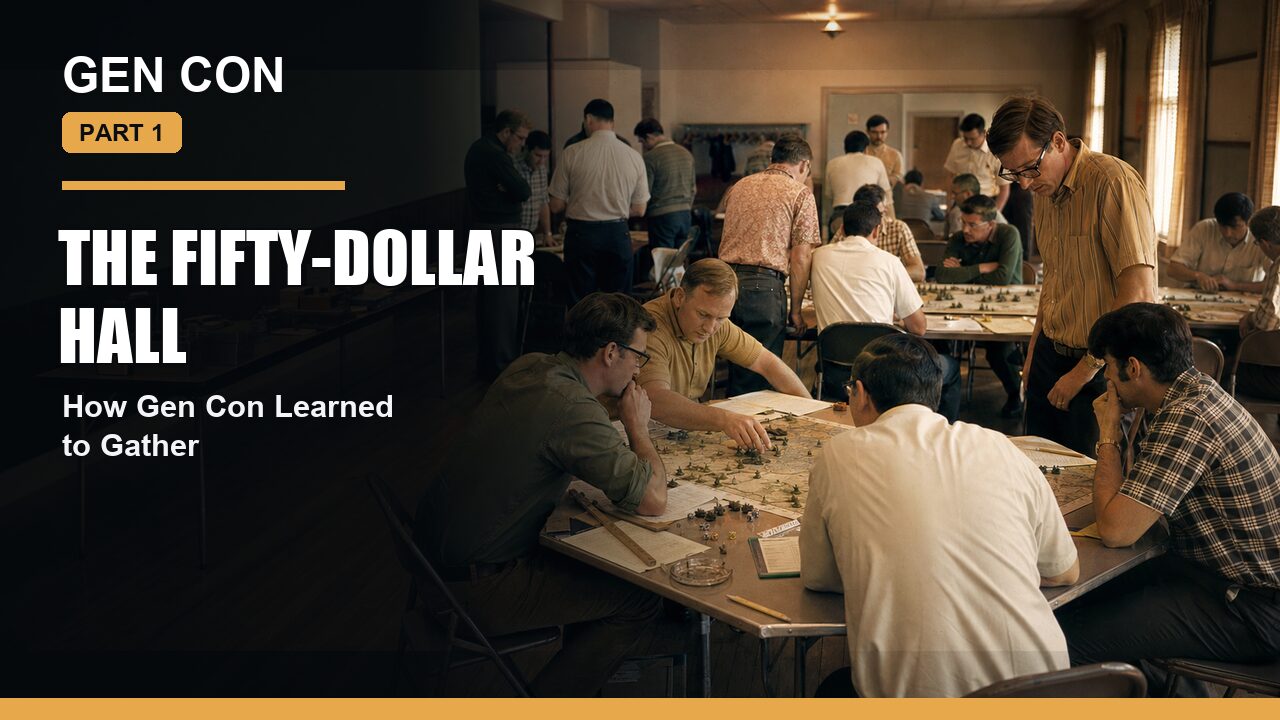
The Fifty-Dollar Hall
How Gen Con Learned to Gather
Gen Con, Part 1 of 3
Gary Gygax needed a room, and the room cost fifty dollars.
That modest bill is one of the few clean numbers in Gen Con's origin story. The surviving record places the first formal convention at Horticultural Hall in Lake Geneva, Wisconsin, on August 24, 1968. The hall was small, the program was short, and the crowd could have fit inside a neighborhood movie theater. Yet the structure created that day would help teach a scattered hobby how to meet itself.
Gen Con's beginning is often given as 1967. That date needs a footnote. Gygax did host a small, invitation-only gathering at his Lake Geneva home that year. Later histories called it "Gen Con 0," and estimates range from roughly twelve to twenty people. It was a precursor, not the first formal public convention. Gen Con's own current pages preserve both sides of the distinction: its About page says the organization was founded in 1967, while official press releases state that the annual convention began in 1968. The federal trademark record claims first use of GEN CON on August 15, 1967, but a claimed first-use date is not proof that a formal show occurred then. Gen Con About GEN CON trademark record
The private gathering still mattered. Gygax had attended a wargaming convention in Malvern, Pennsylvania, and wanted something closer to home. He was active in the International Federation of Wargaming, a network that linked players through clubs, newsletters, and mail. Lake Geneva offered no ready-made institution for them. Gygax and his collaborators had to build one.
They rented Horticultural Hall for $50. Jon Peterson's archival account records 96 attendees, including 33 members of the IFW. Later recollections give other figures, so "roughly one hundred" is safer than treating any count as a modern badge audit. The name was a wargamer's joke. "Gen Con" shortened "Geneva Convention," joining the Wisconsin town to the international rules of war. Best 50 Years in Gaming Jon Peterson on Gen Con 1968
The first program was built around historical conflict. Its two listed event types were Fight in the Skies, a World War I aerial game, and naval gaming. That sounds narrow now, but the room was doing several jobs at once. It was a competition hall, a clubhouse, a demonstration floor, and a place where rules that had traveled by mail could finally be tested face to face.
Face-to-face play changed the speed of the culture. Postal hobby networks were good at circulating rules and arguments, but a letter could not show how a referee handled a disputed move or how miniatures looked in motion across a table. At a convention, one group could borrow another group's practice before going home. The important product was not only a winner or a rules booklet. It was a set of people who had seen the same game played, disagreed about it in the same room, and could teach a revised version to someone else.
The program expanded quickly. By 1969 it included an auction, miniatures events, a Diplomacy tournament, and an opening speech. Program data studied by Neal Baker shows a more important turn in 1971: events appeared that explicitly taught newcomers how to play. A convention could now reproduce the hobby, not just reward those who had already mastered it. Neal Baker, "50 Years of Gen Con Events"
That teaching function became vital when tabletop roleplaying arrived. Dungeons & Dragons was published in 1974 by Tactical Studies Rules, the company Gygax formed with Don Kaye. Gen Con's 2024 anniversary release says D&D made its Gen Con debut that year. The surviving scheduled-event data is less tidy: the Best 50 Years project found no listed D&D event in the 1974 program, then three prize D&D games in 1975. Both facts can stand. The game may have been present outside the surviving schedule, but the printed program shows when organized play became visible. Gen Con 2024 post-show release
The distinction matters because folklore can make a new movement look inevitable. It was not. Early Gen Con still carried miniatures, board wargames, Diplomacy, auctions, and seminars. Roleplaying entered an existing ecology of play. Its growth came partly from the convention's ability to let one player watch another player do something unfamiliar, sit down, ask questions, and try.
TSR also changed the institution around the games. The program record identifies 1975 as the first year TSR managed the convention. Other histories date formal TSR control to 1976, when Gen Con IX was promoted under the company. The most honest sequence is management in 1975 and formal corporate control commonly dated to 1976. The surviving trademark chain supports TSR's later ownership: TSR Hobbies was the original registrant of the GEN CON mark when it filed in 1978.
Corporate management brought resources, but it also tied the convention's future to a fast-growing publisher. By the late 1970s, Horticultural Hall and Lake Geneva's other local spaces could not absorb the demand. In 1978 Gen Con moved to the University of Wisconsin-Parkside near Kenosha. The campus years lasted through 1984.
Parkside was more than a venue swap. It gave the convention classrooms, residence space, and a larger physical grid. Seminars and demonstrations could multiply. Different game communities could occupy separate rooms without losing the sense that they belonged to the same event. Gen Con was becoming a temporary town organized around play.
The move also loosened the event's attachment to Lake Geneva. Gygax's name would remain inseparable from the convention, but TSR was growing into a company with its own executives, pressures, and succession struggles. By the mid-1980s, Gygax's role at TSR was collapsing. Gen Con's survival could no longer depend on the founder who had rented the first hall.
In 1985 the convention left the campus and entered Milwaukee. It arrived with seventeen years of accumulated habits: tournaments, auctions, product demonstrations, seminars, beginner instruction, and the mingling of designers with players. The fifty-dollar hall had taught gamers how to gather. Milwaukee would show publishers what that gathering was worth.
Sources
- Neal Baker, "50 Years of Gen Con Events"
- Best 50 Years in Gaming, "A Brief History of Gen Con"
- Jon Peterson, "Gen Con 1968 and Today"
- GEN CON trademark record
- Gen Con 2024 post-show release
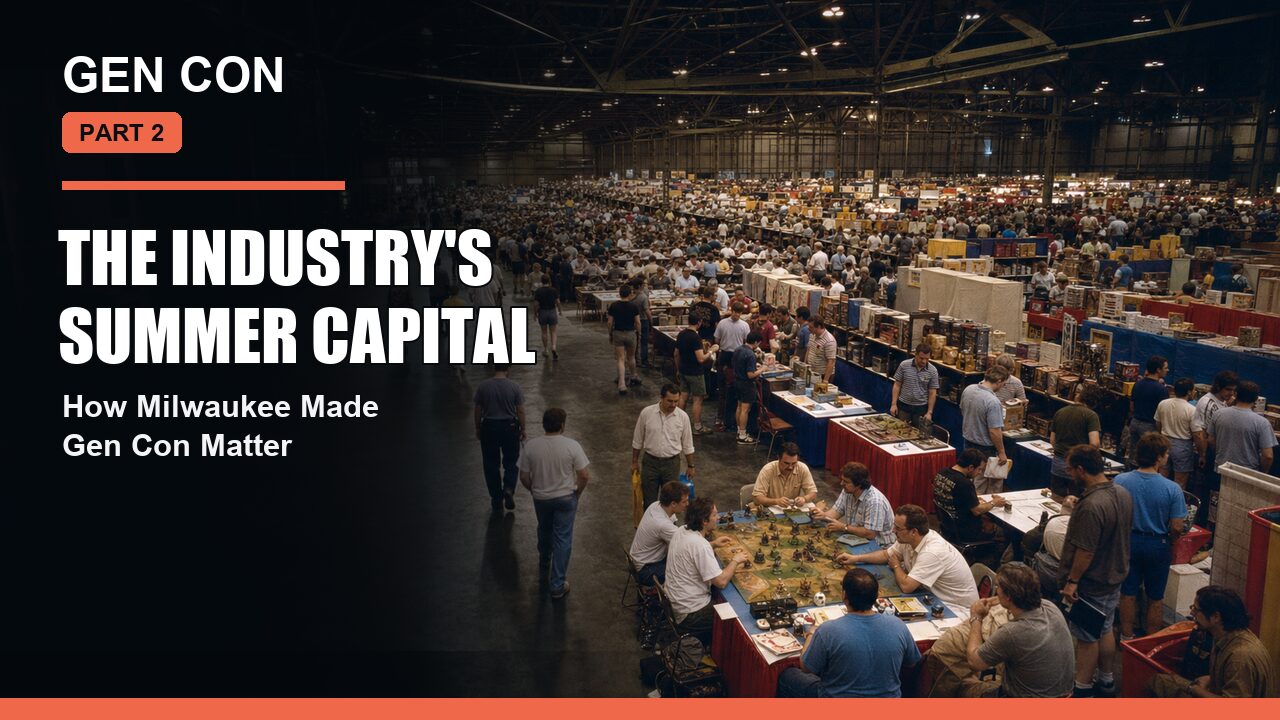
The Industry's Summer Capital
How Milwaukee Made Gen Con Matter
Gen Con, Part 2 of 3
In 1985, Gen Con moved into Milwaukee and discovered what happened when a hobby convention acquired the floor space of an industry.
The event had already outgrown Lake Geneva and spent seven years at the University of Wisconsin-Parkside. Milwaukee offered something different: larger exhibition halls, city hotels, transportation, and room for thousands of people to arrive with different reasons for being there. Players wanted tables. Publishers wanted orders. Designers wanted attention. Retailers wanted to know what customers would ask for next.
Gen Con could put all of them in one building.
The first Milwaukee venue was the Milwaukee Exposition and Convention Center and Arena, usually called MECCA. Retrospective attendance estimates rise from about 5,000 people in 1985 to tens of thousands by the mid-1990s, but the early figures do not use one consistent modern method. The reliable point is the change in scale. The convention was no longer a regional meeting with a large publisher attached. It was becoming the tabletop business's summer capital. Gen Con 2018 program
That status did not come from the exhibit hall alone. Gen Con linked commerce to play. A publisher could show a new game, teach it, run tournaments, listen to player complaints, and watch word of mouth spread before the weekend ended. Players could compare companies that had previously reached them through catalogs, magazines, or a local store's limited shelf.
In 1988, Gen Con and Origins Game Fair were combined in Milwaukee. The joint event did not become a permanent merger, but it showed how central convention weekends had become to the industry's calendar. Publishers had to decide where to display, when to launch, and how to reach both retailers and consumers. Gen Con's advantage was concentration. The biggest news could be turned into a game on a table before it became a story in a magazine.
Magic: The Gathering supplied the perfect demonstration in 1993, though its origin is often simplified. Wizards of the Coast's own history says Magic premiered at Origins in July, where early demonstrations helped build interest. The cards went on sale to the public and made their national splash at Gen Con in August. A year later, Magic players occupied nearly any horizontal surface they could find. Wizards of the Coast, "Once Upon a Time" Wizards of the Coast, "A Different Worlds"
The distinction gives both conventions their due. Origins helped introduce the idea. Gen Con converted attention into a visible consumer phenomenon. Its crowd, tables, dealers, and press made demand impossible to miss. Gen Con's own 2018 retrospective described the first shipment arriving late, then starter decks and boosters moving fast once players tried the game.
Magic did more than give Gen Con a famous launch story. It created a new category of tabletop business. Collectible cards encouraged constant play, trading, tournaments, and repeat purchases. Convention space filled with a product whose community could organize itself anywhere two people found a flat surface. The show became a living sales chart.
The same Milwaukee years broadened the program beyond its wargame and roleplaying roots. Board games, card games, live-action play, seminars, art, costumes, media events, and international guests shared the schedule. Neal Baker's study of five decades of program data found increasing transmedia activity alongside the long-running teaching function. Gen Con was not simply adding attractions. It was showing how tabletop culture connected to stories, performance, art, and other forms of fandom. Neal Baker, "50 Years of Gen Con Events"
Behind that expansion sat a corporate problem. TSR owned Gen Con, and TSR's financial health was deteriorating in the 1990s. Wizards of the Coast, enriched by Magic, announced a plan to acquire TSR on April 10, 1997. By June, Publishers Weekly reported that Wizards was the new owner and intended to pay roughly $13 million in claims from TSR suppliers. The transaction terms themselves were not disclosed. Wizards acquisition announcement mirror Publishers Weekly, "Wizards New TSR Owner"
That last sentence corrects a durable piece of industry folklore. Later histories often attach a $25 million or $30 million price to the acquisition. The strongest contemporary account available for this package says the terms were undisclosed. Supplier claims and purchase price are not the same thing.
Wizards had now purchased a company, major game properties, and the convention where its own breakthrough product had become a sensation. Gen Con's value was clear, but it was also an unusual asset for a publisher. Running a convention required venue contracts, hotels, ticketing, security, event systems, exhibitor relations, and customer service. It was a different business from making games.
The show changed Milwaukee buildings in 1998, moving into the new Midwest Express Center. That larger facility bought time, not a permanent solution. Attendance and exhibitor needs kept pressing against the city's convention and hotel capacity.
Corporate ownership changed again when Hasbro acquired Wizards of the Coast in 1999. Gen Con was now a small operating business inside a global toy company. The convention had cultural prestige and strategic value, but it did not need to remain bundled with the Dungeons & Dragons publisher.
Peter Adkison understood both sides. He had co-founded Wizards, led it through Magic's rise and the TSR acquisition, then left the company. He also knew Gen Con as a participant and executive. On March 21, 2002, Wizards announced that it had sold Gen Con to Adkison. The price was not disclosed.
The transition was deliberately staggered. Contemporary trade reporting said Wizards would support management of the 2002 Milwaukee show, while Adkison would take over management beginning with the 2003 convention. Gen Con's own corporate fact sheet describes the 2002 purchase more simply, but the contemporary account shows why the final Milwaukee event belongs to both eras. ICv2, "Wizards of the Coast Sells GenCon to Peter Adkison" Gen Con corporate fact sheet
Adkison did not buy Dungeons & Dragons back from Hasbro. He bought the convention and its operating future. That separation was significant. For the first time since TSR took control in the 1970s, Gen Con would not be owned by the publisher of D&D.
It also would not stay in Milwaukee.
The 2002 sale announcement was frank about the physical problem: the convention had outgrown the city. Indianapolis offered more connected convention space, a dense hotel network, and a civic partner eager to grow with the show. Milwaukee had made Gen Con the industry's summer capital. The next move would test whether that capital could survive as an independent company in a new city.
Sources
- Gen Con 2018 electronic program
- Neal Baker, "50 Years of Gen Con Events"
- Wizards of the Coast, "Once Upon a Time"
- Publishers Weekly on the 1997 TSR acquisition
- ICv2 on the 2002 Gen Con sale

The Convention That Chose a City
How Gen Con Remade Itself in Indianapolis
Gen Con, Part 3 of 3
When Gen Con arrived in Indianapolis in 2003, it was not merely changing buildings. It was trying to become a company that could outlive every company that had owned it.
TSR had turned the convention into a corporate property. Wizards of the Coast had acquired it with TSR. Hasbro had acquired Wizards. Peter Adkison's 2002 purchase finally separated Gen Con from the publisher of Dungeons & Dragons, but independence came with a harder requirement: the convention now had to support itself.
Indianapolis offered scale. The Indiana Convention Center, nearby hotels, and later Lucas Oil Stadium created a connected downtown campus. Gen Con and Visit Indy describe the first 2003 show as an event of roughly 20,000 people. That figure is an estimate, not a modern badge audit, but the direction is clear. The move created room to grow. Gen Con 2023 post-show release
Gen Con LLC also tried to expand beyond its Indianapolis flagship. It operated events including Gen Con So Cal and licensed projects outside the core show. The Southern California convention was canceled in 2007. Organizers told GameSpot that flat attendance, competing events, exhibitor withdrawals, and the expense of further growth made the event unsustainable. GameSpot, "Gen Con So Cal so canceled"
The larger crisis arrived in 2008.
Lucasfilm filed a civil complaint against Gen Con LLC on January 10 over the company's operation of Star Wars Celebration IV. The complaint alleged breach of contract and other claims. Those were allegations, not court findings. That distinction is essential because later summaries often compress the lawsuit and Gen Con's financial collapse into one proven chain of blame. Lucasfilm Ltd. v. Gen Con LLC complaint docket
In February, Gen Con filed for Chapter 11 protection in Washington. Its public announcement cited significant unforeseen expenses connected to efforts to expand into externally licensed events. The filing came after the Lucasfilm complaint, but the preserved evidence does not establish that the complaint alone caused the bankruptcy. Gen Con said the Indianapolis event would proceed, and it did. ICv2, "Gen Con Files Chapter 11"
A proposed asset purchase surfaced during the case and went nowhere. Later retellings give the proposal a combative label, but the public record supports a narrower description: someone proposed buying the assets, Gen Con rejected the proposal, and ownership did not change. By early 2009, the reorganization was complete. The convention had survived its most serious business test without returning to a major publisher.
Survival did not make every later year easy. It did prove that the Indianapolis show was the core business. Gen Con concentrated on the event, refined its ticketing and program systems, and expanded across downtown. It also learned to describe attendance more precisely.
That precision matters. A four-day convention can count the same person once as a unique attendee or four times in a turnstile total. In 2016, Gen Con reported 60,819 unique attendees and 201,852 turnstile entries. In 2017, it reported approximately 60,000 unique attendees and 207,979 turnstile entries. The larger number did not mean more than 200,000 different people came to Indianapolis. Gen Con 2016 post-show release Gen Con 50 post-show release
The 2017 event also sold out its badges for the first time. By then, Gen Con functioned as a consumer show, a publisher marketplace, a tournament complex, a seminar program, a costume event, an entertainment festival, and a yearly reunion. Its economic presence gave it political weight.
In 2015, that weight entered Indiana's debate over the Religious Freedom Restoration Act. Gen Con asked Governor Mike Pence not to sign the bill and later said it would pause future expansion discussions until attendees had clear protections against discrimination. The company framed the issue as both a matter of safety and a business risk. The statement did not erase the law or end every dispute, but it showed that Gen Con could use future location and expansion decisions as bargaining power. Gen Con anti-discrimination statement
Gen Con took a related position in 2022 after Indiana enacted a broad abortion ban. President David Hoppe warned that the law would affect attendees and make long-term commitment harder. A year later, the company chose to stay and extended its Indianapolis agreement through 2030. Hoppe told local business press that Gen Con would remain and continue to stand for its values rather than withdraw from the city. Inside INdiana Business, "Gen Con extending its stay through 2030"
Between those disputes, the pandemic exposed the basic truth behind the business. Gen Con depends on people sharing physical space.
The company canceled the 2020 in-person convention on May 19. Gen Con Online replaced it with nearly 7,000 events and more than 40,000 participants. Those numbers demonstrated reach, but they were not interchangeable with badge attendance. The in-person event returned in 2021 with more than 35,000 unique attendees, mask requirements, and a smaller program. Gen Con 2020 cancellation Gen Con Online post-show release Gen Con 2021 post-show release
The recovery accelerated. Gen Con reported more than 50,000 unique attendees in 2022 and more than 70,000 in 2023. The 2024 event passed 71,000, with more than 540 exhibitors and nearly 24,000 activities. In 2025, the company reported a new record of nearly 72,000 people, more than 575 exhibitors, and roughly 30,000 activities. It and Visit Indy estimated the event's local economic impact above $82 million. Gen Con 2024 post-show release Gen Con 2025 post-show release
Those are organizer figures, and the economic estimate does not come with a public methodology detailed enough for an independent audit. They still describe a civic relationship unlike the one Gen Con had in Lake Geneva. Indianapolis did not simply rent a hall. It expanded convention facilities, hotel capacity, and downtown connections around events such as Gen Con. The convention, in turn, built an identity tied to the city.
Ownership and leadership also kept changing. In January 2025, Gen Con announced that Adkison would retire as board chair. He retained co-ownership and a board seat, while attorney Brian Lewis became chair. The wording corrects another easy simplification: Adkison remains an owner, but the official release does not call him the sole owner. Gen Con 2025 leadership announcement
The GEN CON word mark reflects the longer chain. TSR Hobbies filed for it in 1978, and Gen Con LLC is the current registered owner. The record claims first use in 1967, while official event histories commonly identify 1968 as the beginning of the annual convention. The contradiction is not a flaw to hide. It records the difference between an informal precursor, a trademark claim, and the first documented public show. GEN CON trademark record
As this article closed on July 30, 2026, the current Gen Con had just begun in Indianapolis and was scheduled to run through August 2. No completed 2026 attendance figure yet existed. Inventing one would miss the lesson of the convention's history.
Gen Con's importance cannot be reduced to a record crowd. It matters because the event concentrates an industry and a culture long enough for each to see the other. A new game can become a public fact over one weekend. A rules question can become a seminar. A local group can discover a national community. A publisher can meet the people represented by a sales report.
The fifty-dollar hall taught gamers how to gather. Milwaukee turned the gathering into a marketplace. Indianapolis made it durable enough to survive independence, bankruptcy, politics, and a year without a physical convention.
The city did not merely host Gen Con. Gen Con chose it, tested it, and grew with it.
Sources
Fact Check Notes
Publication notes
This site is AI-assisted and human-reviewed. Research from independent sources was reconciled, revised, and fact-checked before publication.
Leave a Reply
You must be logged in to post a comment.