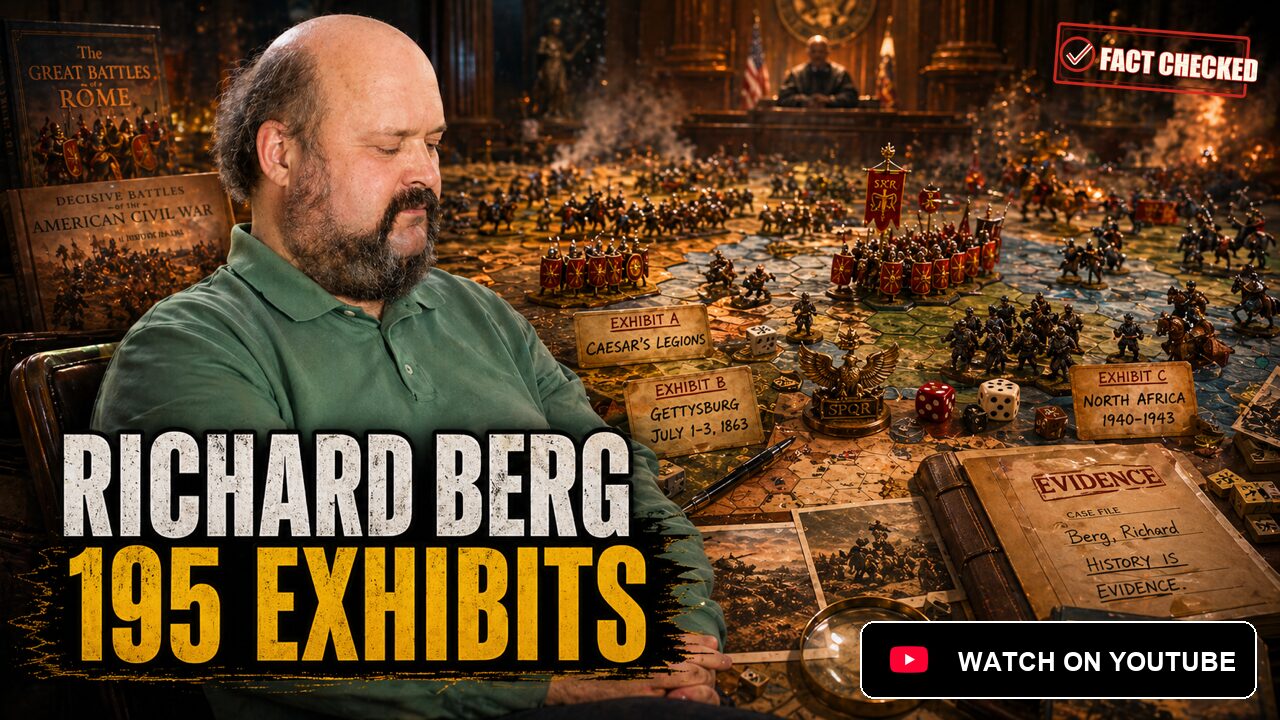
Richard Berg did not treat history like scenery.
He treated it like a case file.
Every battle had witnesses. Every army had habits. Every commander had a record. Every rule needed to explain why it was there. If a cavalry charge broke a line, Berg wanted to know what kind of line, what kind of cavalry, who was giving the order, how tired the men were, and whether the ground itself had already decided the issue before the first counter moved.
That was the shape of his work.
Across more than four decades, Berg became one of the most prolific wargame designers the hobby has ever had. He is often credited with 195 designs or co-designs, depending on how the count is made. The exact number matters less than the evidence sitting behind it: shelves of games on ancient battles, Civil War campaigns, Renaissance armies, Napoleonic fields, fantasy war, modern conflict, and the strange borderland where simulation becomes obsession.
Some designers are remembered for one perfect mechanism.
Berg is remembered for the file cabinet.
The Lawyer At The Map
Berg was not only a game designer. He was a criminal defense attorney.
He earned a degree in Asian History from Union College, then a law degree from Brooklyn Law School. From 1971 to 1988, he worked in criminal defense, including private practice and work connected to the Legal Aid Society. He also had a life in theater, music, writing, directing, and performance.
That mix explains more about his games than a simple resume can.
The historian in him cared about sources. The lawyer in him cared about arguments. The performer in him understood that a battle on paper still needed drama. A wargame could not only say that Gettysburg happened. It had to put pressure on the players until they understood why decisions narrowed, why units cracked, why command mattered, and why history felt inevitable only after it was over.
Berg’s games often feel like arguments with counters.
Not lectures. Arguments.
He made a claim about a battle, then made the players test it.
The Monster At Gettysburg
Berg’s early reputation came fast.
His first published game appeared through SPI in 1975: Hooker and Lee, covering Chancellorsville as part of the Blue and Gray II quadrigame. His next major step was Conquistador, an unusual design about exploration, land, and wealth in the Spanish conquest of the New World.
Then came Terrible Swift Sword.
Published in 1976, Terrible Swift Sword took Gettysburg and refused to shrink it into a polite afternoon. It was large, demanding, and unapologetically serious. The game had thousands of counters, a long rulebook, and a commitment to operational detail that made the battle feel like an unfolding machine.
For some players, that was too much.
For others, it was the point.
Terrible Swift Sword showed what a monster game could be when its size had purpose. It was not big because big looked impressive. It was big because Gettysburg was not one clean decision. It was a hundred decisions under dust, exhaustion, poor visibility, command friction, and human nerve.
Berg gave players the pile of evidence and told them to proceed.
The Game That Became A Legend
The Campaign for North Africa is the Richard Berg game people mention when they want to describe the far edge of simulation.
Published in 1978, it became famous, or infamous, as one of the longest and most intricate board games ever designed. It is the game people cite when they talk about campaigns that could take hundreds upon hundreds of hours. It is the game remembered for supply rules so particular that Italian forces are associated with extra water for pasta.
That kind of detail can sound absurd from the outside.
Inside the logic of Berg’s career, it makes a different kind of sense.
The Campaign for North Africa is not a casual product of excess. It is simulation taken to the horizon. It asks what happens when a designer follows logistics, terrain, distance, supply, and command until play becomes a historical burden rather than a simplified contest.
Most games edit reality so people can play.
Berg sometimes kept adding reality until the game itself became a monument to the problem.
That is why The Campaign for North Africa still has cultural life. Many people know it without playing it. They know the idea of it. They know that somewhere in the history of tabletop games, someone tried to make the desert campaign with almost impossible seriousness.
That someone was Richard Berg.
Ancient Battle, Modern System
Berg was not only the designer of massive oddities.
His most durable work may live in the Great Battles of History series, especially through his collaboration with Mark Herman and GMT Games. Titles such as Great Battles of Alexander and SPQR helped define how ancient warfare could be represented on a tabletop with more than generic attack values and colored blocks.
Ancient battles are hard to model.
They were not just lines walking into lines. They were leadership, formation, morale, troop quality, fatigue, terrain, timing, and the terrible moment when cohesion failed. A phalanx was not a tank. A legion was not a row of numbers. Cavalry did not matter the same way in every army, on every field, under every commander.
The Great Battles of History system gave those differences mechanical weight.
Players had to think about command. They had to think about formations losing order. They had to think about the shape of armies before the collision and the mess after it. The games did not merely ask who had the larger combat factor. They asked whether the army could still behave like an army after the first shock.
That is Berg at his best.
He made the history argumentative, then made the argument playable.
War Of The Ring And The Range Problem
Berg’s range was unusual even inside wargaming.
He worked on Civil War titles, ancient warfare, medieval and Renaissance subjects, World War II, naval and land campaigns, magazine games, boxed games, large simulations, and smaller designs. He also moved into fantasy with SPI’s War of the Ring, a Tolkien wargame that became one of SPI’s major successes.
That range matters because wargame design often rewards specialization. A designer can spend an entire career becoming known for one era or one system.
Berg did not stay in one trench.
He kept changing fronts.
That did not mean every game landed with equal force. A catalog that large will have uneven work. Some designs are revered. Some are curiosities. Some are remembered because they were ambitious. Some are remembered because only Berg would have tried them that way.
But the volume is not just trivia.
The volume is part of the meaning.
Berg proved that historical conflict simulation could be a career of continuous argument. Not one argument, repeated. Many arguments, across many eras, each demanding a different rule vocabulary.
The Reviewer With Teeth
Berg also wrote about games.
Richard Berg’s Review of Games, later known in its fan-published form as BROG, became part of his public voice in the hobby. It was not bland coverage. Berg had opinions. He could be sharp, funny, impatient, generous, theatrical, and brutal. His "Little Mac Awards" carried the same spirit: a designer who loved the field enough to argue with it in public.
That matters because Berg’s career was not only a stack of boxes.
He was part of the conversation around wargaming.
He wrote, reviewed, criticized, defended, joked, provoked, and kept talking. The same instinct that built games as arguments also made him a presence in the culture around those games. He was not a quiet technician hiding behind charts. He was a voice.
Sometimes that voice entertained.
Sometimes it irritated.
Often, it made the room less boring.
What He Actually Built
Richard Berg did not invent historical wargaming.
He did not make every subject accessible. He did not always choose elegance over density. He did not leave behind a catalog where every design is equally loved, equally clean, or equally playable for a modern audience.
What he built was a body of evidence.
He showed that wargames could argue history at scale. He showed that a designer could move from Gettysburg to North Africa to Alexander to Middle-earth without treating any of those worlds as interchangeable. He showed that complexity could be a tool when it served the pressure of the subject, and a warning sign when the subject swallowed the players whole.
His best games do not only ask players to win.
They ask players to understand why winning was hard.
That is the difference.
In Berg’s work, history is not a painted backdrop. It pushes back. The counters are witnesses. The charts are testimony. The rules are cross-examination. The player is not only making moves. The player is entering the case.
Where To Find Him
Richard Harvey Berg died in Charleston, South Carolina, on July 26, 2019.
His work is still easy to find if you know where to look. BoardGameGeek maintains his designer page and credit trail. GMT Games still carries the Great Battles of History line, with product pages, living rules, and series resources. Used copies of SPI, GMT, and other Berg titles continue to move through the collector and wargaming market.
The legacy is not one game.
It is the shelf.
Terrible Swift Sword still stands as a landmark Gettysburg monster game. The Campaign for North Africa still sits at the edge of tabletop myth. SPQR and Great Battles of History still teach players that ancient armies were not abstractions. Berg’s Review of Games still marks him as a critic who refused to treat the hobby like a polite dinner party.
One designer. Four decades. A stack of case files.
Richard Berg rested his case in 2019.
The evidence is still on the table.
Fact Check Notes
Publication notes
This site is AI-assisted and human-reviewed. We use artificial intelligence to help gather research, organize source material, and draft profile content. Human editors then read, revise, and check each profile before it goes live. Most profiles are built through deep AI research and two separate rounds of fact-checking.
Leave a Reply
You must be logged in to post a comment.