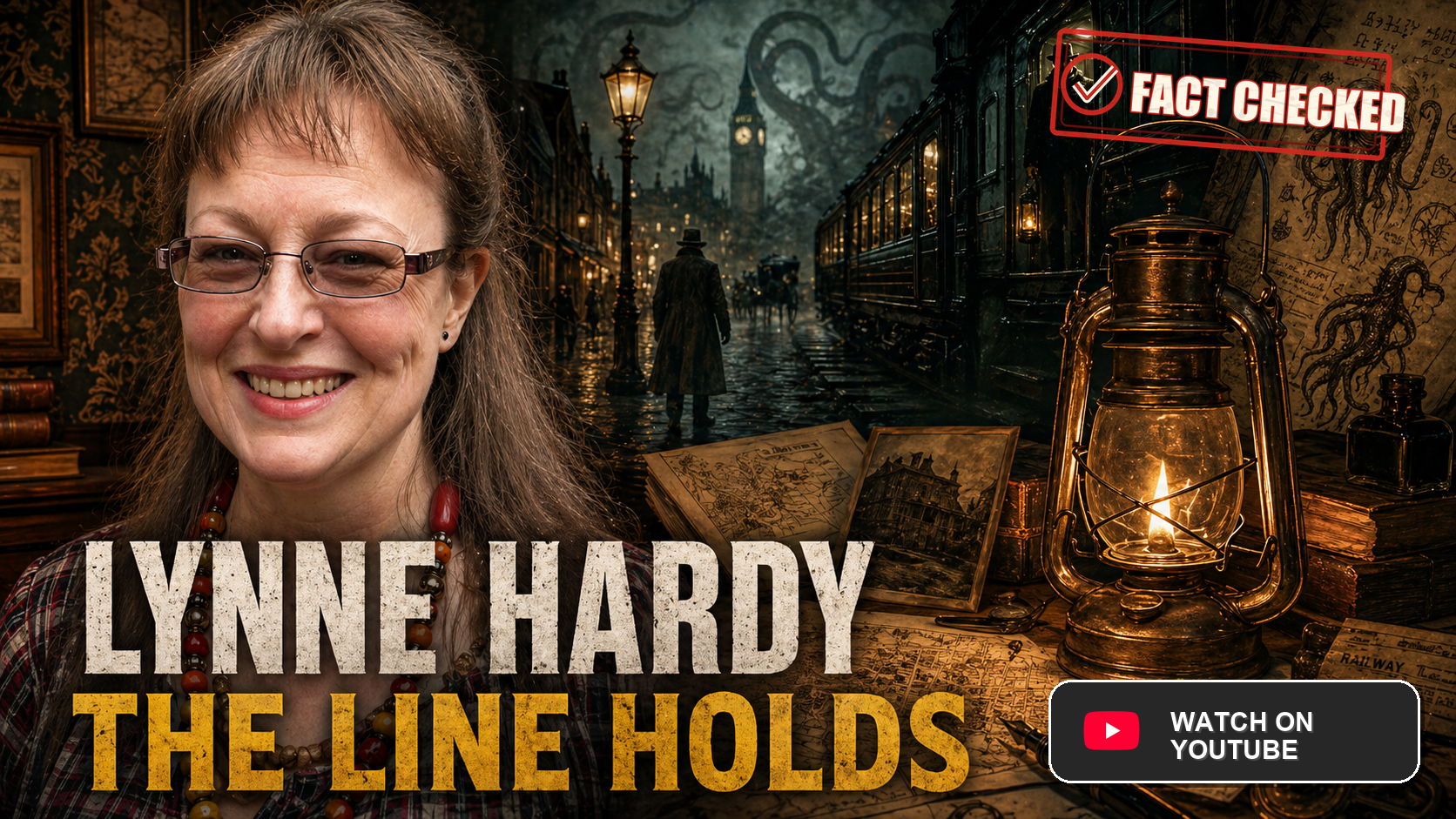
When a horror line loses its tone, everyone feels it. A careless historical supplement makes the table smell the cardboard. If an investigation game forgets how clues, dread, pacing, and human detail fit together, the horror collapses into scenery.
Hardy’s contribution is quieter than a new rules engine.
She helps keep the line running true.
That matters in Call of Cthulhu because Call of Cthulhu is not just old. First published in 1981, it has carried one of the clearest identities in tabletop roleplaying: investigation, fragility, scholarship, history, cosmic horror, and the slow realization that knowing more may not save you.
Working inside that tradition is not the same as simply preserving it.
A long-running game line can become a museum. It can also become a costume rack, where every historical period gets a few props and the Mythos pasted on top. The real work is harder. You have to know what can move and what must not break.
This is where Hardy fits.
She did not invent Call of Cthulhu. She is one of the people helping it remain alive.
The Historical Horror Hand
Chaosium’s public biography identifies Lynne Hardy as Associate Editor for the Call of Cthulhu line. Chaosium has also described her as line editor and project lead on Rivers of London: The Roleplaying Game, and its public materials connect her to years of work across writing, editing, line development, and game design.
Before Chaosium, Hardy was deeply involved with Modiphius’s Achtung! Cthulhu line, serving as lead writer, editor, and line developer on the multi-award-winning Kickstarter project. She also designed the ENnie-nominated steampunk game Cogs, Cakes & Swordsticks.
The path tells you what kind of craft she brings.
Achtung! Cthulhu is not just a war game with tentacles. Its premise asks historical adventure, pulp action, occult conspiracy, and Mythos horror to share the same trench. That kind of mix can go wrong quickly. If the war material dominates, the Mythos becomes a skin. If the horror dominates, the historical frame becomes wallpaper.
The line needs enough research to feel placed, enough energy to move, and enough dread to remind players that no battlefield is only human.
Hardy’s work sits in that tension.
Historical horror requires a particular discipline. It needs period detail, but not so much that play drowns in homework. It needs real places, real anxieties, and real social structures, but also the courage to let something impossible move through them.
The horror only works if the world feels solid before it cracks.
The Call Of Cthulhu Problem
Call of Cthulhu is deceptively hard to steward.
On the surface, the recipe looks obvious. Investigators find clues. Strange things happen. The truth gets worse. Sanity erodes. Something old and vast presses against the little circle of lamplight.
But that formula is easy to imitate badly.
Lore can turn the scenario into a lecture. Weak structure stalls the investigation. Put the monster too far forward and the game becomes a creature feature. Push helplessness too hard and players stop making meaningful choices.
The best Call of Cthulhu material leaves room for agency while reminding players that agency is not control.
Hardy’s public Chaosium credits point toward that kind of line work. She is sole author of The Children of Fear, a major Call of Cthulhu campaign. She is credited on the Call of Cthulhu Starter Set. She appears in credited author roles on Cthulhu by Gaslight material, including the Keepers’ Guide. She has also worked in senior editorial roles around the line.
Those are not interchangeable assignments.
Writing a campaign is not the same as editing a line. Editing a line is not the same as designing a core rules engine. Contributing to a setting book is not the same as creating the setting from whole cloth.
That distinction matters.
Precision is part of respect.
The Children Of Fear
The Children of Fear is the cleanest example of Hardy’s own major Call of Cthulhu authorship.
It is not a haunted-house scenario. It is a large campaign moving through China, Central Asia, northern India, and Tibet in the 1920s. That kind of scope demands more than atmosphere. It needs travel, politics, religion, geography, local pressure, cultural weight, and enough play structure to keep the investigators from vanishing into research notes.
Historical horror, in other words, becomes architecture.
The setting cannot be a painted backdrop. The journey has to matter. The people have to feel like people. The clues have to move. The dread has to grow out of the world rather than arrive as a decorative monster.
Here, Hardy’s strengths become visible.
The horror is not just what waits at the end of the road. It is the way the road itself changes the investigators. Every border crossed, every local power structure, every spiritual idea, every ruined place, every hidden agenda becomes part of the pressure.
The monster is never just the monster.
It arrives inside a world the players already believe.
The Gaslight Still Flickers
Cthulhu by Gaslight shows another side of the same problem.
Victorian horror does not breathe the same way as 1920s horror. The social constraints are different. The class structures are sharper. Gender, empire, science, spiritualism, policing, newspapers, railways, occult clubs, and city poverty all change what an investigation feels like.
A gaslit street is not just a different light source.
A different rhythm of fear altogether.
This is why historical adaptation is a design problem, not just a setting problem. A frontier game cannot simply put cowboy hats on the Mythos. A medieval game cannot rely on the same assumptions about institutions, law, education, or evidence. A wartime pulp-horror line has to negotiate action and dread without letting either one devour the other.
Hardy’s value is in that negotiation.
She works where research, tone, editorial continuity, and playable horror meet. That is not always visible in the final product because good editorial work often disappears into coherence. The supplement simply feels like it belongs. The rules references line up. The scenario tone holds. The historical notes support play instead of stopping it.
When that happens, the editor has done more than clean sentences.
She has helped protect the game from losing itself.
Rivers, Lines, And Continuity
Rivers of London adds another angle to Hardy’s profile.
It is not cosmic nihilism in the same register as Call of Cthulhu. It is modern urban fantasy, mystery, police procedure, folklore, bureaucracy, humor, and magic moving through contemporary London. It needs a different touch.
The hidden world is dangerous, but it is not hopeless in the same way. The tone is sharper, more conversational, more rooted in a living city full of institutions and weirdness under the pavement.
That adaptation shows range inside a narrow-looking lane.
From Achtung! Cthulhu to Call of Cthulhu to Rivers of London, Hardy’s work keeps returning to the same central craft problem:
How do you make hidden realities playable inside recognizable history?
That question is bigger than monsters.
It is about how a fictional world attaches to the real one. If the attachment is weak, the horror floats away. If it is too rigid, play has no room to breathe. The writer, editor, or line developer has to decide what details matter, what can be simplified, and where the supernatural pressure enters.
That is architecture.
Not flashy architecture. Not a new core mechanic everyone copies.
Line architecture.
The Honest Limits
Hardy’s published record is not built around a single original system that changed the hobby.
Much of her most important work is editorial, developmental, and stewardship-based. That kind of contribution is real, but it is harder to measure than a famous boxed set or a new mechanical framework.
It would be wrong to give her sole authorship credit for every historical Call of Cthulhu setting near her orbit. It would also be wrong to imply that she wrote the Call of Cthulhu 7th Edition core rulebook. Public credits support a more careful claim: she is a significant writer, editor, designer, and line steward whose documented work sits heavily in investigative horror, period-inflected play, and long-running RPG ecosystems.
And that is enough.
Long-running RPG lines need stewards. They need people who understand why the old machinery still works, where it needs help, where modern readers expect more, and where nostalgia is not enough.
They need editors who can protect tone without freezing the line in amber.
Hardy belongs in that category.
What She Actually Built
Lynne Hardy built continuity.
In Achtung! Cthulhu, that meant helping historical pulp horror hold together across a line. The Children of Fear turns research, travel, mystery, and dread into the frame for a major Call of Cthulhu campaign across cultures and terrain. Her Cthulhu by Gaslight work keeps Victorian horror playable without reducing it to costume drama. Rivers of London shows the same instinct in a brighter register: a beloved modern fantasy world becomes a tabletop game with its own tone and procedures.
That is not the same as invention at the highest level.
Stewardship with craft.
Her design signature is historical pressure applied to playable mystery and horror. Period detail has to create constraints, not trivia. Research has to become atmosphere, clue structure, social friction, equipment, access, danger, and consequence.
Here is where Hardy’s work matters.
The gaslight still flickers.
The old road still leads somewhere the investigators should not go.
The line still holds.
Where To Find Her
Lynne Hardy’s public tabletop work is most visible through Chaosium, where her author page identifies her as Associate Editor for Call of Cthulhu. Chaosium’s materials also connect her to Rivers of London: The Roleplaying Game, The Children of Fear, Cthulhu by Gaslight, and other horror and mystery work. Her broader credits include Achtung! Cthulhu for Modiphius, Cogs, Cakes & Swordsticks, and Blue Rose editorial work for Green Ronin.
If you want to understand her contribution, do not look only for the loudest credit.
Look at the line.
Look at the settings that keep their tone. Look at the historical frames that feel researched without becoming brittle. Look at the horror that still knows how to move slowly, clue by clue, until the room gets colder.
That is Hardy’s kind of work.
Not the scream.
The hand on the lantern.
Fact Check Notes
Publication notes
This site is AI-assisted and human-reviewed. We use artificial intelligence to help gather research, organize source material, and draft profile content. Human editors then read, revise, and check each profile before it goes live. Most profiles are built through deep AI research and two separate rounds of fact-checking.
Leave a Reply
You must be logged in to post a comment.