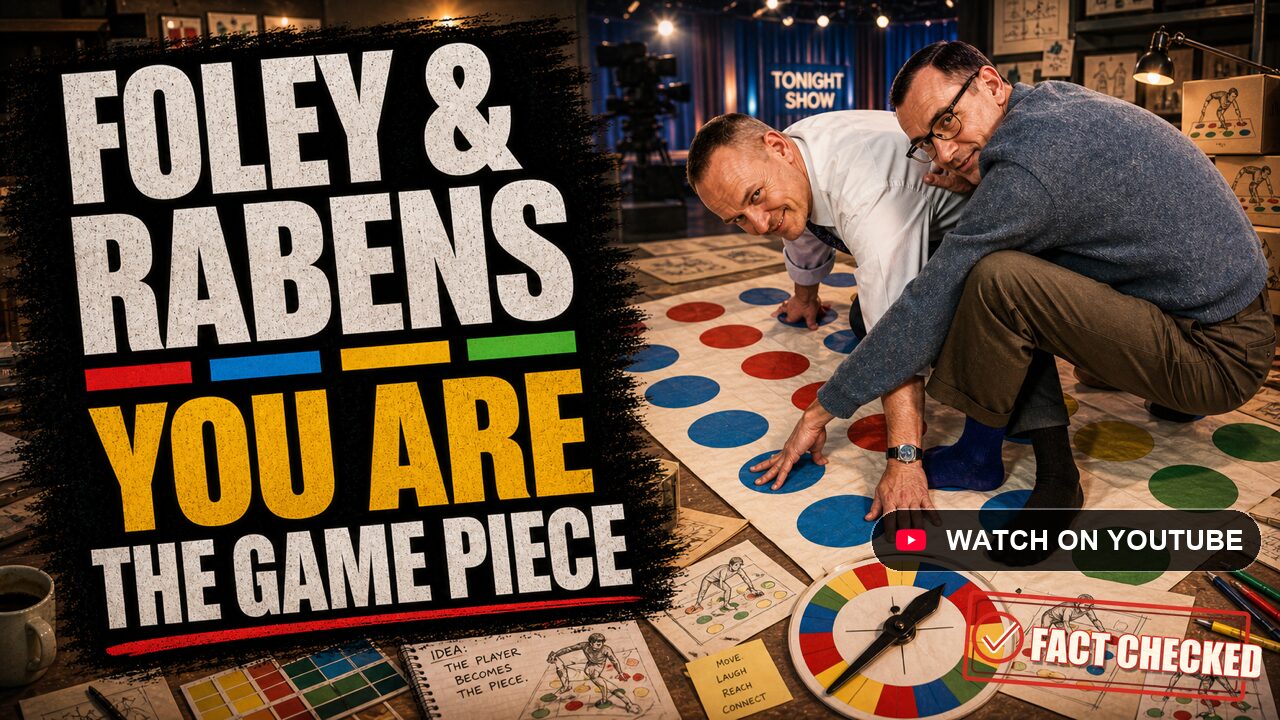
Before Twister, most boxed games asked you to sit at the table and move something.
A pawn. A card. A token. A little wooden marker pretending to be you.
Twister made a stranger bargain.
It did not ask you to move the piece. It made you the piece.
That is why it still has power. Twister is not deep. It is not elegant in the way chess is elegant, or modular in the way modern hobby games are modular. It is a mat, a spinner, four colors, four limbs, and a room full of people trying not to fall over each other.
But in 1966, that was enough to make people hesitate, because it made play visible.
The Mat On The Floor
The story begins in Minnesota, with an advertising and promotion firm called the Reyn Guyer Company.
Reyn Guyer had been working on a floor-mat game concept by the mid-1960s. The early idea existed before Twister had a name or a clean rule set. It was an odd object looking for its final shape.
Charles “Chuck” Foley brought the toy-inventor mind to the problem. Foley was born in Lafayette, Indiana, and later worked a string of ordinary jobs before he found his lane in product invention. He was not a hobby-game theorist. He was a builder. A tinkerer. A person who kept making things.
Neil Rabens brought a different eye. He was a St. Paul artist educated at the Minneapolis School of Art and Design. He understood space, shape, and how a flat surface could invite a body into it.
That combination mattered.
Foley and Rabens did not create Twister out of empty air, and they were not the only names behind it. Modern credit for the game typically includes Reyn Guyer alongside Foley and Rabens. What Foley and Rabens helped do was turn a strange floor-mat idea into a playable physical system.
Colored circles.
A spinner.
Hands and feet assigned to colors.
A human body forced to become both player and component.
The prototype was called Pretzel.
That name tells you what the room was about to become.
A Game With No Hiding Place
Twister works because there is nowhere to hide.
In most games, embarrassment can stay private. You make a bad move. You draw the wrong card. You lose a piece. The board absorbs the mistake for you.
Twister puts the mistake on your body, then makes everybody watch.
Right hand red.
Left foot blue.
Right foot green.
Now you are stretched across the mat, an arm pinned between two people, trying to keep your elbow off the floor while everyone in the room laughs because they know they are next.
The rules are almost nothing. The experience is everything.
That is the design insight Foley and Rabens helped unlock. The spinner does not produce strategy in the traditional sense. It produces pressure. It tells the room what the body must do next, and then the room watches the body try to obey.
The game state is not on the mat. The game state is the tangled arrangement of people above it.
And the emotion underneath it is simple. You are a little scared you will fall. You are a little worried you will look ridiculous. You play anyway.
The Night The Game Became Real
Milton Bradley acquired the game and renamed it Twister.
Then the company, and the retailers around it, nearly lost their nerve.
The Strong National Toy Hall of Fame’s 2015 induction material describes Sears refusing the game for the 1966 Christmas catalog. The reason was not hard to understand. Twister put adults and teenagers in close physical contact, in public, on purpose. In the middle of the 1960s, that made some people see a party game and some people see a problem.
There was skepticism inside the sales channel too. Twister did not look like a respectable board game. It looked like something a company might have to explain.
Then Johnny Carson played it with Eva Gabor on The Tonight Show.
That television moment did what no sales pitch could do. It showed America how the game worked as a performance.
Carson and Gabor did not need to explain Twister. They just had to play it.
The joke was instantly legible. The rules were visible from across the room. The awkwardness was the entertainment. The next day, customers started asking for the game. By 1967, sources tied to The Strong and Hasbro describe Twister selling more than three million copies.
Part of that is marketing, of course. But part of it is the design itself. Twister explains itself in a single image.
People on colored dots.
A spinner in someone’s hand.
Bodies trying to become a board.
The Body As The Board
Twister did not invent physical play. Children had been playing tag, hopscotch, wrestling games, lawn games, and playground games forever.
What Twister did was box that physicality and sell it through the board-game aisle.
That distinction matters.
It took the social rules of a party, the physical rules of a playground, and the product language of a family game, then jammed them into one bright vinyl object. It gave adults permission to act ridiculous because the spinner told them to. It gave children a game they could understand before they could read a rulebook. It gave families a way to make the living room briefly stop being furniture and become a play space.
The game did not need lore. It did not need theme. It did not need a fantasy world.
It used the room.
That is why the central idea keeps echoing. Later physical party games and motion-driven video games live somewhere downstream from the same realization: sometimes the most interesting component is the player.
Hasbro’s 2023 Twister Air announcement makes that lineage explicit. The mat can disappear. The body is still the game piece.
What They Actually Built
Foley and Rabens did not build a long catalog of famous games.
They did not become tabletop auteurs. They did not spend decades refining a signature design language across title after title. Foley continued as an inventor with many patents and products beyond Twister. Rabens continued as an artist and local creative presence in Minnesota.
Their game-design legacy is narrow.
It is also enormous.
What they helped build was a commercial proof that a boxed game could move play off the table and onto the players. They helped turn a mat into a stage. They helped make embarrassment safer by giving it rules. They helped create a party-game format where the laugh is not a side effect.
The laugh is the point.
Twister’s design is easy to underestimate because it looks like almost nothing. But simple games are not automatically small games. Sometimes simplicity is the reason the idea travels.
A spinner can cross language barriers. Four colors can teach themselves. A body trying not to fall is funny almost anywhere.
The Men Behind The Mat
The money story is not as bright as the dots.
Reporting on Foley’s death noted that Foley made little compared to the fortune Twister generated. His son Mark said Foley did not seem especially bitter about it. Twister was not his first creation, and it was not his last. Foley kept building things.
Rabens lived a quieter public life after Twister. He painted signs and murals, illustrated, played music, and stayed connected to his community. He was still remembered locally as one of the people behind Twister, but his life was not consumed by the game.
There is something almost right about that.
Twister is famous because it refuses dignity for a few minutes. Foley and Rabens did not need to spend the rest of their lives standing under its spotlight. They made the thing, the thing escaped, and people kept falling over each other long after the inventors left the room.
Where The Game Lives Now
Charles Foley died on July 1, 2013, at age eighty-two.
Neil Rabens died on May 18, 2020, at age ninety.
Twister was inducted into The Strong’s National Toy Hall of Fame in 2015. Hasbro still treats it as an active brand, and Twister Air carried the same basic premise into an app-enabled format in 2023.
That is the legacy.
Not a huge catalog. Not a school of design. Not a shelf of sequels that proved the same idea ten different ways.
One mat.
One spinner.
One room full of people who suddenly understood that the game was not the cardboard, the plastic, or the vinyl.
The game was them.
Fact Check Notes
Publication notes
This site is AI-assisted and human-reviewed. We use artificial intelligence to help gather research, organize source material, and draft profile content. Human editors then read, revise, and check each profile before it goes live. Most profiles are built through deep AI research and two separate rounds of fact-checking.
Leave a Reply
You must be logged in to post a comment.