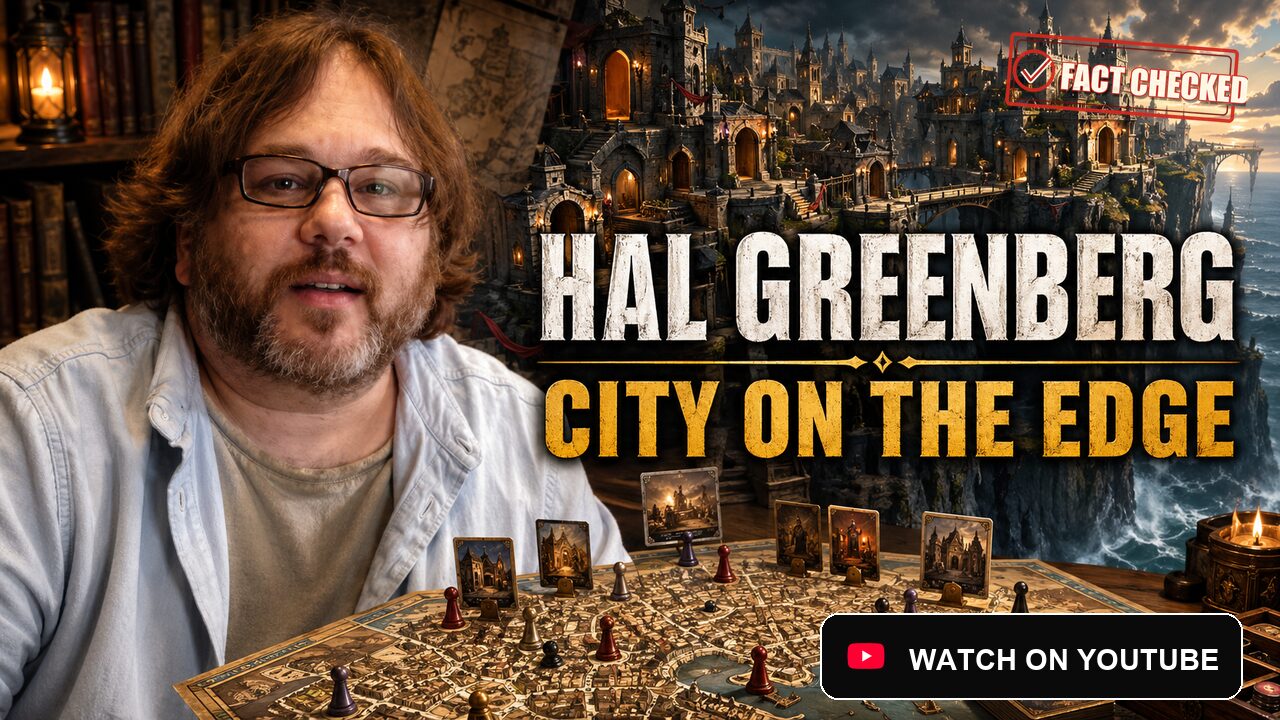
It was a place.
Bluffside: City on the Edge arrived during the early d20 boom, when the Open Game License had thrown the doors open and small publishers were trying to figure out what a third-party Dungeons & Dragons book could be. Some companies chased classes. Some chased monsters. Some chased prestige rules, feats, spells, and new ways to bend the same engine.
Greenberg looked at the opening and built a city.
That choice tells you a lot about him. Bluffside was not just a pile of lore with a map attached. It was a fantasy city designed to be used. A game master could take one district, one location, one contact, one rumor, one strange door, and put it on the table. The book’s strength was not that it explained everything. Its strength was that it gave the table places where things could happen.
That is different from worldbuilding as decoration.
Greenberg’s instinct has always been architectural. He thinks in addresses. Rooms. Districts. Power relationships. The person who owns the tavern. The regulars who show up there. The road from one problem to the next. A good city supplement does not just say what a place is called. It tells you why someone might go there on a bad night.
Bluffside understood that.
The D20 Opening
Greenberg came into tabletop publishing through Thunderhead Games, a small company with the energy and risk profile of the early 2000s d20 era.
The timing mattered. The Open Game License created a brief, chaotic moment when independent publishers could build around the biggest fantasy roleplaying system in the world. That did not make the work easy. It made the gate visible. A lot of publishers walked through it with products that aged quickly because their value depended on mechanics tied to one version of the rules.
Bluffside aged better because its core utility was not only mechanical.
The city was system-portable by nature. Its Points of Interest structure gave the game master usable units of play: locations, NPCs, hooks, factions, and implied consequences. A location was not just a label on a map. It was a node in a social web. That made Bluffside easier to move from one rule system to another, because the strongest part of the product was not a stat block. It was the relationship between places.
That is why Bluffside kept coming back.
It began in the d20 period, then later appeared in Castles & Crusades through Troll Lord Games. Public listings describe it as a revised and expanded version of the original 2001 Thunderhead book, with more than one hundred Places of Interest and enough modular structure to stand alone or drop into another fantasy campaign.
That kind of survival is not glamorous.
It is better than glamorous. It is useful.
A rule combo can be clever for six months. A city that game masters still want to use after two decades has done something harder.
The Address Book
The key to Bluffside is that it treats urban fantasy as a network instead of a museum.
A weak city book gives the reader a history lesson. It tells you who founded the city, which king ruled it, what trade goods move through its harbor, and what the old wall is called. Some of that matters. A little can help. Too much becomes a guided tour of information the players may never touch.
Bluffside works from the other direction.
Where can the players go? Who is there? What can happen when they arrive? What problem does this place create? What other place does that problem point toward?
Those questions are practical. They are the questions a working game master asks at the table.
That practical instinct is the strongest part of Greenberg’s design legacy. He built a city that wanted to be played, not admired from a distance. The Places of Interest function like little story engines. Each one can be lifted, moved, expanded, ignored, or connected to something else. A single location can feed a session. A district can feed a campaign. A recurring NPC can pull the players across town because now the map has social gravity.
That is how a fictional city starts to feel alive.
Not because the book says it is alive.
Because the players keep finding reasons to go back.
The Company Of Builders
Thunderhead’s place in the d20 gold rush was small, but it was connected to larger currents.
The old Thunderhead downloads page still points to Bluffside support material and to "The Blood Guardian" by Monte Cook. That matters less as a celebrity credit than as a signal. Greenberg was not building in isolation. He was building at the edge of a new publishing ecosystem, where independent companies, freelancers, artists, and established designers were testing what the market could hold.
After Thunderhead, Greenberg became part of the Mystic Eye Games and Samurai Sheepdog circle with longtime collaborators Doug Herring and Ken Shannon. That work pulled him across writing, design, publishing, art direction, and setting development. The catalog is not one clean line of authored games. It is a working creative shop: settings, fiction, adaptations, art direction, Pathfinder material, Castles & Crusades work, and projects that moved between prose and tabletop.
That is important because Greenberg is not best understood as a single-engine designer.
He is a builder of containers.
Bluffside is a container for fantasy urban play. The Awakened moved between fiction and game setting. Fall of Man tried to make a ruined Earth and a fantasy realm collide hard enough that the geography itself pushed back on the characters. Samurai Sheepdog’s broader catalog shows a creator comfortable with the mess between art, prose, and game rules.
Some designers build one elegant mechanism and spend years refining it.
Greenberg builds places for other people to enter.
The Rough Edges
The honest assessment has to name the limits.
Greenberg’s published tabletop legacy is stronger in setting architecture than in standalone mechanical design. He is not a designer whose reputation rests on one widely copied rules engine. He did not create a system that reshaped how the hobby resolves combat, skill checks, narrative authority, or campaign advancement.
His work is more local than that.
Bluffside matters because it solves a real table problem: how do you make a city immediately playable? The Awakened and Fall of Man matter because they show his preference for worlds under pressure. The design question is not simply "what are the rules?" It is "what does this place do to the people standing inside it?"
Fall of Man is the cleanest example of the ambition and the friction.
The premise is strong: a catastrophic collision between modern Earth and fantasy reality, where technology, faith, magic, mutation, and ruined geography all compete for authority. That is exactly the kind of world Greenberg likes to build. It is not a neutral setting. It is a stress test.
The mechanics were more difficult.
When a game tries to make metaphysical conflict into a persistent rules structure, precision matters. Pathfinder-era design can punish fuzzy language. Too many overlapping checks, too much interaction with existing subsystems, and a powerful idea can slow down at the table. Fall of Man’s core thought is compelling. Its execution, by the accounts available, was rougher than its premise.
That does not erase the design value.
It locates it.
Greenberg is often strongest before the dice hit the table, when he is deciding what kind of place the characters are trapped inside.
The Witching Hour Correction
Approaching Dawn: The Witching Hour belongs in the conversation, but carefully.
Public WizKids material describes the game as a cooperative story game about blood-bound witches, black and white magic, corruption, demons, and scenes that can be played as a continuing arc. It is a strong premise, and the game sits near Greenberg’s creative orbit. Board-game listings credit Hal Greenberg on the art side, while WizKids identifies Ken Shannon as the designer.
That distinction matters.
It would be easy to overstate Greenberg’s role and make the story cleaner than the evidence allows. The stronger version is also the truer one: Greenberg was part of a creative circle where art direction, publishing, setting thinking, and game products crossed over constantly. Approaching Dawn fits that circle. It does not need to become a false solo-design claim to be relevant.
If anything, the correction sharpens the profile.
Greenberg’s real throughline is not ownership of every mechanism near his name. It is the habit of building and supporting worlds where other creators can work.
Field Stewardship
That same pattern shows up outside the products.
Greenberg is President of the RPG Creators Relief Fund, a charitable organization created to provide financial assistance to tabletop roleplaying game creators facing medical emergencies, natural disasters, and other catastrophic hardship. The RCRF site lists the organization as a 501(c)(3) public charity and states that its board members are volunteers.
That work is not a game mechanic.
It still belongs in a design profile because a field is not made only of products. It is made of people who keep making them. Small tabletop creators often work without the safety nets that outsiders assume exist. A medical emergency, disaster, or sudden crisis can end a career that looked stable from the outside.
RCRF is a different kind of architecture.
Not a fantasy city. Not a ruined Earth. Not a story anthology. A support structure. A place for creators to turn when the real world gets hard.
There is a line from Bluffside to that work, even if it is not obvious at first. Greenberg builds places where people can go.
What He Actually Built
Hal Greenberg did not build the flashiest engine in tabletop history.
He built durable spaces.
That is the key. Bluffside survived because it was more than a product of one rules moment. Its city structure, Points of Interest, NPC webs, and gameable locations could move underneath different systems because the core idea was not chained to one edition’s math. The Awakened and Fall of Man show the same interest in worlds with internal pressure. Samurai Sheepdog shows the collaborative version of that instinct. RCRF shows the human version.
The limits are real. His standalone mechanical catalog is thinner than his setting and publishing work. Some of the most interesting mechanical claims around his orbit belong to collaborators or need careful sourcing. The score should stay grounded.
But grounded does not mean small.
A good city book is harder to make than it looks. It has to carry history without burying the table. It has to give the game master options without turning every page into homework. It has to feel like a place before the players arrive and still leave room for them to change it.
Greenberg understood that.
He built addresses.
Twenty-five years later, people are still knocking.
Where To Find Him
Hal Greenberg remains associated with Samurai Sheepdog, Bluffside, The Awakened, Fall of Man, and the RPG Creators Relief Fund. The RCRF site lists him as President and describes his broader game-industry work across design, writing, art direction, and publishing.
Bluffside is still the clearest starting point for understanding his design mind. Not because it is the newest thing. Because it is the cleanest expression of the pattern.
A city on the edge.
A hundred doors.
Stories waiting behind them.
That is his contribution: not the machine under the floor, but the building that keeps standing after the machinery changes.
Fact Check Notes
Publication notes
This site is AI-assisted and human-reviewed. We use artificial intelligence to help gather research, organize source material, and draft profile content. Human editors then read, revise, and check each profile before it goes live. Most profiles are built through deep AI research and two separate rounds of fact-checking.
Leave a Reply
You must be logged in to post a comment.