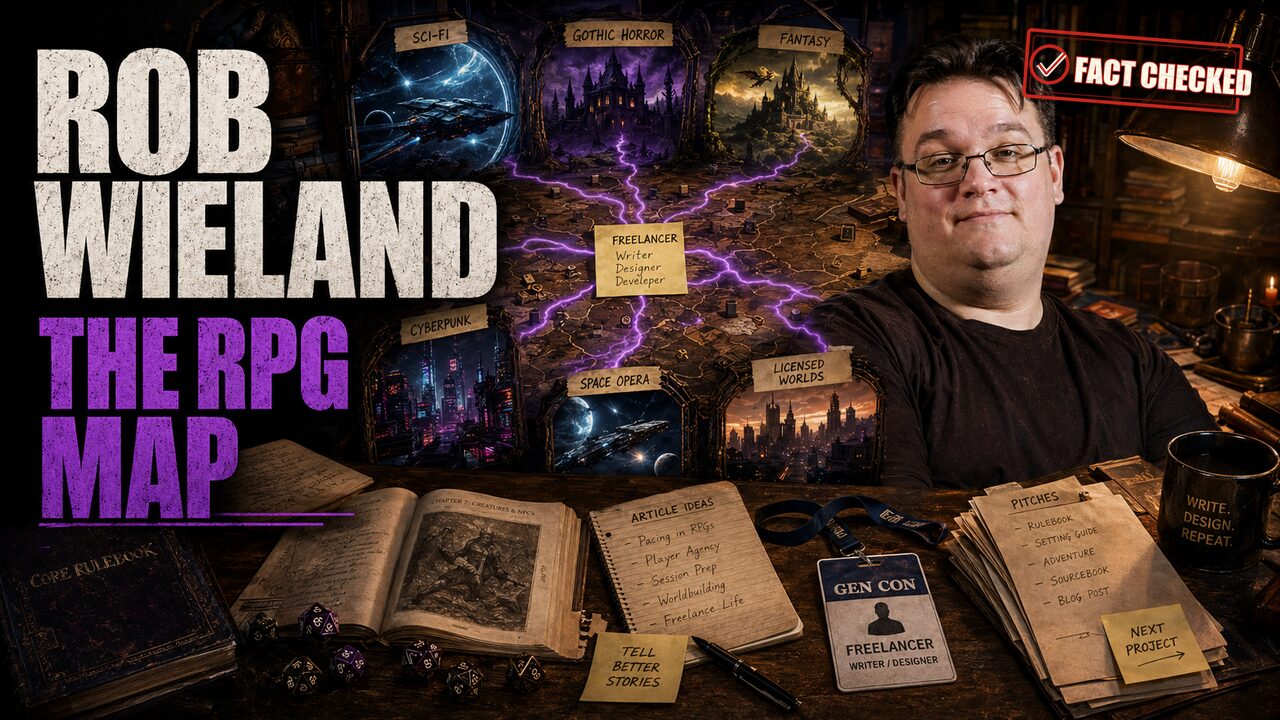
Rob Wieland’s career looks less like a monument and more like a map.
Follow the credits and the roads split everywhere. Star Wars. Shadowrun. Firefly. 7th Sea. Vampire: The Masquerade. Hunter: The Reckoning. Werewolf: The Apocalypse. Star Trek Adventures. Pugmire. Everyday Heroes. Fate worlds like Camelot Trigger and Save Game.
That is not the usual shape of a tabletop career.
Some designers become identified with one system. Some build one world and keep returning to it. Some become publishers, studio heads, line developers, or the public face of a single game. Wieland worked in a different space. He moved through the industry as a freelancer, critic, journalist, podcaster, community voice, and player who could walk into someone else’s game line and understand what it needed.
That job is easy to underestimate.
It should not be.
The Work Between The Headlines
Role-playing games are not sustained only by core books.
The core book matters. It gives the game its first body. But a living RPG line needs more than one dramatic launch. It needs adventures, sourcebooks, player options, setting material, convention scenarios, essays, previews, interviews, reviews, and connective tissue. It needs people who can serve the game after the banner release has already passed.
That is where freelancers live.
They are often not the name on the spine that everyone remembers. They may not be the person credited with inventing the system. Their work is more practical and more fragile. They have to read the rules closely, hear the line’s voice, understand the audience, hit the deadline, and make the material feel like it belongs there.
The best freelancers do not flatten every game into their own style.
They adapt.
That was Wieland’s gift. He could work inside a licensed science-fiction universe, then turn toward urban horror, then write for fantasy, television adaptation, space opera, modern action, or indie framework without treating all of them as the same assignment.
The map mattered because he could read the terrain.
That kind of range is not only a matter of taste. It is a matter of professional humility. A freelancer has to bring skill without dragging every assignment back toward himself. The page has to sound like the line, not like a stranger visiting for the weekend. Wieland’s career kept showing that discipline. He could leave fingerprints without leaving the wrong fingerprints.
Science Fiction, Horror, And Licensed Worlds
Licensed RPG writing carries a special kind of pressure.
The writer is not only serving a rules system. The writer is also serving a fan memory. Star Wars players know the sound of the door opening. Star Trek players know when a mission feels like the show and when it just borrows the uniforms. Firefly fans know the difference between lived-in scrappiness and generic space-western paint.
Wieland’s credits across those kinds of lines show a professional comfort with borrowed worlds.
That does not mean he owned those worlds. That is the point. Freelance RPG work is often about stewardship without ownership. A writer has to help players feel the promise of the license while staying inside the mechanical language of the game.
The same kind of fluency matters in horror.
World of Darkness games are not just catalogs of powers. Vampire, Werewolf, and Hunter each carry a different emotional engine. Vampire is about hunger, politics, control, and cost. Werewolf is about rage, spirituality, territory, and apocalypse. Hunter is about ordinary people staring into something bigger and worse than they were prepared to see.
Writing across those lines requires more than lore recall.
It requires tone discipline.
That is one reason Wieland’s range stands out. His career does not revolve around a single system he bent around himself. It shows a professional who knew how to listen to the game in front of him.
The Personal Designs
Wieland was not only a hired hand.
His own games and settings show the strange angles he liked to chase when the assignment was his. Camelot Trigger is the easy example: Arthurian legend rebuilt through mecha drama using the Fate framework. That is not a timid pitch. Knights become pilots. Myth becomes machinery. The Round Table gets reimagined through a genre mashup that should not work unless the designer understands both halves of the collision.
Save Game moves in another direction, using Fate to capture the emotional logic of video game worlds. It treats digital genre memory as playable material: bright heroes, strange maps, boss fights, power-ups, and the feeling that a world can be saved if the characters can survive the next screen.
Those projects did not make Wieland a household name.
They did something more specific. They showed the imagination behind the freelance discipline. The same writer who could serve an existing line could also build a premise from a sharp collision: Arthur plus mecha, video games plus Fate, familiar language pushed into a new shape.
That matters because good freelance work can hide the writer.
Personal projects show where the writer peeks out.
Beyond The Credit Line
Wieland also wrote about games.
His public work appeared through outlets including Forbes, Geek & Sundry, Dicebreaker, Wyrd Science, The Milwaukee Record, and others. That part of the career matters because journalism and design are not separate in a small hobby culture. The person explaining games also shapes how people talk about them. The person interviewing designers helps readers understand what design work looks like before it becomes a product.
Wieland used that public voice as a booster for the hobby.
He wrote about tabletop role-playing games for broad audiences. He covered new releases, communities, trends, and the human culture around play. He also pushed for a more open table, where diversity and inclusion were not treated as side topics but as part of who the hobby was for.
That can sound abstract until you remember what tabletop actually is.
A role-playing game is a room full of people agreeing to imagine together. Who feels welcome in that room is not a cosmetic question. It changes the stories. It changes the future players. It changes who decides to become a designer, writer, critic, publisher, or game master later.
Wieland understood that the table was part of the text.
The Milwaukee Table
The remembrance pieces after Wieland’s death make one thing clear: people did not only remember the credits.
They remembered his presence.
Rascal described him as a diehard tabletop writer and player. Wyrd Science called him a critic, designer, journalist, RPG booster, and regular contributor. Milwaukee Record remembered him as an author, game designer, journalist, critic, podcaster, and performer. The words vary, but the pattern is steady.
He was a working node in the hobby.
Not node as a cold technical term. A real one. The person who writes the article. The person who runs the game. The person who shows up at the local event. The person whose name appears in the credits and whose voice appears in the conversation around the credits. The person who helps the network stay alive.
That is not a small role.
Tabletop gaming depends on those people. The ones who connect product to player, publisher to audience, local scene to wider culture, enthusiasm to craft. They are not always easy to measure because their value is distributed. They make the hobby more navigable for everyone else.
Wieland’s career was full of that work.
What He Actually Built
Rob Wieland did not create Star Wars role-playing. He did not invent Shadowrun, Vampire, Star Trek Adventures, Firefly, or 7th Sea. His name was not the single architectural signature behind one massive system.
What he built was a professional life across the connective tissue of RPGs.
He wrote inside major lines. He made smaller personal designs. He explained games to public readers. He advocated for better tables. He worked across systems without needing all of them to become his. That is its own craft.
The freelancer’s achievement is not always visible from across the room. It is visible when a supplement works, when an adventure runs, when a licensed game feels right, when a column sends someone toward a book they would have missed, when a local scene feels a little more seen because someone kept writing about it.
Wieland’s career makes the invisible labor easier to name.
He was not the monument.
He was one of the mapmakers.
Where To Find His Work
Rob Wieland died in October 2025.
His work remains scattered in the best way a freelancer’s work can be scattered: across shelves, PDFs, publisher credits, convention memories, articles, podcasts, and the people who played at tables he helped support. The easiest public paths are his Forbes archive, credited RPG products on digital storefronts, his Fate material, and the remembrance pieces from Rascal, Wyrd Science, and Milwaukee Record.
That is a fitting legacy for someone whose career was never only one road.
Open the map and the routes keep branching. A licensed space mission. A gothic horror sourcebook. A Fate world full of mythic machines. A column explaining why a new game matters. A local scene remembering someone who kept showing up.
Some designers leave one giant door behind them.
Rob Wieland left directions.
Fact Check Notes
Publication notes
This site is AI-assisted and human-reviewed. We use artificial intelligence to help gather research, organize source material, and draft profile content. Human editors then read, revise, and check each profile before it goes live. Most profiles are built through deep AI research and two separate rounds of fact-checking.
Leave a Reply
You must be logged in to post a comment.