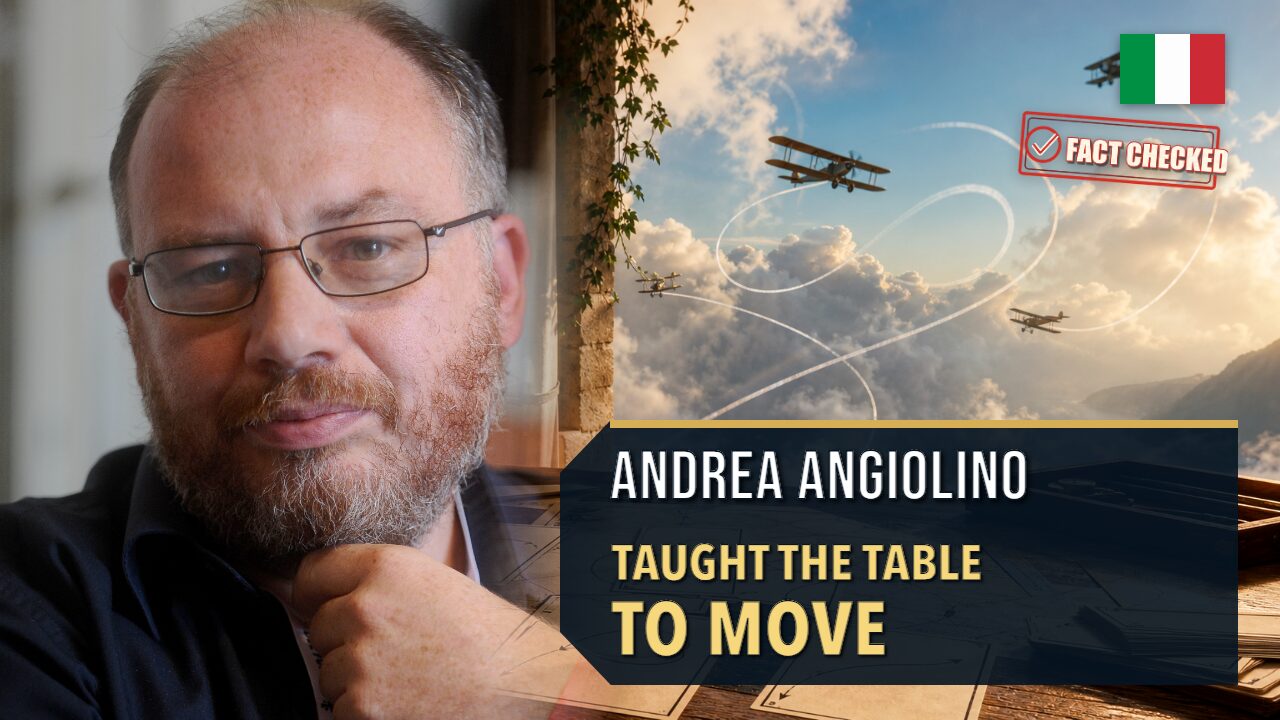
It moves because a player chooses a maneuver card, places that card in front of the aircraft, and slides the model along a printed path. The table becomes open sky. A nimble fighter and a heavy bomber do not need pages of exceptions to feel different. Their decks carry the difference.
Andrea Angiolino and Pier Giorgio Paglia built that system together. It became Wings of Glory after moving to Ares Games, and it gave Angiolino his widest international audience. Yet the maneuver deck also reveals the pattern behind a much broader career. Again and again, Angiolino has taken something that looked difficult to enter, then found the physical or narrative gesture that let ordinary people begin.
He did it with airplanes. Before that, he did it with roleplaying games in libraries.
The Column Before The Industry
Angiolino was born in Rome in 1966. In September 1982, while still a teenager, he began writing about roleplaying games for the Italian monthly Pergioco with Gregory Alegi. Imported games such as Traveller and Dungeons & Dragons were still unfamiliar objects to much of the Italian public. The column did more than review products. It helped explain what this new form of play was.
That distinction matters. Angiolino did not enter a mature Italian RPG business with a clear career ladder. He entered while the vocabulary, audience, and institutions around the hobby were still forming.
By the end of the decade he had joined the Roman game-author collective C.Un.S.A., working with other designers on commissioned, educational, promotional, radio, and television games. The assignments changed, but the pressure remained useful: make the rules legible to people who did not arrive as hobby experts.
His early credits should not be flattened into a solo-author myth. I Cavalieri del Tempio, published around 1990, was a shared project with Giuliano Boschi, Agostino Carocci, Massimo Casa, and Luca Giuliano. Angiolino later described himself as the young apprentice in a ten-handed job. The exact division of labor is not documented well enough to assign individual inventions.
That is the honest beginning. He learned inside a group.
A Roleplaying Game For The Library
In the early 1990s, Angiolino found himself introducing roleplaying games in public-library settings. The medium still carried suspicion. For some parents and educators, fantasy roleplay sounded like an imported subculture with strange rules and worse rumors attached to it.
Angiolino and illustrator and co-designer Gianluca Meluzzi chose a remarkable bridge: Ludovico Ariosto’s Orlando Furioso.
The poem already held knights, enchantments, monsters, impossible journeys, and heroes knocked off course by desire. Children could recognize the ingredients of fantasy adventure. Teachers and librarians could recognize one of the central works of Italian literature. The setting did not disguise roleplay. It showed that the method could be used to enter a text rather than escape from one.
The Municipality of Rome published the first Orlando Furioso roleplaying game in 1993 as a short booklet for children, teachers, and libraries. Later editions expanded it, including a third edition released by Raven Distribution in 2024. Meluzzi remained the co-designer of the original game, while Angiolino continued developing the project across its long life.
The important move was not simply adapting a famous poem. It was choosing a form that lowered resistance on both sides of the library desk.
Angiolino made similar accessibility choices elsewhere. Mediterraneo, first published in 1992, used a compact system for adventures in the classical Mediterranean. He worked on historical and educational roleplaying projects, co-designed licensed adaptations, wrote for existing games, and helped curate the pocket-sized I Giochi del 2000 line. He also contributed to Lex Arcana as a supplement writer and, decades later, as creative director for its second edition.
Those roles are different. Writing an adventure is not designing the core game. Creative direction is not original authorship. Translation and curation are not the same as either one.
One especially important correction follows from that rule. Andrea Angiolino did not design The One Ring. Its designers are Francesco Nepitello and Marco Maggi. Angiolino has worked with both men and served as creative director on the revived Lex Arcana, whose design history also includes them, but professional proximity is not a transferable credit.
The Path On The Card
Wings of War arrived in 2004 after Angiolino and Paglia turned aerial combat into a sequence players could plan, reveal, and see.
Traditional air wargames often ask players to read speed, turning, altitude, and firing information through grids, tables, rulers, or written procedures. Angiolino and Paglia did not remove the differences between aircraft. They relocated those differences into the maneuver decks.
Choose a card. Lay it down. Move the plane along the line.
The rule is easy to demonstrate, but the decision is not trivial. A player has to imagine where an opponent will be after both aircraft move. Plans collide in open space. A good turn can put a target in the firing arc. A bad one can send two carefully piloted machines past each other with nothing but empty air between them.
The system began as Wings of War with Nexus. After that publisher’s closure, Ares Games reached an agreement with Angiolino and Paglia and relaunched the line as Wings of Glory. The new line remained compatible with the earlier material, preserving the design rather than asking the community to discard it.
The core idea also proved adaptable. With Andrea Mainini, Angiolino co-designed Sails of Glory, where wind and the weight of ships demanded different movement problems. The same pair later designed Battlestar Galactica: Starship Battles, which had to express spacecraft that could continue in one direction while turning to fire in another. Angiolino also joined Marco Maggi and Francesco Nepitello on Tripods & Triplanes, bringing machines inspired by The War of the Worlds into the Wings of Glory framework.
These were not solo projects, and they were not simple reskins. Each credit belongs to the named team. Angiolino’s recurring contribution is easier to see at the level of the problem: how can motion become readable without becoming dull?
Games As Public Culture
Angiolino’s career never stayed inside game boxes. He has written journalism, books on games, interactive fiction, radio pieces, educational material, and reference works. With Beniamino Sidoti, he co-authored Dizionario dei giochi, a large Italian reference book devoted to the vocabulary and history of play. His books on gamebooks and paper-and-pencil games treat design as something people can learn, use, and teach.
He has also worked in radio and television, served on juries and committees, and taught game culture. These activities do not make him the designer of every game he discusses. They show a separate part of the same career: explaining play to the public and arguing, through repeated practical examples, that games belong in cultural life.
Recognition followed. Lucca Games honored Angiolino with a career award in 2004. He was named Italy’s Personalità Ludica dell’Anno for 2007, and received the Gradara Ludens prize in 2022. His public biographies also record consulting and educational work connected to Italy’s Ministry of Public Education.
Awards are useful markers, but they are not the story. The story is the route between a teenager’s magazine column, a municipal library booklet, an aircraft maneuver deck, and a classroom discussion about how interactive stories work.
What He Actually Built
Andrea Angiolino did not build one signature genre. He did not design The One Ring, and he did not create Lex Arcana by himself. Many of his strongest games are shared designs, with collaborators whose names belong beside his.
What he built was a series of entrances.
For Italian readers in 1982, the entrance was a column explaining roleplaying games. For teachers and children in Rome, it was Ariosto turned into playable choices. For would-be designers, it was a pocket game or a practical book. For miniature players, it was a printed path that made a machine move the instant a card touched the table.
Accessibility can be mistaken for simplification. In Angiolino’s work, it is more often an act of placement. The difficult information is still there, but it has been moved into a deck, a story, a familiar text, or a physical action that the player can understand.
The table moves because the rule tells the hand what to do.
Where To Find Him
Andrea Angiolino maintains an official site at https://www.angiolino.info/. His design credits are also cataloged through BoardGameGeek and RPGGeek. Ares Games continues to publish Wings of Glory and Sails of Glory products, with the relevant co-designers credited on its product and rulebook pages.
Orlando Furioso returned in an expanded third edition in 2024. The project that began as a way to welcome roleplaying games into libraries still lives, more than thirty years later.
That may be the cleanest summary of Angiolino’s work. He does not ask people to admire complexity from outside. He gives them a card, a character, or a line on the table, and lets them enter.
Fact Check Notes
Publication notes
This site is AI-assisted and human-reviewed. We use artificial intelligence to help gather research, organize source material, and draft profile content. Human editors then read, revise, and check each profile before it goes live. Most profiles are built through deep AI research and two separate rounds of fact-checking.