That is not a dismissal.
It is the shape of the work.
Reynolds has touched hundreds of role-playing books across Dungeons & Dragons, Pathfinder, Monte Cook Games, and his own independent projects. His fingerprints are on monsters, campaign settings, beginner products, safety tools, and long-running fantasy engines that millions of players have used.
But his importance is not easy to measure by looking for one famous system with his name alone on the spine.
He is a developer’s designer.
The person who makes a thing clearer. The person who takes a heavy rules machine and asks where a new player will get lost. The person who looks at a table full of assumptions and turns them into something explicit enough to use.
That is the throughline.
From online community work to 3rd Edition monsters to Pathfinder accessibility to Consent in Gaming, Reynolds kept translating rough systems into playable ones.
The Name In The Machine
Reynolds came into the RPG industry during one of its most unstable transitions.
He had discovered Dungeons & Dragons as a kid, studied chemistry, and entered TSR through online work at a time when the company had a notoriously tense relationship with fans posting D&D material on the internet. That job was community and coordination work first, not game design.
But it placed him inside TSR near the end.
When Wizards of the Coast acquired TSR, Reynolds moved into the design and development world around the birth of D&D Third Edition. That timing mattered. Third Edition was not just another rules revision. It was a full re-language of D&D: feats, skills, unified d20 resolution, clearer monster math, open-system publishing, and a rules architecture meant to support a massive d20 ecosystem.
Reynolds became one of the people doing the translation work.
His early credits moved quickly. Adventures, source material, monsters, setting work. The useful professional skill was speed plus reliability. He could step into a complex system, understand the local rules, and produce usable material under pressure.
That is why the baseball phrase fits.
Utility infielder.
Not the single face of the franchise.
The person who can play where the team needs him.
Monsters And Realms
One of Reynolds’s most visible early D&D contributions came through the Third Edition Monster Manual.
His credit was not lead designer. It was additional design. That distinction matters. The Monster Manual was a team product inside a much larger edition-design machine.
Still, the work mattered.
Reynolds created the krenshar, an original creature that carried forward into later D&D history, and he helped translate classic monsters into the new mechanical language of 3E. That work is less glamorous than inventing a new game, but it is central to how a new edition becomes playable.
Players do not experience edition design only through core rules.
They experience it when a gnoll, ghoul, medusa, or owlbear hits the table and the stat block works.
The Forgotten Realms Campaign Setting for Third Edition elevated the scale. Co-designed with Ed Greenwood, Skip Williams, and Rob Heinsoo, the book became the anchor reference for the Realms in that era and won major industry recognition.
Again, attribution has to stay clean.
Reynolds did not single-handedly build the 3E Realms.
He was part of a team that made a huge setting legible to a new rules architecture. That is development as design. Not pure invention, but high-level translation.
The Accessibility Instinct
Reynolds’s strongest design voice is accessibility.
Not simplicity for its own sake. Accessibility as a way of making complex play possible for more people.
That voice shows clearly in the Pathfinder Beginner Box, co-authored with Jason Bulmahn. Pathfinder, at its commercial height, was not a light system. It carried the d20 inheritance forward with dense character options, tactical combat, feats, spells, monsters, and exceptions. Teaching that system to a new player was not easy.
The Beginner Box had a specific job.
Open the door.
It had to preserve enough Pathfinder to be honest while stripping away enough weight to be usable. It had to teach without sounding like homework. It had to let a player roll dice, make choices, and feel the game before the full rules mountain came into view.
That is Reynolds’s lane.
He is not always the person inventing the mountain.
He is often the person building the path up it.
Five Moons
Every developer who spends decades fixing other people’s systems eventually faces the harder question.
What happens when you build your own?
Five Moons RPG was Reynolds’s answer.
It began as a crowdfunded project and later became available for free. The design target was clear: take the lessons Reynolds had learned from D&D and Pathfinder and build a fantasy RPG that addressed familiar pain points. Martial characters should not fall behind spellcasters. Characters should not depend on piles of magic gear to function. Social play should matter mechanically. The playable range should focus on where campaigns actually live, not on theoretical high-level play that few groups reach.
Those are smart goals.
The result did not become a major movement.
There is no broad Five Moons ecosystem. No wave of designers building on it. No large player community turning it into a standard. It exists as a thoughtful, accessible, designer-aware fantasy RPG that never found the audience its problems deserved.
That is the honest read.
Five Moons proves Reynolds understood the disease.
It does not prove he built the cure people chose to take.
Consent In Gaming
Reynolds’s most widely propagated individual contribution may not be a game mechanic.
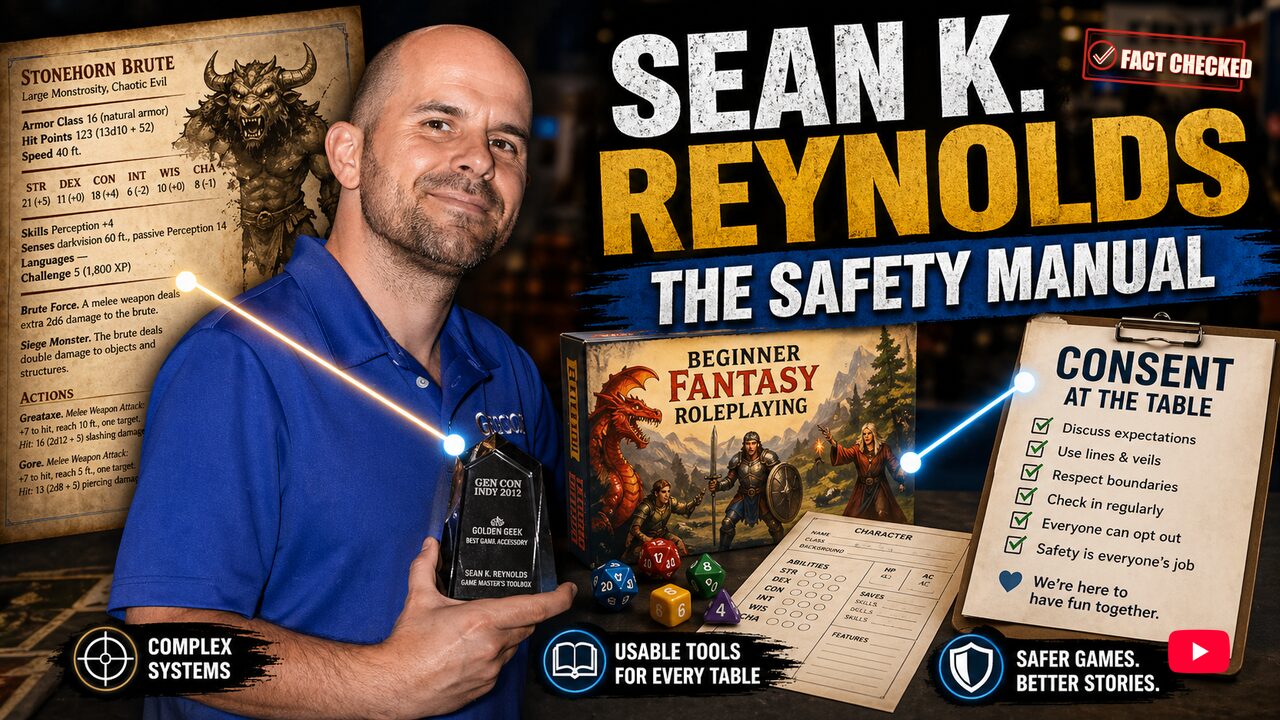
Consent in Gaming, co-authored with Shanna Germain and published by Monte Cook Games, gave the tabletop community a clear tool for discussing boundaries, sensitive content, and player comfort before a session begins.
The ideas did not appear from nowhere. The RPG community already had safety tools, informal practices, Lines and Veils, and years of debate about how to handle difficult material at the table.
What Consent in Gaming did was package the conversation clearly.
It made the implicit explicit.
It gave people a document they could hand to a new game master or a nervous group and say, "Start here." It treated the social contract as part of play infrastructure, not as an awkward side conversation for someone else to solve.
That is why it spread.
Not because it invented consent.
Because it made consent usable at the table.
That may be Reynolds’s clearest design act. A framework, a checklist, a conversation path, and a tool that helped people play more safely.
No stat block.
No spell list.
Still design.
The Old Tower And The New Table
Reynolds’s career also tracks a larger shift in RPG culture.
The D&D Third Edition era rewarded system mastery. Some choices were better than others, and part of the game was learning to recognize that. Later critics called this Ivory Tower design: a system that lets players discover strong and weak options through study.
Reynolds was part of that world.
His later work pushes in the other direction.
Five Moons tries to reduce trap choices. Pathfinder accessibility work tries to welcome new players. Consent in Gaming treats table safety as a shared design concern rather than a private burden. His design philosophy bends away from "prove you know the system" and toward "make the system usable."
That arc matters.
It mirrors the hobby’s own movement from gatekeeping through mastery toward broader access, clearer expectations, and more explicit care for the people at the table.
What He Actually Built
Sean K. Reynolds did not design D&D Third Edition by himself.
He did not create Pathfinder. He did not make the Forgotten Realms alone. His best-known works are often collaborative, developmental, or embedded inside larger brands.
What he built was clarity.
He helped translate monsters and settings into new rules languages. He helped make Pathfinder approachable for beginners. He designed Five Moons as a direct answer to problems he had seen for decades. He co-created a consent framework that became part of the table-safety conversation across the RPG community.
That is a real design legacy.
It is not the legacy of a singular system architect.
It is the legacy of a professional who kept making other people’s systems easier to use, safer to approach, and clearer to understand.
Where To Find Him
Reynolds remains publicly reachable through seanreynolds.com and related social channels, and his bibliography stretches across D&D, Pathfinder, Monte Cook Games, Five Moons, articles, design commentary, and other game work.
Five Moons remains available for anyone who wants to see what he does when no inherited engine is in the way.
Consent in Gaming remains the cleaner public artifact: a short document that changed more actual tables than many larger rulebooks.
That is the strange balance of the career.
The solo game waited for an audience.
The safety manual found one.
And maybe that is the point. Reynolds’s strongest work has always been less about standing in the spotlight and more about making sure the table works once everyone else arrives.
Fact Check Notes
Publication notes
This site is AI-assisted and human-reviewed. We use artificial intelligence to help gather research, organize source material, and draft profile content. Human editors then read, revise, and check each profile before it goes live. Most profiles are built through deep AI research and two separate rounds of fact-checking.