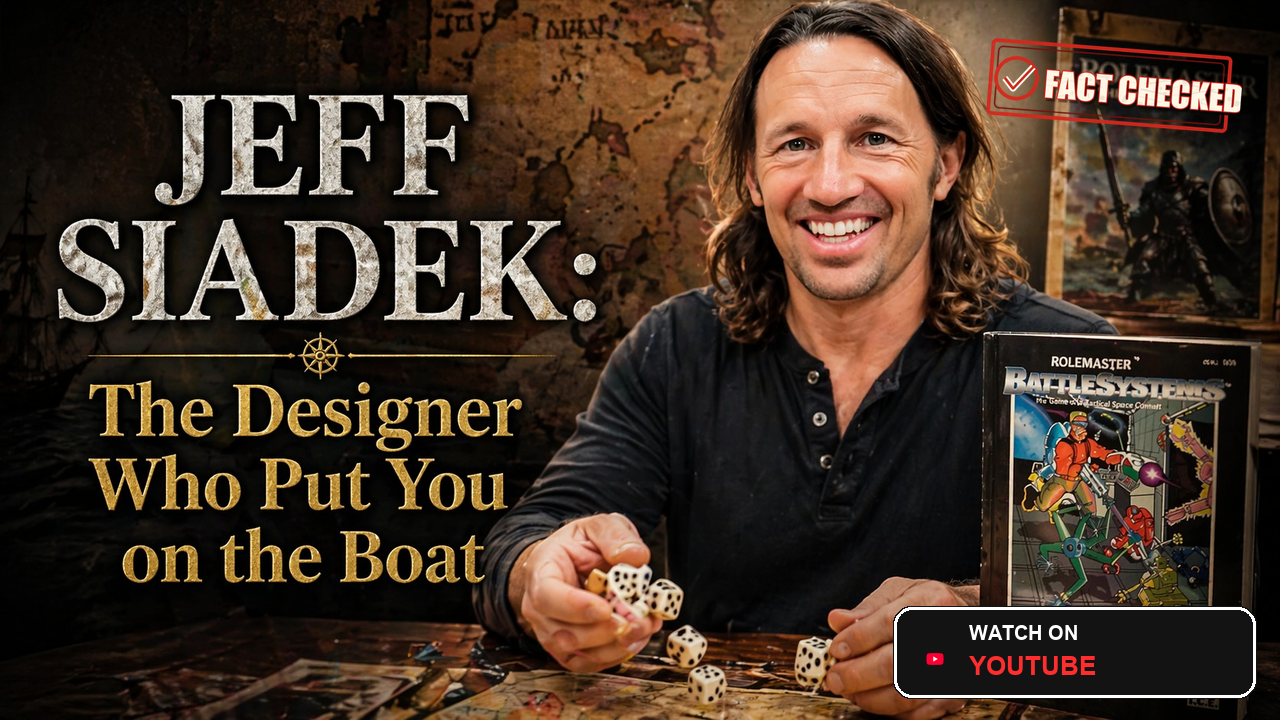
Jeff Siadek has spent thirty years designing games where ordinary people get thrown into impossible situations. Lifeboats filling with water. Starships losing power. Relationships breaking under pressure. The mechanics change. The question underneath stays the same: what do you actually do when the rules stop protecting you?
He’s never worked for a major publisher. Never had a corporate marketing budget. Never waited for someone else to greenlight his ideas.
He just kept making games. And some of them landed harder than their shelf space would suggest.
The Resume That Reads Like A Character Sheet
Siadek grew up in Utah and California in a family of skiers, river runners, and outdoor adventurers. He’s described his extended family as deeply physical and adventurous, a culture built around calculated risk: figure out the environment, read the conditions, commit.
Before games became his full-time work, Siadek reportedly held a range of jobs that sounds like someone rolling on a random occupation table. Climbing guide, lifeguard, water polo coach, substitute teacher, game store manager, bus driver. His real education came from navigating systems that didn’t care whether he understood them.
That background shows up in everything he designs. His games don’t simulate abstract strategy. They simulate people under pressure. The lifeguard who knows what panic looks like built a game about a sinking boat. The climbing guide who assessed real risk built a game where every decision on a starship matters because someone has to physically be at the helm.
He eventually concluded he was, in his own words, "not cut out for anything other than designing games."
Gamesmiths And The Early Years
Siadek’s early self-published titles included a card game called Mass Murderer in the mid-1980s. By 1992, he’d founded Gamesmiths alongside his younger brother Jason, who started as an assistant and pushed his way into a full creative partnership.
The 1990s were brutal for independent publishers. Magic: The Gathering had detonated the collectible card game market, and the industry was consolidating fast around that model. Siadek didn’t follow the trend. He developed Throwing Stones, a collectible dice game that reportedly reached retail around the same period as TSR’s Dragon Dice. Getting a small-operation product to market on that kind of timeline took real logistical discipline.
Through Gamesmiths, he released a string of titles: Total War, Pantheon, RoboTanks, Caesar, Monster Derby. Each one blended strategy with theme, often with a sense of humor baked into the design. Monster Derby was a fantasy horse race game. The kind of thing that sounds ridiculous until you play it and realize the mechanics work.
By 2000, he’d designed the game that would follow him for the next quarter century.
The Boat
Lifeboat drops players into a grim scenario. Six characters adrift after a shipwreck. Supplies running low. Some of the cargo barrels are filled with jewels and paintings instead of food and water. Not helpful when you’re dying of thirst.
The game runs on social negotiation and hidden agendas. Each player gets two secret cards at the start: a character they love and a character they hate. You score points if your loved character survives. You score points if your hated character dies. And you score points for your own survival and whatever wealth you’re holding when land appears.
The draw is random. You can end up as a narcissist who loves only themselves. You can end up as a psychopath whose only goal is to kill everyone else on the boat. You can draw the same character for both cards and play in total chaos. The mechanics force alliances built entirely on lies, because nobody at the table can be sure who’s protecting whom and who’s quietly waiting for the right moment to push someone overboard.
Lifeboat arrived years before the social deduction explosion that brought games like The Resistance and Secret Hitler into the mainstream. It’s been published internationally and remained available for many years. Siadek calls the design philosophy behind it "mitigated success." Even when you lose, the game gives you a moment worth remembering.
Battlestations
If Lifeboat proved Siadek could design a tight, psychological game in a small box, Battlestations proved he could build an entire universe.
The concept started with his brother Jason, who was trying to build a first-person space combat video game using the Unreal engine. The budget required to finish it ran into the millions. Jeff took the core ideas and translated them into a board game in a few months.
First released in 2004 through Gorilla Games, his new publishing imprint, Battlestations solved a problem that science fiction tabletop games had struggled with for years. Most sci-fi games either focused on fleet-level ship combat, where the crew were just numbers on a stat sheet, or they focused on RPG-style boarding actions, where the ship was just a dungeon with metal walls. Battlestations did both at the same time.
Players take on individual crew roles on a modular starship. To pilot the ship, someone has to physically be at the helm. To fire weapons, someone has to be at the cannons. To keep the engines running, someone has to be in the engine room. The action economy is spatial. Where your character stands determines what you can do. And the game runs as a persistent campaign, with characters earning upgrades and abilities across multiple sessions.
The design was good enough that it crossed mediums. In 2012, Subset Games released FTL: Faster Than Light, a critically acclaimed video game built on a similar premise of managing crew across ship modules during space combat. The developers have acknowledged Battlestations as an inspiration. A concept that started as a video game idea, became a board game out of financial necessity, then helped inspire one of the most successful indie video games of the decade.
Battlestations expanded through a second edition in 2017, the standalone planetary expansion Dirtside in 2019, novels, scenario packs, and over a dozen expansions with names like Bot Wars, Deep Ones in Deep Space, and Pirates of Trundlia.
The Gorilla Games Catalog
Siadek never stopped producing between the big releases. The Gorilla Games catalog runs deep.
Who Would Win? is a party game where two players have twenty seconds to argue why a randomly paired character would beat the other in a given scenario. The Worst Game Ever deliberately builds mechanics around everything people hate in games, then makes you play through all of it. It became a cult hit because the satire landed. The Best Expansion Ever followed in 2016, somehow managing to be better than the thing it was parodying.
Love Conquers All, released in 2022, took a sharp turn in a different direction. A cooperative tile-laying game about maintaining a romantic relationship. Players navigate challenge tiles representing work, religion, children, sickness. Each challenge imposes placement restrictions until players cooperate to neutralize it with a love tile. It received a Spiel of Approval Award. The same designer who built a game about throwing people off a lifeboat built a game about holding a relationship together through difficulty.
That range is the point. Siadek doesn’t have a single mode. He has a question: what happens to people when the situation gets complicated? Sometimes the answer is funny. Sometimes it’s dark. Sometimes it’s cooperative. The mechanics shift to fit.
Staying Independent
Siadek has run multiple successful Kickstarter campaigns, funding games and a novel. He manages fulfillment, runs the web store, handles shipping. Gorilla Games has no distributor, no outside investors, no board of directors. Just a designer who also runs the business.
That model has costs. Without traditional distribution, his games rarely showed up on store shelves in the quantities that build broad awareness. The presentation was functional rather than polished. His titles competed for attention against products with bigger budgets and shinier boxes.
But the model also has a specific advantage. Nobody can cancel his games. Nobody can shelve a project because the market shifted. Nobody can tell him that a cooperative game about romantic relationships doesn’t fit the catalog. Every Gorilla Games title exists because Siadek decided it should.
What He Actually Built
Jeff Siadek didn’t change how the tabletop industry operates. He didn’t rewrite the rules of publishing or create a movement.
What he did was prove something simpler and harder: that one designer, working independently for three decades, could build a catalog that ranges from vicious psychological survival games to cooperative relationship puzzles to a full-scale space adventure system complex enough to inspire a hit video game. He did it without a major publisher, without corporate backing, without waiting for the industry to make room for him.
His design philosophy ties it together. "Life is a cooperative game," he says at convention panels, "and we all win by making it better for one another." Even in Lifeboat, the game where you throw people to sharks, the mechanics are designed so that everyone at the table has a moment worth talking about afterward.
The work is consistent. The output is real. The independence is absolute.
Where To Find Him
Jeff Siadek is still making games.
As of 2025, Gorilla Games is fulfilling the Lifeboat Deluxe 25th Anniversary Edition, a fully funded Kickstarter that overhauls the classic with a physical game board, full-color components, and all previous expansions built into the base game. He’s actively developing new Battlestations content and maintaining the full catalog through the Gorilla Games web store.
He’s a regular at Strategicon conventions in Southern California, where he runs "Battlestations HUGE" sessions, massive multi-table games that walk new players through the system. He also hosts Improv 101 jams and party game events at conventions, because running a publisher’s booth was never the point. Playing with people was.
You can find him at gorillaboardgames.com, on Facebook, and at pretty much any Strategicon event where someone is building a starship out of modular tiles and arguing about who forgot to power the shields.
He’s the one who put you on the boat. He’s still there.
Fact Check Notes
Publication notes
This site is AI-assisted and human-reviewed. We use artificial intelligence to help gather research, organize source material, and draft profile content. Human editors then read, revise, and check each profile before it goes live. Most profiles are built through deep AI research and two separate rounds of fact-checking.
Leave a Reply
You must be logged in to post a comment.