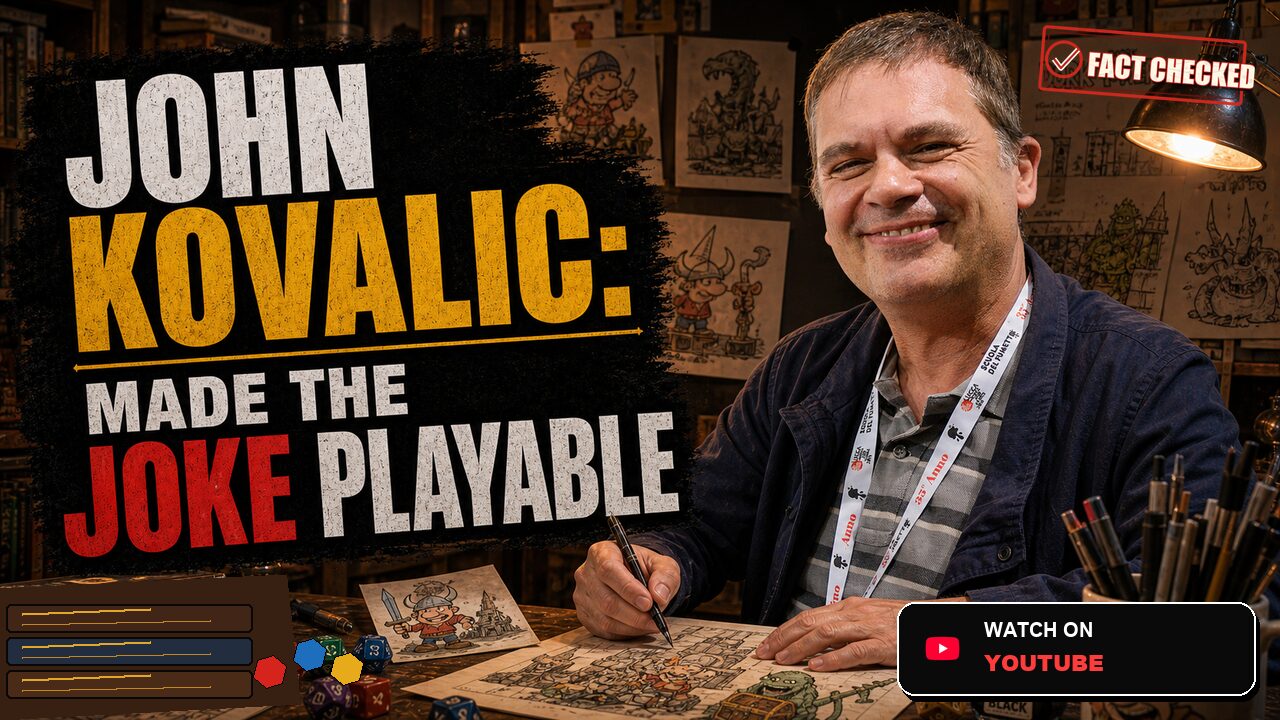
John Kovalic did not make games look serious.
That was the point.
He made them look readable. He made them look funny before anyone explained the rules. He made a card full of backstabbing, monsters, puns, and bad behavior feel like something you could hand to a casual player without asking them to learn a secret language first.
That is harder than it sounds.
Tabletop gaming has always had dense corners. Rulebooks. Charts. Combat systems. Lore arguments. Tiny distinctions that matter deeply to the people already inside the hobby and look completely impossible to everyone standing outside the door. Kovalic’s gift was not stripping the hobby of its weirdness. He loved the weirdness.
He drew it with a face.
Through Dork Tower, Munchkin, Apples to Apples, Chez Geek, Blink, Dr. Blink, and a long shelf of game and comic work, Kovalic became one of the people who translated gamer culture into a form the culture could laugh at, recognize, and share.
He did not make the joke cruel.
He made the joke playable.
The Cartoonist Before The Card Game
Kovalic’s story starts before Munchkin, before Dork Tower, and before game-store culture became a thing people could sell on T-shirts.
He was born Robert John Kovalic, Jr. in Manchester, England, and grew up between the United Kingdom and the United States. That back-and-forth matters less as trivia than as texture. His imagination formed across more than one version of childhood: British hobby shops, American comics, model kits, newspapers, student papers, role-playing games, and the particular kind of kid logic that treats all of those things as one continuous playground.
Comics were not a distant dream in his house. His mother wrote Hops, a comic strip that appeared in My Weekly Reader. That meant comics were not just something printed by strangers somewhere else. They were work. They were deadlines. They were communication.
Kovalic has often pointed back to Charles Schulz and Peanuts as a formative influence, and you can see why. Schulz taught generations of cartoonists that a simple line can carry embarrassment, longing, panic, ego, and a punchline. The drawing does not need to be ornate if the expression lands.
That lesson never left Kovalic.
His later work is full of bodies, noses, glasses, smiles, slumps, props, and tiny moments of defeat that read instantly from across a table. The art does not ask you to admire its rendering. It asks you to understand the joke now.
The Gamer Inside The Cartoonist
Kovalic was also a gamer early.
The old source story mentions model kits, British wargaming, SPI’s Panzer 44, and the discovery of early Dungeons & Dragons as important childhood signals. Whether the exact storefront memory matters less than the pattern. He was drawn to systems and stories at the same time.
That combination explains a lot.
A pure cartoonist might look at tabletop games and see costumes, monsters, dice, and funny hats. A pure systems person might see probability, incentives, player behavior, and rules. Kovalic saw both. He understood the visual absurdity of the hobby because he was inside the hobby. He understood the emotional truth of it too: the way players argue, collect, brag, panic, over-plan, betray each other, and still come back next week.
He went to Queen Mary College in London to study astrophysics, then transferred to the University of Wisconsin-Madison and graduated with a degree in economics in 1986. The cleaner résumé version makes that sound like a shift from science to business. The funnier version, which Kovalic has leaned into, is that games kept pulling him sideways.
Traveller is part of that legend. So is Madison. So is the student newspaper world where he built Wild Life, the comic strip that introduced Carson the Muskrat.
Carson matters.
Not because a muskrat explains the whole career, but because recurring characters are a promise. They tell the reader, come back tomorrow. This odd little person will still be here. Wild Life gave Kovalic daily-strip muscles: character rhythm, simple silhouettes, repeated jokes, and the ability to produce on schedule.
That schedule became a career engine.
The Newspaper Deadline
Before Kovalic became a familiar name in game stores, he worked in newspapers.
That part of the story is easy to underplay because the game credits are louder. It should not be underplayed.
Editorial cartooning is brutal training. You wake up with a blank page and a public issue. By deadline, the idea has to be clear enough for a reader to understand in seconds. The drawing has to carry the argument. The joke has to land without footnotes. The panel has to survive reproduction on newsprint.
That is almost perfect training for game illustration.
A Munchkin card has to be read fast. A party game logo has to welcome people before they know what the game does. A comic strip about gamers has to make sense to insiders while still letting outsiders feel the shape of the joke. Kovalic’s newspaper years gave him the habit of compression.
His cartoons appeared in places such as the Wisconsin State Journal, The New York Times, The Washington Post, USA Today, Dragon Magazine, and other outlets. The point is not just prestige. The point is range. He learned to talk visually to people who had not asked for a lesson in the subject.
Then he brought that skill back to games.
Dork Tower And The Friendly Mirror
Dork Tower is the place where Kovalic’s insider eye becomes a cultural record.
The strip grew out of the 1990s gaming world, when geek culture was changing but had not yet become the default language of mainstream entertainment. Role-playing gamers, comic readers, computer obsessives, miniatures players, convention regulars, and science-fiction fans were still often treated as separate tribes, or as jokes told by people who did not know them.
Kovalic told the joke from inside the room.
That difference matters.
Dork Tower laughs at gamers, but it does not despise them. It understands the weird purchases, the edition arguments, the convention energy, the collector hunger, the rules-lawyer brain, the romantic awkwardness, the little status games, and the way a hobby can become a whole social ecosystem.
Matt, Igor, Ken, Gilly, Carson, and the rest of the Mud Bay world are not documentaries. They are cartoons. But good cartoons often preserve what formal histories miss.
Dork Tower caught the emotional temperature of a hobby learning how public it wanted to be.
The strip could satirize power gamers, computer wars, collectible mania, Renaissance fairs, game-store life, pop-culture obsession, and the rising confidence of people who once thought their interests had to be hidden. As geek culture moved outward, Dork Tower moved with it.
It did not say, "Look how ridiculous these people are."
It said, "Yes, this is us. We are ridiculous. Roll anyway."
Munchkin And The Cartoon That Defused The Knife
Munchkin is Steve Jackson’s game.
That needs to be said cleanly. Kovalic did not design the core game. He illustrated it.
But some games need a visual voice so badly that the art becomes part of how the game behaves in the player’s hands. Munchkin is one of those games.
The rules reward kicking down doors, killing monsters, taking treasure, climbing levels, and stabbing friends at exactly the worst time. In a different visual style, that could feel mean. It could feel too sharp, too smug, too pleased with itself.
Kovalic’s art changes the temperature.
The monsters are silly enough to invite laughter. The gear is ridiculous enough to soften the betrayal. The expressions tell players what kind of trouble they are in before the rules text has finished the job. The art gives permission for bad behavior because it makes the whole table understand that the cruelty is theatrical.
You are not really ruining a friendship.
You are wearing the joke hat.
That is the genius of the fit. Munchkin’s player behavior is aggressive, but Kovalic’s line keeps it buoyant. His drawings make the game feel like a cartoon argument rather than a knife fight.
Over the years, that visual voice became inseparable from the brand. Kovalic drew thousands of Munchkin cards and helped make the game recognizable across expansions, editions, translations, jokes, monsters, and settings. When Steve Jackson Games prepared Munchkin Second Edition for the game’s twenty-fifth anniversary era, the official 2026 product page still named the same pairing: designed by Steve Jackson, illustrated by John Kovalic. The new edition is listed as 100 percent illustrated by Kovalic, with updated cards, a board, coins, standies, and compatibility guidance for old cards.
That is rare.
A game can survive many kinds of change. New packaging. New rules clarifications. New components. New jokes. But Munchkin still needs to look like Kovalic, because the look tells players how to behave.
The Party Game Doorway
Kovalic’s influence did not stay inside the hobby aisle.
As a co-founder and co-owner of Out of the Box Games, and as an art director and illustrator, he helped shape games that reached people who might never buy a role-playing book. Apples to Apples is the obvious landmark. It did not look like a war game. It did not look like a fantasy product. It did not ask the room to master a rule system.
It asked people to make social judgments and laugh about them.
Kovalic’s visual work on that family of games sits in a different lane from Munchkin, but the same design instinct is underneath it. Make the object approachable. Make it readable. Make the first move easy.
That was the bridge Out of the Box needed to build.
Hobby games often assume that difficulty is part of the ritual. Party games cannot afford that. They have to survive the living room, the holiday table, the mixed-age group, the skeptical uncle, the friend who insists they hate games, and the person who missed the explanation because they were getting a drink.
Kovalic’s clean, friendly visual language helped those products look like permission rather than homework.
That is a serious contribution.
Not because every casual card game descends from his pen. That would be too much. But because his work sits directly inside the moment when analog games widened their audience and learned how much friendliness mattered.
The Work Ethic Hiding Under The Goof
The danger with Kovalic is that the goofiness can hide the labor.
Cartoon art often gets dismissed because it looks easy. A few lines. A funny face. A pun. A chicken. A duck. A muskrat. A monster with a stupid expression.
But easy-looking work is usually where the discipline is buried.
Kovalic’s career required speed, consistency, and range. Newspaper cartoons. Dork Tower strips. Game cards. Party-game logos. Board-game components. Convention sketches. Charity rewards. Patreon posts. Comic scripts. Licensed jokes. Thousands of drawings that had to stay clear, funny, printable, and recognizably his.
That kind of production is not an accident.
It is craft under pressure.
It also explains why so many publishers could use him. Steve Jackson Games, Out of the Box, Fantasy Flight, 9th Level Games, Cumberland, and others were not buying only a drawing style. They were buying a promise that the work would communicate.
That is the part worth naming.
Kovalic’s art does not sit beside the game like decoration. In his best-known work, it lowers friction. It tells the joke. It sets the emotional contract.
What He Actually Built
John Kovalic did not create Dungeons & Dragons.
He did not design Munchkin. He did not invent gamer humor. He did not single-handedly make geek culture mainstream. He did not turn Apples to Apples into a mass-market force by himself. The games, companies, and comics around him were collaborative works, built by designers, publishers, editors, developers, retailers, fans, and timing.
What Kovalic built was a translation layer.
He took the clarity of newspaper cartooning and applied it to game culture. He made insider jokes legible without sanding off the insider truth. He made selfish play feel silly instead of cruel. He made hobby culture laugh at itself without asking it to be ashamed. He helped casual games look less intimidating and gamer comics feel less defensive.
That is why his influence is so hard to reduce to a single credit.
It lives in the way a Munchkin card reads instantly from across a table. It lives in the way Dork Tower made players feel seen before geek culture had finished becoming fashionable. It lives in the way a party game can invite a non-gamer in through visual friendliness before the first rule is explained.
Kovalic made the hobby’s jokes easier to enter.
Then he kept drawing.
Where To Find Him
John Kovalic is still publicly active through Dork Tower, his Patreon, selective convention appearances, charity work, and his continuing connection to Munchkin.
His official Dork Tower site remains the best central doorway for biography, appearances, comics, shop links, and contact information. His Patreon continues under his name, supporting Dork Tower as a web series. Steve Jackson Games’ official Munchkin Second Edition page lists the 2026 edition as illustrated by Kovalic, with all-new updated art across the set.
That is the right close for this story.
The cartoonist who made the joke playable is still at the drawing table, still making the hobby look like itself, and still reminding gamers that the fastest way into a complicated world is sometimes a simple face, a clear line, and the exact wrong treasure at the exact right time.
Fact Check Notes
Publication notes
This site is AI-assisted and human-reviewed. We use artificial intelligence to help gather research, organize source material, and draft profile content. Human editors then read, revise, and check each profile before it goes live. Most profiles are built through deep AI research and two separate rounds of fact-checking.
Leave a Reply
You must be logged in to post a comment.