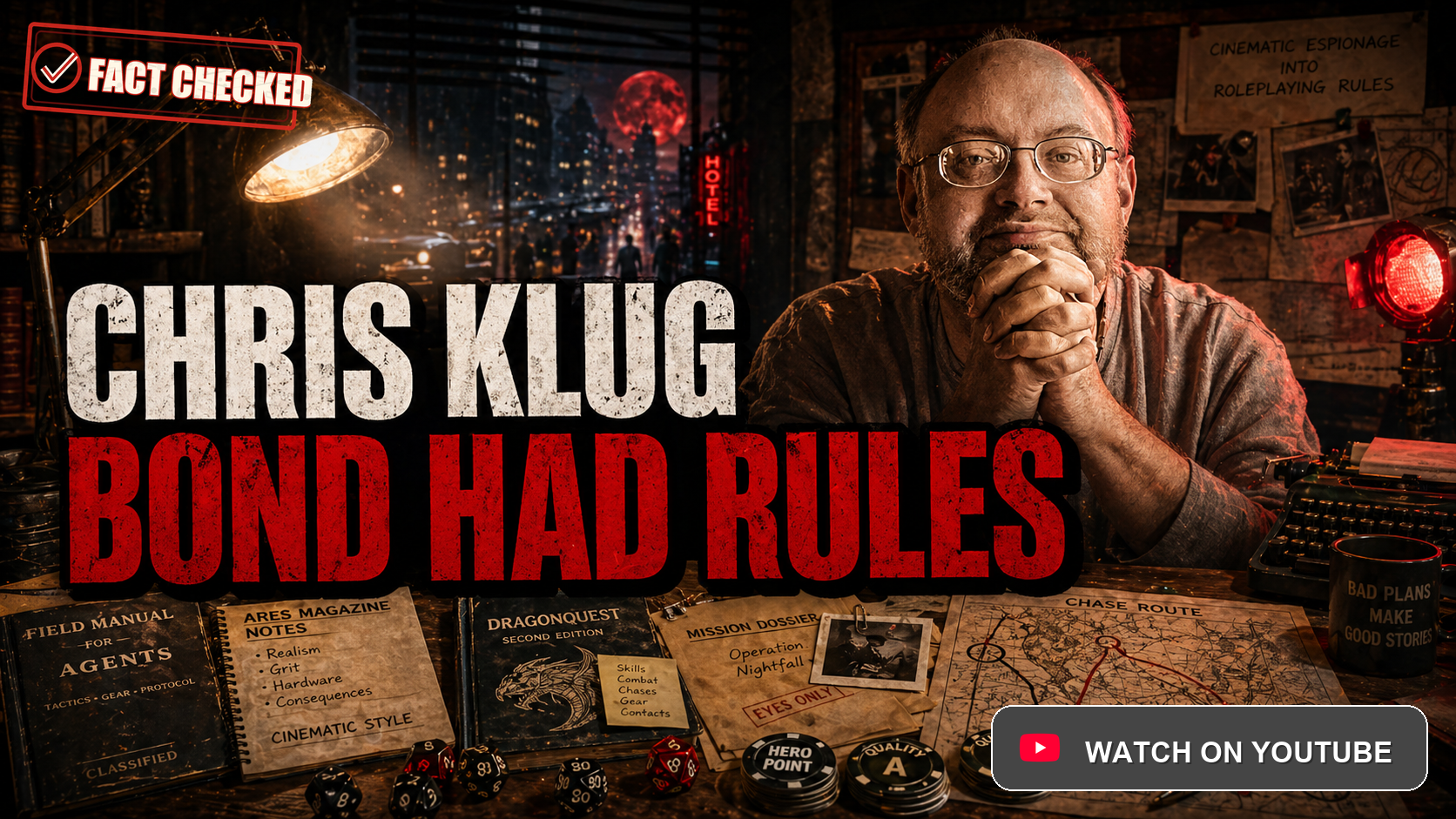
Chris Klug understood something many licensed games miss: a famous name is not enough.
You can put a logo on a box. You can quote the movies. You can name the villains, list the gadgets, draw the maps, and still miss the thing people came for.
James Bond is not only a spy with a gun.
James Bond is a performance under pressure. Timing. Style. Risk. Confidence that looks effortless even when it is not. A chase that should kill him, a bluff that should fail, a villain’s lair that should be absurd, and a hero who survives because the story itself seems to lean toward nerve.
In 1983, Victory Games published James Bond 007: Role-Playing In Her Majesty’s Secret Service, designed by Gerard Christopher Klug, a name that also appears in tabletop credits as Gerry Klug. In his current professional life and Carnegie Mellon listings, he is Chris Klug.
The game did not simply let players pretend to be spies. It taught them how to behave like cinematic agents.
That is why Klug matters.
The Lighting Designer At The Table
Klug did not come to games from the usual early hobby path.
He trained as a theatrical lighting designer. Carnegie Mellon’s public Entertainment Technology Center biography places him in Broadway work, regional theater, and the world of 1970s rock bands before games became the main stage. That background is not trivia. It explains something about the work.
Lighting design is not decoration. It tells the audience where to look. You feel the change before you can name it. One angle of light and the same room becomes safe. Or watched. Or doomed.
It controls tension without speaking. It can make a room feel safe, then dangerous, then impossible, all before an actor says a line. It is structure disguised as atmosphere.
Klug carried that instinct into games.
His best-known tabletop work is not a pile of clever subsystems looking for attention. It is design as staging. Who has the spotlight? What does the scene ask the player to do? How much risk can the rules invite before the fantasy collapses? What makes the player feel like the genre instead of merely reading about it?
That question runs through his career.
Spi And The Edge Of The Old World
Klug moved into tabletop design at Simulations Publications, Inc. in 1981.
SPI was a strange and important place. It came out of the wargame tradition, but it was also pushing into role-playing games, science fiction, fantasy, magazine experiments, and hybrid forms. The company still thought in procedures, maps, systems, and numbered rules, but the audience was changing. Players wanted worlds, not only battles.
At SPI, Klug worked on Universe, the company’s science-fiction role-playing game. He also became a major second-edition development figure on DragonQuest, SPI’s fantasy RPG alternative to Dungeons & Dragons.
DragonQuest was not his original creation. That matters.
Its first edition came from a larger design team. Klug’s role sits in the second edition and development history, where the game was refined, clarified, and carried forward.
That is still meaningful work.
DragonQuest was one of the early fantasy games trying to take another path. It was skill-based, tactical, procedural, and more interested in granular character capability than the simple class-and-level assumptions that dominated D&D. It never displaced D&D, but it earned a long afterlife among players who liked its texture.
Klug also worked on Horror Hotel, Damocles Mission, and the role-playing side of Ares magazine. Those titles show the same transitional moment. Science fiction. Horror. Fantasy. Strategy. Role-playing. Magazine culture. Designers at SPI were still close enough to wargaming to think in systems, but close enough to RPGs to see that the system now had to carry mood.
Then TSR acquired SPI, and the next stage moved fast.
Victory Games And The Bond Problem
In the early 1980s, former SPI staff moved into Avalon Hill’s Victory Games imprint. Klug brought with him an espionage RPG concept he had discussed at SPI with designer Robert Kern. Once Victory Games acquired the James Bond license, that concept found its perfect skin.
But the license created a design problem.
Most role-playing games are built for groups. James Bond is built around a spotlight.
Most RPG combat makes caution sensible. Bond stories require nerve.
Most adventure design rewards careful tactical play. Bond rewards the player who walks into danger with a plan, a smile, and just enough luck to make the scene work.
If the rules made players behave like ordinary commandos, the game would fail.
If the rules made them invincible, the game would also fail.
Klug needed a structure that could make danger real while still letting the player feel stylish.
That is the hard part.
James Bond 007
James Bond 007 solved the problem by caring about quality, not just success.
A roll did not merely answer yes or no. It produced a Quality Rating. How well did you do? Did you barely make it? Did you pull it off cleanly? Did the scene land the way a Bond scene is supposed to land?
This mattered because Bond is not a character who survives by grinding hit points. He survives by looking competent.
Klug’s rules gave that competence a mechanical shape. They rewarded the player who acted like the protagonist. They pushed the table toward the rhythm of a film: quick pivots, clean outcomes, and moments where the agent succeeds with style even when the situation is dangerous.
The system also made room for the other core truth of Bond stories. He gets lucky.
James Bond 007 used Hero Points to let a player spend narrative fuel at the moment the genre demands it. The point was not to erase danger. The point was to let the player lean into danger and still come out the other side in a way that felt earned.
If you want an example of the difference, look at how the game treated chases. Bond chases are not just movement. They are set pieces.
They are the part of the movie where a car flips, a ski breaks, a window shatters, and the hero keeps moving. The James Bond 007 chase rules turned that into a repeatable table experience, with pressure that escalated and choices that mattered.
The result is why the game still gets cited by RPG historians as one of the sharpest licensed role-playing designs of its era. It did not ask, "How do we simulate espionage?"
It asked, "How do we make the table act like a Bond film?"
That is a different question.
It is the question that made the game last.
The Adventure Line
Klug also helped shape the James Bond adventure line, including movie-based scenarios. Carnegie Mellon’s published bio credits the line with award recognition, and the adventures are still admired for how well they turn familiar material into playable pressure.
Those modules had a tricky assignment. They had to be recognizable to Bond fans, useful to gamemasters, and playable by people who already knew the plots. That meant the designer had to treat the films as raw material, not sacred scripts.
The game did not confuse adaptation with transcription. It used familiar material to create new decisions.
That is a lesson many licensed RPGs would need years to learn.
The Digital Turn
After tabletop work, Klug moved through Macintosh consulting and into video game design.
His documented digital credits include Aidyn Chronicles: The First Mage, Earth & Beyond, Star Trek: Deep Space Nine: Dominion Wars, and Stargate: Resistance. Institutional bios and secondary listings also associate him with titles such as Duke Nukem: Time to Kill, Europa Universalis, and Diamond Dreams Baseball.
The strongest throughline is not platform.
It is story structure.
On Aidyn Chronicles, credit listings describe him as a lead design and story figure. On Earth & Beyond, sources describe him as a major content and narrative leader. Later, as creative director on the unlaunched Stargate Worlds MMO, he was again working at the boundary between a known dramatic world and a playable system.
Stargate Worlds never became the shipped MMO its fans hoped for. That should be said plainly. But the ambition fits Klug’s pattern. He kept trying to make a licensed world behave like itself when players got their hands on it.
Teaching The Next Designers
Klug eventually brought that cross-medium career into education.
He is listed as a Teaching Professor at Carnegie Mellon University’s Entertainment Technology Center, where his public profile says he teaches game production, game design, and creative writing. The same profile connects him to the Role Playing Game Writing Workshop and the National High School Game Academy.
That is a fitting late-career position.
Some designers leave behind one famous mechanism. Some leave behind a company. Some leave behind a shelf of books.
Klug leaves all of that in pieces, but he also leaves a teaching line. Theater to tabletop. Tabletop to video games. Video games to MMO narrative. Professional work back into the classroom.
The thread is not genre. It is craft.
What He Actually Built
Chris Klug did not create DragonQuest from nothing.
He did not invent the spy genre. He did not invent licensed role-playing games. He did not single-handedly create narrative RPG design.
What he built was more precise.
He helped refine one of the early serious alternatives to D&D, then designed one of the cleanest examples of cinematic genre emulation in early role-playing history.
James Bond 007 remains the center of that legacy because it understood the assignment better than most licensed games of its era. It did not just ask players to enter the setting. It gave them rules that pushed them toward the behavior, rhythm, and confidence of the source material.
That is the real achievement.
Klug made style procedural.
He took the thing that usually lives in performance and built it into resolution, pacing, adventure design, and player choice. Style is a fragile illusion. At most tables it collapses the moment the dice turn against you. Klug built rules that let the illusion survive contact with play.
The lighting designer became a game designer, and the lesson held: if you want the audience to feel something, you have to know where to put the light.
Where To Find Him
Chris Klug is currently listed as a Teaching Professor at Carnegie Mellon University’s Entertainment Technology Center. His ETC profile is the best current public starting point, with links to his personal site and professional profile.
For tabletop players, the essential work is James Bond 007: Role-Playing In Her Majesty’s Secret Service. It is long out of print, but it remains widely discussed by RPG historians and fans because the design still feels sharp.
For the SPI side, look at DragonQuest second edition, Universe, Horror Hotel, Damocles Mission, and the Ares role-playing material around that period.
For the later career, follow the trail through Aidyn Chronicles, Earth & Beyond, and the work around Stargate Worlds.
Different media. Same problem. How do you turn a genre into behavior?
Chris Klug spent a career answering that question from the wings, from the table, from the screen, and finally from the classroom.
Fact Check Notes
Publication notes
This site is AI-assisted and human-reviewed. We use artificial intelligence to help gather research, organize source material, and draft profile content. Human editors then read, revise, and check each profile before it goes live. Most profiles are built through deep AI research and two separate rounds of fact-checking.
Leave a Reply
You must be logged in to post a comment.